Introduction
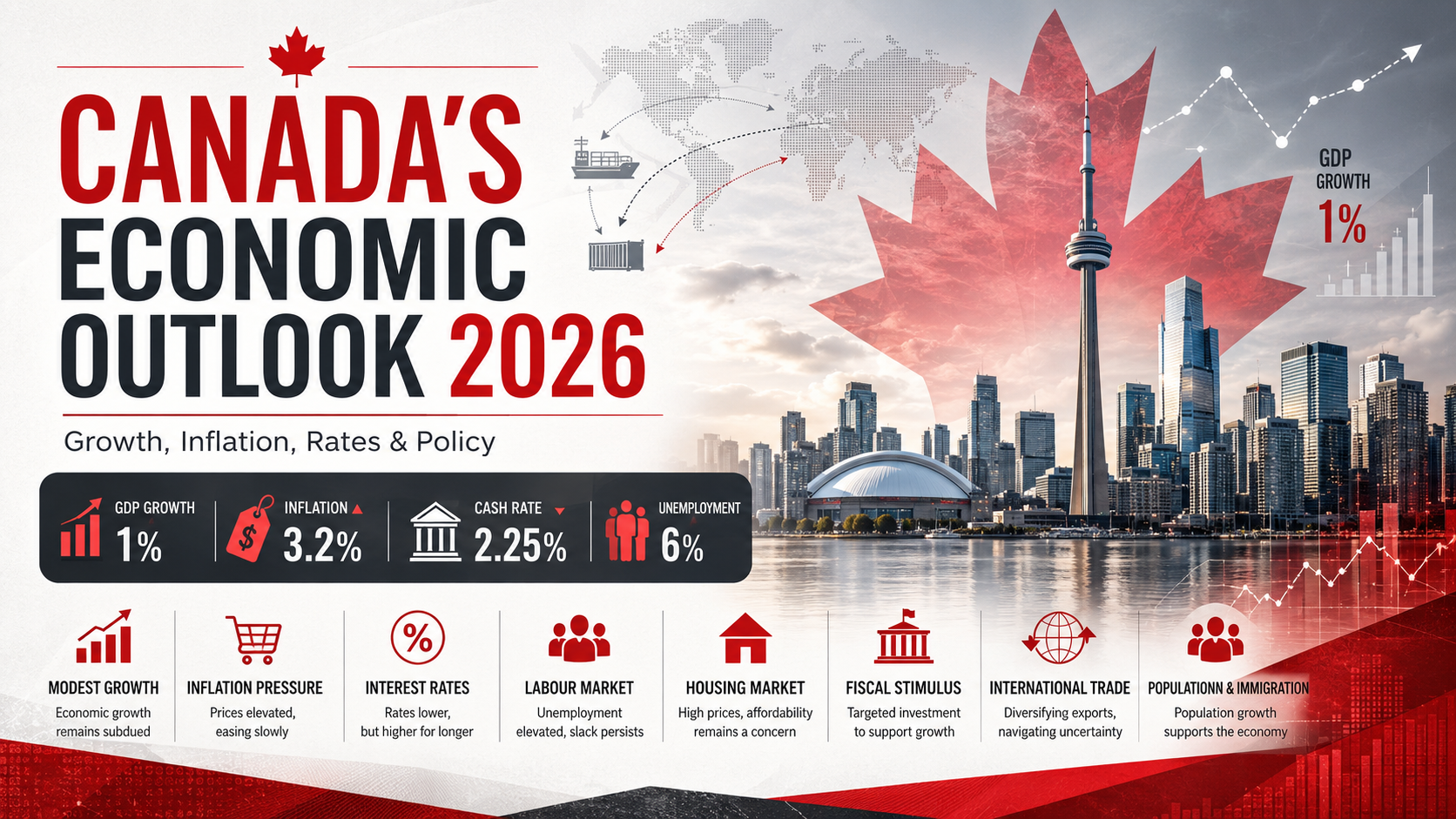
Canada’s economic outlook is expected to be moderate, with 1% growth amid macroeconomic challenges in 2026.
The recent US-led Iran-Israel war has further deteriorated Canada’s economic position in the first quarter of 2026. Canada has been faced with high fuel costs due to disruptions in fuel supply caused by the Middle East war. However, the rise in fuel costs has increased the inflation rate, a concern for the Bank of Canada.
Therefore, the Bank of Canada faces a challenging economic environment in reducing the current inflation rate of 3.2% to within its desired comfort range. If the inflation rate remains above 3%, the Bank of Canada will inevitably raise the cash rate from its current 2.25% and potentially lead the Canadian economy into a downturn or further slow the economy.
However, a seemingly economically advantageous rise in the cash rate to contain inflation will further unintentionally decimate Canadian economic growth in 2026 and could lead to a property market crash.
The trade-off in containing inflation, if it persists above 3% in the second half of 2026, is that the cash rate would be held at 2.25% rather than raised further.
While SunX economists envisage inflation dropping below 3% in the fourth quarter of 2026, the unemployment rate is projected to remain around 6% for the remainder of 2026, and the Canadian GDP is forecasted to grow at 1%; this assumes the war in Iran does not further escalate or cause significant additional disruptions to the global economy.
Canadian policymakers should instead consider introducing effective policies to stimulate the economy while cautiously navigating economic constraints. This publication will cover some important policy drivers that will form part of progressive, stimulative economic policies.
Monetary Policy 2026
Canada’s monetary policy is in a tight spot at 2.25%, with inflation above the Bank of Canada’s target range while the economy remains relatively stagnant.
The bank has limited ability to intervene and offer impactful strategic policy. For example, if the bank considers stimulating the economy by reducing the cash rate by 0.25 percentage points to 2%, it risks further elevating the inflation rate. While a 0.25% rate cut would not be sufficient to stimulate the economy, further rate cuts of 0.50% to 0.75% would be necessary to boost it.
A 0.75% rate cut over three consecutive rate cuts would certainly provide vital momentum to kick-start the economy and increase Canada’s economic activity.
Mortgage holders would find the reduced interest rate a welcome relief, as property sector transactional activities would significantly increase. Increased demand for properties will stabilize property values, with market price corrections aligning with the property supply and demand.
While the relatively increased risks of further inflation rate escalation exist, it is imperative for the Bank of Canada policymakers to acknowledge that the inflation rate rise from 2.8% to 3.2% in May 2026 has been attributed to the increase in fuel costs that filtered through increased transportation costs as a direct result of the war in the Middle East. Added to the inflationary pressure was the rising cost of fertilizers, which in turn increased the cost of fresh produce, such as vegetables and fruits.
As fuel and fertilizer costs stabilize to pre-war price levels, and the lagging prices of fresh produce vegetables and fruits will revert to pre-war levels towards the end of 2026, the inflation rate will then gradually reduce to pre-war levels.
Therefore, using the Bank of Canada’s monetary policy cash rate adjustment tool would be the best course of action to stimulate the Canadian economy and achieve higher economic growth in 2026, rather than holding the cash rate hostage to pre-emptive, unfounded inflationary fears.
To the contrary, if inflation exceeds the May 2026 rate of 3.2% in the latter part of 2026, it would increasingly become imperative for the Bank of Canada to raise the cash rate, with a clearly defined strategic position of containing the rising rate of inflation.
However, at this time in July 2026 and going forward this year, reducing the cash rate is a prescriptive course of action for the good of the wider Canadian economy.
Fiscal Stimulus 2026
Canadian governments’ fiscal spending must be carefully directed to support economic growth.
The fiscal stimulus, for instance, should pave the way for attracting labor-intensive multinational corporations from around the world to choose Canada as one of their locations for opening production and manufacturing facilities, including shifting their major operations and corporate administration workforce to Canada.
The fiscal stimulus package should include infrastructure development, targeted offshore businesses and industries, and an effective marketing plan to achieve the desired outcome of foreign businesses shifting their facilities and offices to the planned sites in Canada.
The comprehensive plan should target automobile manufacturers, technology and AI businesses, pharmaceutical manufacturers, and labor-intensive businesses that create new employment for the vast local Canadian workforce.
For Canada to achieve a promising economic growth rate of 2% or more, it needs to address its rate of unemployment with an emphasis on elevating the productivity level.
Additionally, the fiscal stimulus should include appropriate tax incentives and easy access to business registration and local regulatory approvals for large multinational businesses with global operations, strong reputations, and an exceptional track record of business performance, to consider Canada as one of their business locations.
Fiscal stimulus must also factor in incentives to boost domestic investor confidence and increase business investment. Small businesses in Canada contribute significantly to economic growth; therefore, appropriate tax measures and business grants should be offered to stimulate domestic investor confidence.
Taxes and grants should promote the adoption of modern technologies, such as AI, Machine Learning, and Robotics, so that Canada can keep pace with the rapidly advancing world and have a demand-driven, technology-savvy workforce.
Fiscal stimulus must include, prioritarily, fee subsidies for staff skills-upgrading programs and for demand-driven, advanced-technological courses to support the evolving employment criteria for job placements.
Research grants in AI, Machine Learning, and Robotics should be included in the package to support local Canadian researchers and innovative thinkers. Financial support for concepts and ideas that demonstrate the potential to generate high financial returns should be provided through grants, interest-free loans, and tax incentives, enabling local talent to reach international standards in global technological business.
Canada should avoid economic policies that drive the country into regression and instead focus on key areas that would entice foreign enterprises to consider Canada as their next location for relocating their business operations.
Population Dynamics
Canada is facing a downward population shift trend due to its immigration policies. New migration intakes are crucial to Canada’s economy.
New migrants help fill job vacancies, which is important for supporting the economy. New migrants further increase the number of consumers, and increasing aggregate consumer spending supports businesses in maintaining and growing their operations. More consumers mean more business for local Canadian business operators.
As the Canadian aging population continues to grow, new migrant intake is the immediate solution for maintaining a certain level of economic activity and stability across the country.
The aging population places significant strain on the healthcare system and aged-care services.
In turn, this imposes a significant fiscal burden on the government as the funding requirements for social welfare programs increase. To support the increased demand on the healthcare system, aged security payments, and aged-care services, the government will require higher tax revenue.
A balanced, more equitable immigration policy framework should focus on predominantly tiered visa categories. The tier-based visa system must meet the Canadian government’s short-term requirements and its long-term economic sustainability.
Short-term requirements would include filling the rising number of job vacancies and increasing tax revenue in the near term. Long-term economic sustainability includes an educated workforce, high-income earners, and high-tax-paying professionals who will support the Canadian economy over the next several years.
The Tier 1 visa category could include professionals with education and 1 to 3 years of experience in emerging fields such as Data Science, Artificial Intelligence, Machine Learning, and Robotics, to enter Canada on conditional approval to secure a job in their field of qualification.
The conditional letter would allow those candidates to apply for jobs relevant to their qualification and education in these selective fields from offshore. The Tier 1 visa category enables Canada to approve visas for applicants who work in emerging fields, and those roles are expected to remain high-demand professions in the future and to continue to command high salaries.
An analysis of the model shows that the Tier 1 visa category supports both short-term requirements and long-term economic sustainability criteria. Evidently, this visa category will generate expected economic and social returns for the Canadian economy.
The purpose of the emerging-fields-professional visa is to help new migrants secure jobs in their fields in a relatively short time, so they can start contributing to the economy rather than being unemployed for prolonged periods and becoming a burden on society.
At the same time, Canada should position its industries and business sectors in emerging areas that will continue to demand highly skilled workers and high pay, thereby enabling higher tax revenue to meet the growing healthcare and assisted living needs for the aging population.
Similarly, the design of visa programs should be aligned with short-term requirements and long-term economic sustainability, and address labor and entrepreneurial shortages. Small- and medium-sized businesses are crucial to economic growth.
Therefore, Canada should design entrepreneurial visas based on a few sub-criteria, such as capital investment in a new business or the number of employee positions created. For online businesses, visa qualification should be based on annual turnover, with a threshold of CAD 1,000,000 for startups that have proven net operating profit after tax of over CAD 300,000.
This will allow many successful and established small- to medium-sized online business entrepreneurs to migrate to Canada. Online businesses operate without geographic boundaries and can generate revenue worldwide, with less impact from local economic challenges.
Therefore, online businesses that operate across multiple geographic locations are less susceptible to local economic challenges that hinder their operations and revenue. This should be a criterion for understanding the online business market, risk, and return to assess and project the applicants’ financial background in the future.
By designing policies that incorporate similar variables, Canada could increase its population, raise tax revenue, and meet the growing labor demand.
International Trade
Canada has been caught up in global trade disruptions, with US trade measures such as tariff increases that have negatively impacted the Canadian economy. Tariff increases impose a heavy cost burden on Canadian manufacturers, which in turn forces them to reduce production, as higher product prices reduce demand in the US market.
Reducing production leads to staff layoffs, thereby increasing unemployment and reducing productivity.
The affected Canadian products become more expensive in the US market, decimating their competitiveness due to high tariffs.
Canada should vigorously pursue new markets for the impacted products through diplomatic efforts to reduce disruptions to its domestic economy. The Canadian government should work with the affected industry and business groups to open new offshore markets and reduce its reliance on the US market. By opening new offshore markets, Canada will diversify markets for its locally manufactured products and sell them to new countries and regions worldwide.
However, the government should continue negotiations with US officials to reduce tariffs, with a balanced outcome for both countries.
Likewise, the United States-Mexico-Canada Agreement is further straining Canadian businesses and the economy. Negotiations on the agreement have been derailed by US officials who have opted for annual rolling reviews. Canada should now focus on forming new trade agreements with new countries.
A highly skilled and experienced team of government-appointed diplomats should take charge of working with business groups and offshore governments to create new markets for its domestically manufactured goods.
International trade is vital to economic growth, job creation, and overall economic prosperity; therefore, the Canadian government should consider initiatives to open new international markets founded on comparative advantage.
Conclusion
While there are significant macroeconomic challenges impeding Canada’s growth, with a sluggish economy and ineffective policies, SunX economists forecast Canada’s unemployment rate will remain around 6%. The economy will grow moderately by 1%, with weak business confidence, changing population dynamics, and a weaker property sector further exacerbating the economic slowdown.
On the contrary, the Canadian economy could rebound with a strong level of growth momentum if policymakers design and refine policies tailored to the specific challenges impeding Canada’s economic growth.