
Introduction
Canada’s unemployment rate has been relatively high. The unemployment rate has been hovering around 6%. While the unemployment rate has declined significantly from its abrupt pandemic peak of 13% in 2020, it stubbornly remains undesirably high in 2026, despite the world returning to normality.
Data from Labour Force Survey, May 2026, Statistique Canada shows that unemployment has improved by 0.3 percentage points, and the rate sits at 6.6% as of May 2026.
However, the rate movement reflects the summer season’s increased economic activity, a consistent year-on-year phenomenon. Canadian policymakers’ efforts to reduce and maintain the unemployment rate at 5 to 5.5 percent have somewhat derailed, given the economic impediments Canada is facing.
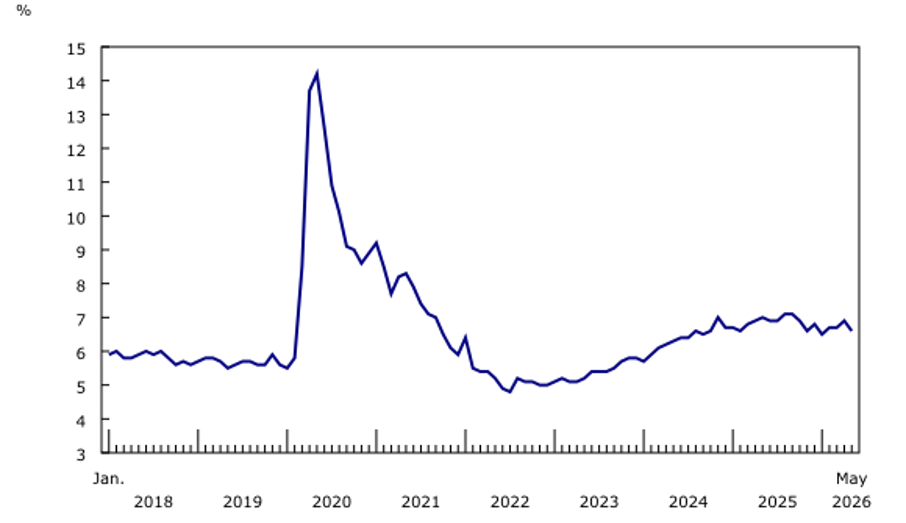
(Source: Statistique Canada, Labour Force Survey (3701), table 14-10-0287-01, Canada – SunX Statistique Canada website access 28 June 2026)
| Unemployment rate falls to 6.6% in May 2026, below the recent high of 7.1% in August and September 2025, % | |
|---|---|
| Jan-18 | 5.9 |
| Feb-18 | 6 |
| Mar-18 | 5.8 |
| Apr-18 | 5.8 |
| May-18 | 5.9 |
| Jun-18 | 6 |
| Jul-18 | 5.9 |
| Aug-18 | 6 |
| Sep-18 | 5.8 |
| Oct-18 | 5.6 |
| Nov-18 | 5.7 |
| Dec-18 | 5.6 |
| Jan-19 | 5.7 |
| Feb-19 | 5.8 |
| Mar-19 | 5.8 |
| Apr-19 | 5.7 |
| May-19 | 5.5 |
| Jun-19 | 5.6 |
| Jul-19 | 5.7 |
| Aug-19 | 5.7 |
| Sep-19 | 5.6 |
| Oct-19 | 5.6 |
| Nov-19 | 5.9 |
| Dec-19 | 5.6 |
| Jan-20 | 5.5 |
| Feb-20 | 5.8 |
| Mar-20 | 8.5 |
| Apr-20 | 13.7 |
| May-20 | 14.2 |
| Jun-20 | 12.6 |
| Jul-20 | 10.9 |
| Aug-20 | 10.1 |
| Sep-20 | 9.1 |
| Oct-20 | 9 |
| Nov-20 | 8.6 |
| Dec-20 | 8.9 |
| Jan-21 | 9.2 |
| Feb-21 | 8.5 |
| Mar-21 | 7.7 |
| Apr-21 | 8.2 |
| May-21 | 8.3 |
| Jun-21 | 7.9 |
| Jul-21 | 7.4 |
| Aug-21 | 7.1 |
| Sep-21 | 7 |
| Oct-21 | 6.5 |
| Nov-21 | 6.1 |
| Dec-21 | 5.9 |
| Jan-22 | 6.4 |
| Feb-22 | 5.5 |
| Mar-22 | 5.4 |
| Apr-22 | 5.4 |
| May-22 | 5.2 |
| Jun-22 | 4.9 |
| Jul-22 | 4.8 |
| Aug-22 | 5.2 |
| Sep-22 | 5.1 |
| Oct-22 | 5.1 |
| Nov-22 | 5 |
| Dec-22 | 5 |
| Jan-23 | 5.1 |
| Feb-23 | 5.2 |
| Mar-23 | 5.1 |
| Apr-23 | 5.1 |
| May-23 | 5.2 |
| Jun-23 | 5.4 |
| Jul-23 | 5.4 |
| Aug-23 | 5.4 |
| Sep-23 | 5.5 |
| Oct-23 | 5.7 |
| Nov-23 | 5.8 |
| Dec-23 | 5.8 |
| Jan-24 | 5.7 |
| Feb-24 | 5.9 |
| Mar-24 | 6.1 |
| Apr-24 | 6.2 |
| May-24 | 6.3 |
| Jun-24 | 6.4 |
| Jul-24 | 6.4 |
| Aug-24 | 6.6 |
| Sep-24 | 6.5 |
| Oct-24 | 6.6 |
| Nov-24 | 7 |
| Dec-24 | 6.7 |
| Jan-25 | 6.7 |
| Feb-25 | 6.6 |
| Mar-25 | 6.8 |
| Apr-25 | 6.9 |
| May-25 | 7 |
| Jun-25 | 6.9 |
| Jul-25 | 6.9 |
| Aug-25 | 7.1 |
| Sep-25 | 7.1 |
| Oct-25 | 6.9 |
| Nov-25 | 6.6 |
| Dec-25 | 6.8 |
| Jan-26 | 6.5 |
| Feb-26 | 6.7 |
| Mar-26 | 6.7 |
| Apr-26 | 6.9 |
| May-26 | 6.6 |
| Source(s): Labour Force Survey (3701), table 14-10-0287-01. | |
(Source: Statistique Canada, Labour Force Survey (3701), table 14-10-0287-01, Canada – SunX Statistique Canada website access 28 June 2026)
In May 2026, the employment rate rose by 88,000, or 0.2 percentage points. According to Labour Force Survey, May 2026, Statistique Canada, this was the first increase in employment since November 2025, a remarkable outcome.
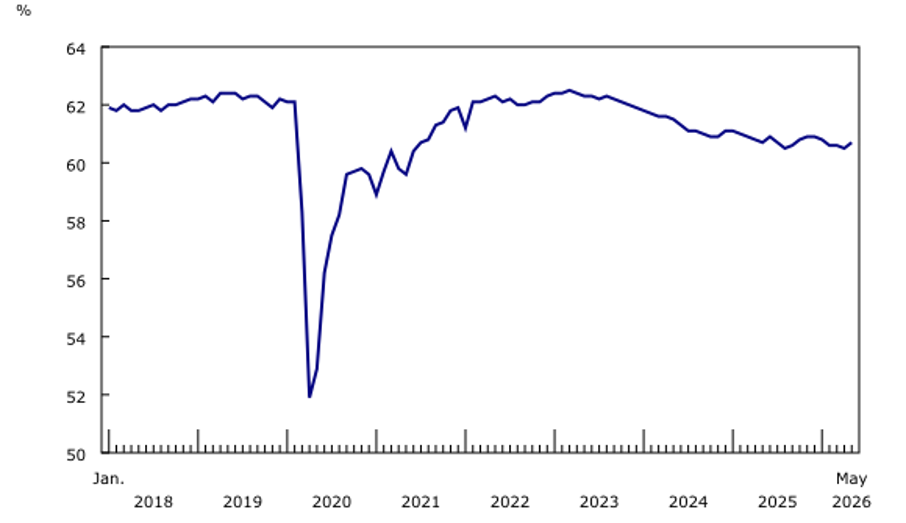
(Source: Statistique Canada, Labour Force Survey (3701), table 14-10-0287-01, Canada – SunX Statistique Canada website access 28 June 2026)
| Employment rate rises in May 2026 | |
|---|---|
| Jan-18 | 61.9 |
| Feb-18 | 61.8 |
| Mar-18 | 62 |
| Apr-18 | 61.8 |
| May-18 | 61.8 |
| Jun-18 | 61.9 |
| Jul-18 | 62 |
| Aug-18 | 61.8 |
| Sep-18 | 62 |
| Oct-18 | 62 |
| Nov-18 | 62.1 |
| Dec-18 | 62.2 |
| Jan-19 | 62.2 |
| Feb-19 | 62.3 |
| Mar-19 | 62.1 |
| Apr-19 | 62.4 |
| May-19 | 62.4 |
| Jun-19 | 62.4 |
| Jul-19 | 62.2 |
| Aug-19 | 62.3 |
| Sep-19 | 62.3 |
| Oct-19 | 62.1 |
| Nov-19 | 61.9 |
| Dec-19 | 62.2 |
| Jan-20 | 62.1 |
| Feb-20 | 62.1 |
| Mar-20 | 58.3 |
| Apr-20 | 51.9 |
| May-20 | 52.9 |
| Jun-20 | 56.2 |
| Jul-20 | 57.5 |
| Aug-20 | 58.2 |
| Sep-20 | 59.6 |
| Oct-20 | 59.7 |
| Nov-20 | 59.8 |
| Dec-20 | 59.6 |
| Jan-21 | 58.9 |
| Feb-21 | 59.7 |
| Mar-21 | 60.4 |
| Apr-21 | 59.8 |
| May-21 | 59.6 |
| Jun-21 | 60.4 |
| Jul-21 | 60.7 |
| Aug-21 | 60.8 |
| Sep-21 | 61.3 |
| Oct-21 | 61.4 |
| Nov-21 | 61.8 |
| Dec-21 | 61.9 |
| Jan-22 | 61.2 |
| Feb-22 | 62.1 |
| Mar-22 | 62.1 |
| Apr-22 | 62.2 |
| May-22 | 62.3 |
| Jun-22 | 62.1 |
| Jul-22 | 62.2 |
| Aug-22 | 62 |
| Sep-22 | 62 |
| Oct-22 | 62.1 |
| Nov-22 | 62.1 |
| Dec-22 | 62.3 |
| Jan-23 | 62.4 |
| Feb-23 | 62.4 |
| Mar-23 | 62.5 |
| Apr-23 | 62.4 |
| May-23 | 62.3 |
| Jun-23 | 62.3 |
| Jul-23 | 62.2 |
| Aug-23 | 62.3 |
| Sep-23 | 62.2 |
| Oct-23 | 62.1 |
| Nov-23 | 62 |
| Dec-23 | 61.9 |
| Jan-24 | 61.8 |
| Feb-24 | 61.7 |
| Mar-24 | 61.6 |
| Apr-24 | 61.6 |
| May-24 | 61.5 |
| Jun-24 | 61.3 |
| Jul-24 | 61.1 |
| Aug-24 | 61.1 |
| Sep-24 | 61 |
| Oct-24 | 60.9 |
| Nov-24 | 60.9 |
| Dec-24 | 61.1 |
| Jan-25 | 61.1 |
| Feb-25 | 61 |
| Mar-25 | 60.9 |
| Apr-25 | 60.8 |
| May-25 | 60.7 |
| Jun-25 | 60.9 |
| Jul-25 | 60.7 |
| Aug-25 | 60.5 |
| Sep-25 | 60.6 |
| Oct-25 | 60.8 |
| Nov-25 | 60.9 |
| Dec-25 | 60.9 |
| Jan-26 | 60.8 |
| Feb-26 | 60.6 |
| Mar-26 | 60.6 |
| Apr-26 | 60.5 |
| May-26 | 60.7 |
| Source(s): Labour Force Survey (3701), table 14-10-0287-01. | |
(Source: Statistique Canada, Labour Force Survey (3701), table 14-10-0287-01, Canada – SunX Statistique Canada website access 28 June 2026)
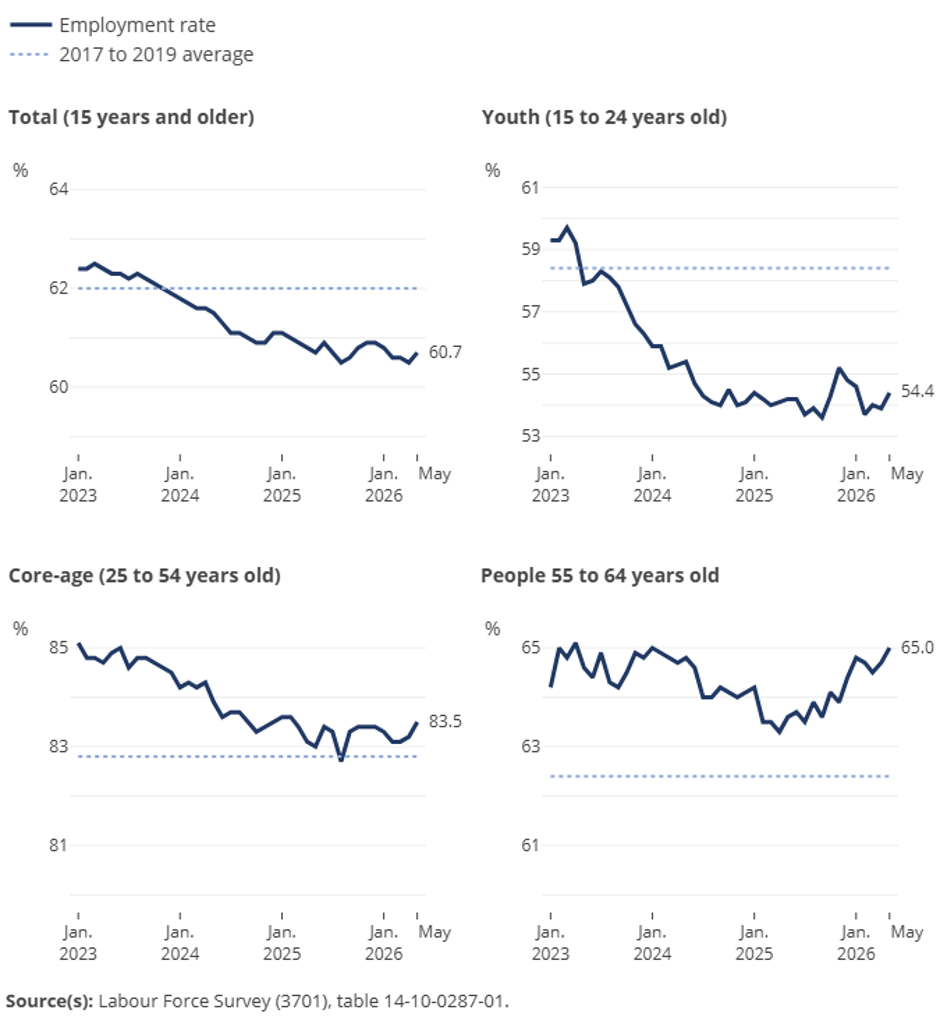
Additionally, the employment-by-age-group graph from Labour Force Survey, May 2026, Statistique Canada shows the employment data for 4 age groups. Interestingly, the graph provides the following employment data for May 2026 for each age group:
- Total (15 years and older) – 60.7%. The average employment rate from 2017 to 2019 was 62.0%.
- Youth (15 to 24 years old) – 54.4%. The average employment rate from 2017 to 2019 was 58.4%.
- Core-age (25 to 54 years old) – 83.5%. The average employment rate from 2017 to 2019 was 82.8%.
- People (55 to 64 years old) – 65%. The average employment rate from 2019 to 2019 was 64.4%.
(Source: Statistique Canada, Labour Force Survey (3701), table 14-10-0287-01, Canada – SunX Statistique Canada website access 28 June 2026)
SunX economist acknowledges the information, data, graphics, and Excel-format tabular sources from Statistique Canada, titled Labour Force Survey (3701) table 14-10-0287-01, Canada, with the reference period May 2026, accessed by SunX on 28th of June 2026.
Reducing the unemployment rate should be a high-priority economic reform on the agenda of Canadian economic managers, as it has an undue influence and flow-on effects on other major economic challenges, such as the nation’s productivity levels.
A rising unemployment rate or a stubbornly high unemployment level in an era of an aging population and AI-driven disruptions replacing monotonous labour jobs with robotic technology would inevitably create broader macroeconomic issues in the next decade.
As part of this, Canada’s unemployment data and analysis, we will briefly review the causes of unemployment hovering around 6%, its implications for the broader Canadian economy, the result-oriented effective policies to drive the rate down, and the benefits of reducing the rate at a considerably faster pace to contain the opportunity cost of a higher rate on the country’s social and economic position.
Causes of High Unemployment Rate
It is highly undesirable for any advanced nation to have an unemployment rate above 5%, as it imposes high social welfare costs on the government and the country. Therefore, it becomes increasingly important to address macroeconomic problems with effective, solutions-based policies to quickly reduce the unemployment rate and restore economic balance.
Unemployment rate rises can be triggered by external economic shocks, unfavourable domestic economic policies, or flow-on effects from regulatory changes, either directly or indirectly.
External shocks, such as US tariff rate adjustments, affect exporting countries to the US, especially when the tariff increase will negatively affect demand for imported products in the US.
For example, if Canada exports product A to the US and, due to tariff adjustments, export volumes for that product A decline substantially, the local Canada-based manufacturers will be negatively impacted, with a shrinking export market, and the flow-on effect could be mass unemployment in that industry. Further flow-on effects could spread to other businesses that provide essential inputs and resources into the production of product A. The aggregate effect of such external shocks would significantly contribute to rising levels of unemployment.
High-level government diplomatic intervention in such cases is imperative to renegotiate the terms and conditions of international trade, adopting a balanced approach to achieving a feasible outcome that supports their own economic interests. An appointed high-calibre delegation team should proactively present its counter-policies aligned with its domestic economic expectations and adopt a results-oriented approach to secure a desirable positive outcome.
Unfavourable domestic policies implemented during certain economic cycles, intended to generate strong economic returns and benefits for society, could inevitably lead to unimaginable disruption in the economy and the labour market. For example, during the US-led Iran-Israel war period, when fuel prices rose, inflation rates rose significantly in some countries. The central bank’s approach would inevitably lead to a rise in the cash rate to contain inflation. However, the rate of inflation increase was primarily driven by global increases in fuel costs. If a central bank had increased rates on a few occasions during the first half of 2026, it would have invariably caused economic downturn or slowed the economy, which could have taxed household incomes.
A counter-monetary policy to contain rising inflation could further unintentionally reduce investor confidence and discourage vital business investments, which in turn could lead to employee layoffs.
Similarly, an intentionally good economic policy to decelerate foreign capital investment by increasing taxes on foreign businesses’ local operations could trigger the closure of foreign-owned businesses, resulting in mass labor layoffs. Alternatively, the policy would encourage foreign-owned businesses to scale back operations and move some activities offshore, thereby reducing employee headcount.
Policies that directly or indirectly affect employment rates should be carefully evaluated to eliminate or reduce their impact on employment levels.
Canada is experiencing rapid growth in new entrants to the job market; however, their skills do not enable them to gain employment in a reasonable timeframe. The current economic environment does not offer businesses incentives to increase hiring, which in turn creates a hurdle for the growing number of unemployed seeking jobs with lacking required skill sets.
The problem intensifies as these collective factors that prevent an unemployed person from securing a job further deteriorate labour hiring.
Effects of High Unemployment Rate on the Canadian Economy
The undesirable effects of the high unemployment rate give rise to other unforeseen economic problems. Unemployed people face financial hardships and are prone to domestic violence, with the situation further amplifying where children are involved.
Unemployed individuals seeking urgent funds may resort to unlawful acts, such as theft and property damage. They can also face mental health-related issues as they face heightened financial crisis.
The rising social welfare costs to the government in direct response to rising crime, domestic violence, and other abuses of law and order become a waste of public resources. Similarly, the public health system gets overloaded as people face physical and mental health issues that require medical assistance.
When businesses slow hiring or lay off staff, the unemployment rate rises or remains stubbornly high, and investor confidence declines, reducing vital business investment.
The productivity rate declines due to a lack of business investments and slowing economic activity. Businesses implement cost-cutting strategies to remain sustainable in a softer economic environment, cautiously navigating rising challenges.
Consumer sentiment also gradually declines, and consumers become more selective in their spending.
Borrowers face financial challenges; those who lose their jobs and are unable to find a comparable-paying job are more likely to default on their repayment commitments.
Collectively, the economy could shrink, enter a downturn, or experience slow growth. The government should draft urgent policy prescriptions and implement effective counter-strategic policies to reverse the deteriorating economic impact of escalating macroeconomic problems.
Result-Driven Policies to Reduce Unemployment Rate
The government initiative should primarily focus on subsidizing job-ready skills training programs to help young, willing workers gain the skills to secure work.
Registered training providers must obtain government accreditation, meet stricter compliance requirements, and work with business groups to arrange trainee work placement for their students upon completion of their prescribed coursework.
Government subsidies should prioritize skills shortages and skills with growing demand in job-ready training programs.
Further, the government should consider providing Canadian businesses with tax incentives or grants to hire inexperienced employees and provide them with on-the-job training.
Attracting foreign-owned businesses to establish physical operations in Canada will also create new employment opportunities and reduce the unemployment rate.
The macroeconomic issues counter solutions-based target policies should effectively offer tax incentives to foreign-owned businesses, especially to attract large multinational companies to shift part of their operations to Canada.
Benefits of Reducing Unemployment Rate to Canadian Economy
As the employment rate increases, productivity levels rise, and the pace of economic activity picks up. Businesses hire new staff as demand for goods and services increases.
Rising demand for employees drives their wages higher. Consumer spending behaviour changes as they gain access to funds, either to increase consumption or save money for future investments.
Purchases of properties, cars, and white goods, as well as services such as hospitality, further increase the demand for workers thereby creating new job opportunities.
With effective policies, the benefit to the Canadian economy will undoubtedly grow as economic activity increases, leading to improvements in the quality of life and standard of living for local Canadians.