Introduction
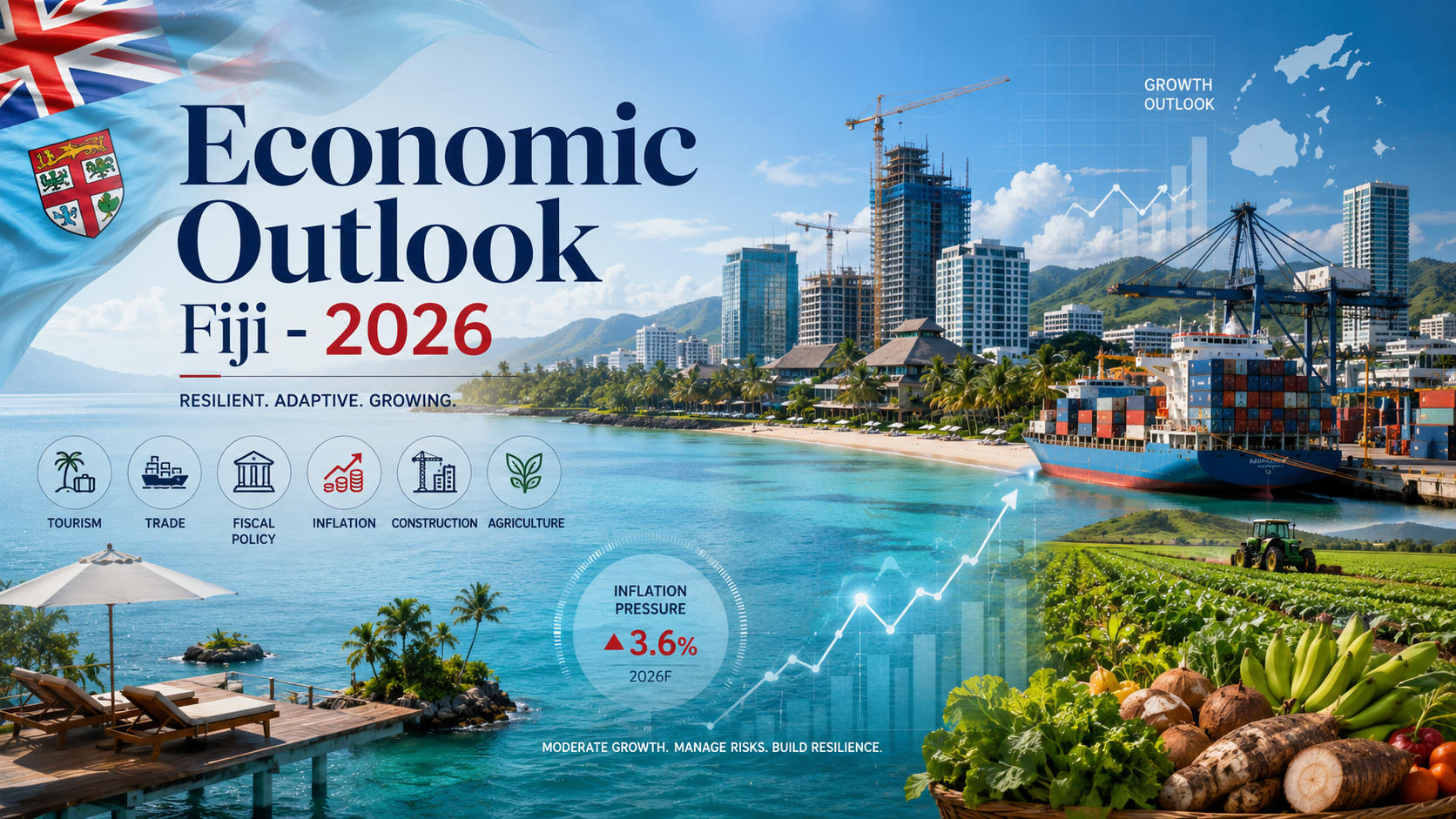
Fiji’s economic growth in 2026 is projected by SunX economists to be in the range of 1.8% to 2.4%, with a more precise forecast of 2.1%.
Fiji’s economy is robust and well-positioned for new stimulus and expansionary policies in 2026, supported by cautious fiscal spending directed toward growth-driven public-sector investment, which is expected to deliver additional resources and capabilities for businesses, enhanced productivity, and improved financial returns.
Fiscal spending, therefore, must focus primarily on creating reasonable employment opportunities and strengthening the economy for sustainable future growth.
Fiji’s growth momentum is largely supported by the historically steady growth of the tourism sector.
Offshore remittances have further supplemented local income and support consumption spending, but reliance on them does not reflect good economic management for the nation in the long term.
Policies should drive new sources of income and strengthen existing businesses and industries in Fiji. A primary driver of economic expansion would require a growing number of new business establishments that will collectively generate high aggregate economic returns and contribute to building a better nation.
Result-oriented policies should encourage and attract foreign multinational businesses capable of scaling up production of highly in-demand products overseas, where Fiji has a comparative advantage in production and export.
Policies should focus on Fiji’s economic advantages and address growing macroeconomic concerns and escalating problems, using advanced data analytical tools to uncover hidden trends and patterns and gain better performance insights.
To optimize policy initiatives, macroeconomic solution modeling should emphasize the best possible outcome without an inbuilt cost-cutting strategy. Public funding is for the public’s benefit and in the public’s best interest.
Fiscal Policy
Fiji’s fiscal policy is crucial to its economic growth, given that the current monetary policy stance provides little to no stimulus. Fiscal policy should prioritize strengthening the environment for the development of new commercial precincts and new business set-ups.
The key focus of fiscal spending must include measurable new job opportunities created near the development works undertaken as part of stimulus spending. For example, if a new commercial subdivision includes 20 warehouses and manufacturing sites, and the total new labor created is 1,536, those businesses will generate new job opportunities and income for local residents, thereby increasing productivity and export revenue.
Those new employees will generate increased tax revenue for the government. Additionally, their earnings will increase the aggregate consumer income and spending, further boosting domestic economic activity. Those individuals who had been unemployed and caused social disturbances will now contribute to household earnings.
Part of fiscal spending should support upskilling the local workforce through an accredited training provider scheme that ensures participants are job-ready and includes a worker placement program for a seamless transition to work.
The government should focus on merchandise exports, international trade in services, and the domestic operating and trading environment. With a more simplified, streamlined business environment, adequate technological and physical infrastructure, and a strong legal system for complex global transactions, Fiji could become a favored destination for offshore companies relocating parts of their operations.
If Fiji were to experience a surge in new business start-ups, it should offer zero business and personal taxes to overseas residents who are non-residents of Fiji contemplating registering and operating a business in Fiji.
There are hundreds of thousands of highly successful, top-end online revenue-generating service providers and entrepreneurs across many fields. Fiji could become an international business hub for ultra-net-worth, high-achieving entrepreneurs to choose as their residence.
Foreign investors require a friendly business operating environment, low or zero tax rates, and less stringent requirements for shifting their business registration to a country where they do not live.
If the criteria for business registration require the owner to relocate, the policy would become a famously disastrous failure.
However, if the offshore business owner could register the business in Fiji and operate it from anywhere in the world, he could make further investments in Fiji. This is especially true for an online business or an e-commerce operator, who does not require a physical location to conduct business.
Policy formulation should focus on offering tax relief on both business and personal income for funds derived solely from physical operations in Fiji, or, for remote online operations, the businesses must be mandatorily registered in Fiji.
Such policy drives generate year-on-year economic returns and add recurring benefits to the country’s growth.
While the monetary policy stance is virtually ineffective, policy managers should ensure that once growth momentum begins and reaches a certain level, the Overnight Policy Rate is raised cautiously to strengthen the monetary policy position. At the same time, it is imperative to acknowledge that fiscal policy cannot be relied upon indefinitely, and is not a remedy for all macroeconomic issues.
Inflation
Fiji’s headline inflation is tracking above tolerance levels at just below 4.0%. The ongoing US-led-Iran-Israel war in the second half of 2026 signals further escalation of tensions that will impede the free flow of international trade.
Elevated military strikes in the war regions of Iran, reported in July 2026, further undermine the envisaged peaceful resolution of the conflict and the restoration of global economic stability and the free flow of trade in the region, more precisely, the opening of the Strait of Hormuz anytime soon.
Fuel and fertilizer supply disruptions, along with their compounding effects on global trade since the war began, will continue to take a heavy toll on supply chains worldwide, raising the prices of goods and services.
Inflationary pressure will rise in proportion to disruptions at that particular production origin. For example, if the cost of transporting meat increased in New Zealand due to rising fuel prices, importing countries would have to pay the higher price.
In the example of meat being exported from New Zealand to Fiji, a surge in fuel prices caused by a fuel shortage in New Zealand would have inevitably contributed to higher retail meat prices in Fiji, which is outside of Fiji’s control.
Assume a country had a formal agreement in place to secure fuel at a set price until a specified date. The war’s continuation beyond a reasonable projected timeframe could put upward pressure on fuel prices. In turn, this would lead to higher fuel acquisition costs.
The transport operator would pass the increased fuel costs to its client, with the resulting increase reflected in the final retail price paid by the consumer.
In an era when the war seems to be an ongoing global event for 2026, it is prudent to prepare mitigating measures against likely further inflation rises to 5.5%-6%.
Fiji relies on imports, which are highly susceptible to foreign cost rises. As import costs rise, the inflation rate rises, and consumers’ real purchasing power falls. A high inflation rate then taxes a larger percentage of consumers’ available net income for consumption.
When prices are rising, the consumer must either increase income to offset inflation and maintain consumption or forgo some consumption as purchasing power declines.
Elevated inflation can push reasonably financially stable families into poor, unhygienic living conditions and degrade the quality of their meals. Subsequently, the collective societal damage will add to rising social costs and increase the burden on public resources.
The government, in the interim, should implement strong short-term remedial measures to directly address the urgent inflationary pressure on Fiji’s economy. The rise in the inflation rate stems primarily from the ongoing conflict in the Middle East.
Simultaneously, policymakers should aggressively design and implement policies to drive economic growth. Despite the challenges that threaten Fiji’s economic stability, as evidenced by the downgraded Fiji’s economic growth forecast for 2026, the nation remains relatively alert and responsive to external shocks and demonstrates balanced strategic planning, with more practical solutions that could further strengthen Fiji’s economic standing.
Tourism
Tourism is a major industry that has consistently outperformed others in generating economic returns. Cities and remote island resorts that cater to the growing tourism sector experience above-average earning potential.
The central government, in close consultation with city councils, should consider expanding tourism-related ventures in other parts of Fiji that could become major tourist destinations with attractive modern recreational activities.
Modern mountain-range developments with outdoor activities, pubs, restaurants, children’s play centers, men’s and women’s activities, and a zoo should be a high-priority development agenda to expand tourism-related economic activities. The industry could further benefit from gambling machines in some high-end tourist venues, with close monitoring of their effect on domestic gambling abuses.
Areas with fewer economic activities will experience undue economic growth due to increased tourism-related commercial activity. Local businesses focused on serving tourists will see growth, while new businesses will enter the market, creating new job opportunities.
The economic benefit of tourism expanding across Fiji will increase business transactions and development, raising property values due to increased demand for prime property locations and greater workforce participation in paid employment.
A rising percentage of new job openings and rising consumer income and spending will contribute to ongoing growth momentum across the country. Nationwide tourism expansion will help boost Fiji’s economic performance and growth across more towns, cities and the islands.
Conclusion
While Fiji’s economic forecast for the second half of 2026 remains quite subdued, external shocks, in particular the ongoing global disruptions to fuel and fertilizer supply amid rising uncertainty on the war in the Middle East, Fiji is well-placed to weather global economic turbulence.
Focus should be diverted from the rising economic challenges to improving the economic performance. Resources should be aligned to generate economic returns progressively year on year, expanding opportunities across the country.
Fiji must inherently explore untapped industries with unparalleled comparative advantage to generate strong export earnings. The extended consideration of economic growth policies should include both the agricultural and manufacturing industries, with a special focus on services in emerging, technology-driven sectors such as data science, AI, and machine learning.
Manufacturing, powered by advances in technology, for example, robotics, will enable Fiji to develop a reasonable number of skilled workers in emerging fields.
Certain struggling industries that require financial assistance, such as the construction industry, should be offered interim relief packages to help small businesses continue operating and contribute to Fiji’s economic stability. The benefits of the packages should be adjusted to provide a period of consistent relief for business operators.
The construction industry is pivotal to Fiji’s economy and sensitive to inflationary pressure. A rise in construction material prices negatively impacts the construction industry. As inflation is adding mounting costs to construction materials and exerting financial challenges, the government’s assistance to the industry will undoubtedly be a welcome relief.
The benefits should extend to other trade-services operators, especially where rising inflation has significantly reduced their business turnover.
The agricultural industry remains important to the economy and requires undue assistance, especially because crop yields are realized after harvest. Therefore, a financial relief package for the agricultural segment must be designed to meet the specific needs of its recipients.
Low-income earners should be offered cash assistance to ensure that families on the edge of financial crisis do not face a degrading meal. The government should work with different groups of individuals across categories of assistance to formulate and prepare interim welfare support payment packages.
Reliance solely on the tourism sector may not deliver the desired economic assurance given the risks in the tourism industry; the government should consider diversifying risk by prioritizing the development of other industries that generate millions of dollars in annual revenue.
While tourism poses risks to income due to a vast array of internal and external economic shocks, another industry with comparatively less vulnerability and a guaranteed path to high-end, ultra-sustainable, income-generating opportunities is one the government should focus on and work with the private sector to establish businesses in the identified and emerging industrial opportunities.
The government should facilitate high-end, income-generating ventures for local aspiring would-be-entrepreneurs by offering training and financial support to increase market competition and boost job creation. An employee package should cater for employee training, a job-ready program, and worker placement. These governmental initiatives will reduce reliance on offshore remittances as a vital source of regular income, and domestically, residents will become more productive by taking paid work, either full- or part-time.
Offshore remittances are a valuable backup financial source for sudden, incidental, or unforeseen events in personal life; the funds from that source cannot be treated as regular wages, except when the sole household income earner moves overseas to work.
The risks of relying on offshore remittances pose a larger financial crisis for locals who rely on this source for daily financial commitments. A change in migration policy or a policy enactment in another country from which Fiji receives much of its remittances could jeopardize the livelihoods of Fiji’s local residents. Technological advancement in that offshore country, which replaces labor in manufacturing, could further affect remittance levels if laborers from Fiji were employed in technology-driven, rapidly advancing industries.
Therefore, the leadership team of the government of Fiji, working alongside the economic managers and policymakers of the Reserve Bank of Fiji, should introduce policies that promote economic stability and deliver sustainable growth while navigating pressing macroeconomic challenges, external shocks, and natural disasters through innovative, real-time data capture, data-intensive analysis, and modeling of desirable, outcome-based, data-driven solutions.
Fiji has readily available resources to further accelerate economic growth with planning and result-driven, effective policies.