Introduction
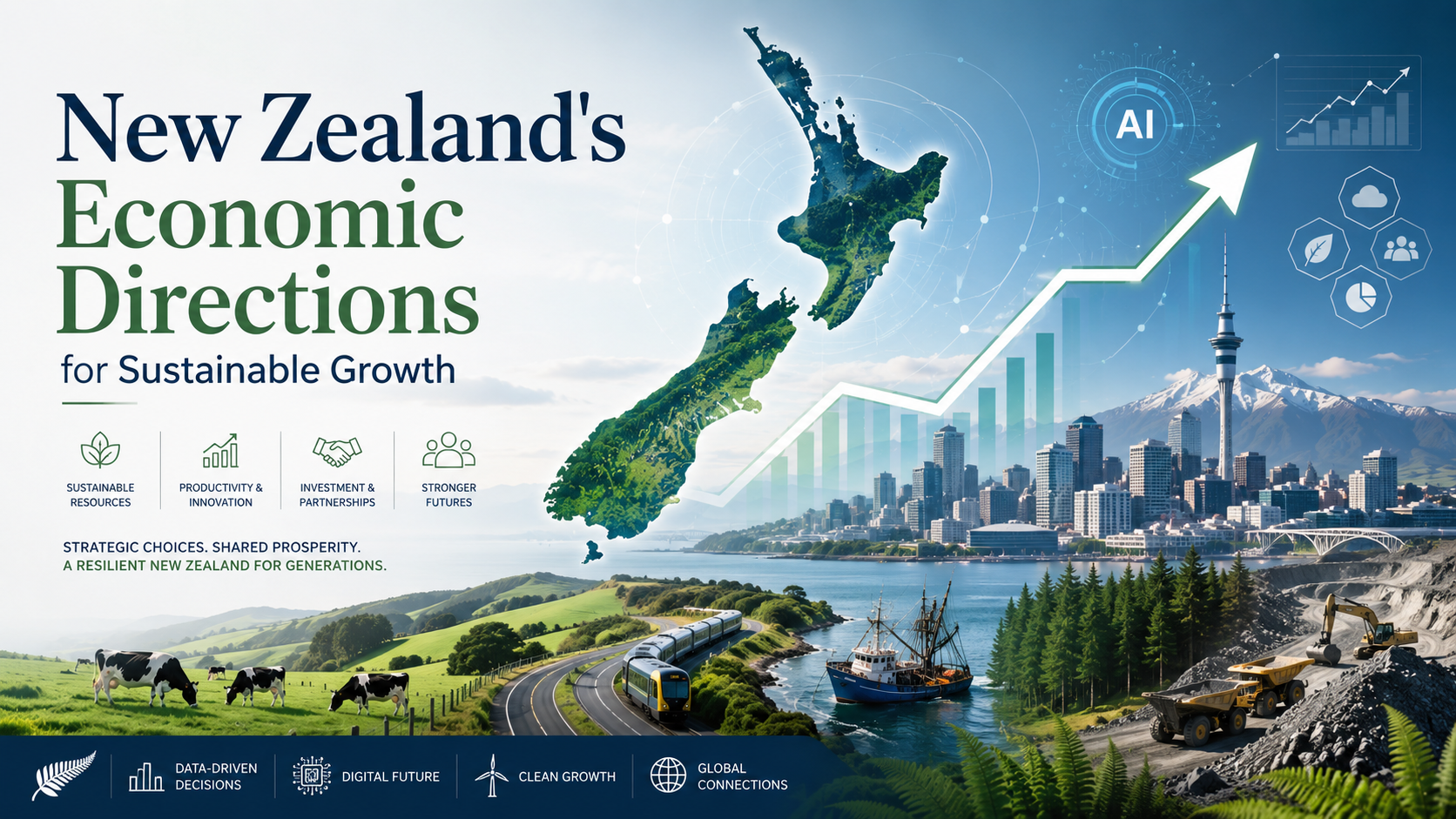
New Zealand is a resource-rich country centered on fishing, forestry, pastoral farming, and untapped mineral reserves.
The scope for accelerating economic growth based on readily available rich resources has been largely impeded by the visible core challenges undermining New Zealand’s growth prospects.
Counter-strategic, objective-driven, practically effective policy design and outcome-oriented fiscal spending aimed at addressing the identified challenges and navigating constraints will yield high long-term sustainable economic growth.
Rational, high-impact decisions stem from ambitious policy outcomes that focus on the core constraints. Remedial policy initiatives with prioritized, proactive actions on impediments would generate a sustainably high economic return in the long run.
However, if the constraints are left to run their course for a prolonged period, they will further compound flow-on hindrance across other NZ, generating undesirably high economic and societal costs.
To achieve practically optimal economic outcomes rather than focusing on theoretical aspects, the SunX economist analysed economic constraints and challenges, considered high-impact counter-strategic remedial policies, and projected their economic outcomes, extending the focus to rich resources that could inevitably yield high economic returns.
Economic Challenges and Constraints
New Zealand’s economy faces a set of intense temporary challenges and several fixed constraints.
These identified core impediments to lasting economic growth demand a results-driven policy design. The policy must explicitly specify the defined economic outcomes as policy objectives.
While the distinction between challenges and constraints contributing to economic costs fades categorically into economic impediments, focusing on the root causes and practically realistic solutions is the core of this research.
A major challenge to growth is the prolonged persistence of stubbornly low productivity, which, as a root cause, filters through to other sectors. The effect of low productivity has sat at the forefront of NZ’s macroeconomic problems, which affect the rate of return for the private sector, creating a disincentivised business environment for further vital private investments, limiting business opportunities, and eroding the prospects of new labor hires.
Flowing on, the unemployment rate remains higher at firmly over 5%, and the labor participation rate is relatively high, over 70%.
While low productivity comes at a high economic cost, it is gradually leading to a dramatic increase in the number of welfare recipients seeking unemployment benefits, placing pressure on the NZ government’s fiscal position by reducing tax revenue and increasing social assistance payments.
New Zealand’s federal government faces an unequivocally intensified pressure on its fiscal spending pattern and a tightened budgetary position.
Historically and unprecedentedly, the national debt has surpassed $180 billion, equivalent to approximately over 45% of New Zealand’s GDP.
Furthermore, the structural deficit pressure from a rapidly growing aging population is compounding the already elevated fiscal spending trend.
In terms of aggregate expenditure, rising unemployment and social benefit payments, along with pension payments from the growing aging population, are largely driving a significant hike in fiscal spending, which is projected to worsen without an effective regulatory policy.
As the national debt balance rises, the cost of servicing debt increases, continually imposing further budgetary constraints and diverting fiscal spending from the major underfunded public sector, notably public health.
The flow-on effect of the tightened budgetary position results in inadequate spending on improving quality and upgrading aging infrastructure to meet the growing population’s demand, supporting long-term environmental sustainability.
Moreover, low productivity, lower private investments, rising unemployment, federal budgetary constraints, and underinvestment in infrastructure have slowed population growth. NZ citizens are increasingly leaving the country for better and brighter opportunities overseas, while the net migration continues to decline dramatically.
The population decline is dampening housing demand, which is economically detrimental and causing national economic havoc, as the real value of property gradually declines. A prolonged decline in real property values could cause financial instability and a national disaster if it is not managed and reversed relative to the country’s aggregate mortgage funding.
Consumer sentiment shifts due to declining property wealth could lead to a vicious cycle of a property market decline, affecting the broader NZ economy, accelerating a deeper economic downturn, a phenomenon that would cause serious economic damage to the country on an unimaginable scale.
High Impact Counter Strategies to NZ’s Pressing Economic Challenges
Effective policy design, grounded in a solution-centered approach, requires undertaking empirical-based studies and econometric modelling to identify causal effects and patterns, and to remove competing variables from data-driven models for informed policy design.
For accurate predictions, tangible outcomes must be measurable to ensure policy outcomes fall within the scope intended to address the core challenges or constraints in a specified time period.
Low productivity is a pressing concern that requires strategic and policy assessments and analyses of key drivers of productivity growth. Previous policy initiatives that may have failed to address the issue require evaluation to identify the drivers that undermined intended outcomes.
Policy design to break from the low-productivity stagnation would include a broader array of government actions, such as tax reforms to encourage investment, policy redesign to support competition, and regulatory change implementation to facilitate faster business establishment and operations.
Grants and special tax concessions should be offered to businesses that invest in technology, Artificial Intelligence, and Machine Learning capabilities. Businesses that leverage data at scale and implement advanced technologies improve productivity by achieving high efficiency.
To fast-track employment, the government should offer free training programs to reskill the workforce in digital technologies and data analytics, equipping them with work-ready skills.
Following increased investment and technology adoption, it is imminent for businesses to hire employees for increased business operations. As employment increases, economic activity accelerates, boosting consumer confidence and changing consumer spending behaviour.
Pensioners who are healthy and willing to enter the workforce, either on a full-time or part-time basis, should be offered tax concessions on earnings, tax-free earnings, or a combination of a part pension and income tax concessions on employee-based earnings up to a threshold, with an attractive package to incentivize them.
Increases in business activity, leading to a high rate of employment, along with reductions in unemployment assistance and pension payments, will improve the government’s net revenue position.
Fiscal spending may be redirected to the appropriate needs-based public sector to improve public service delivery. At the same time, the government could consider taking steps to address infrastructure gaps and increase funding for vital maintenance, development, and redevelopment of major infrastructure projects that support the economic growth momentum.
This growth cycle could increase the real value of properties, stabilizing property holders’ wealth and restoring consumer confidence.
NZ citizens contemplating leaving for better opportunities offshore would rethink their path, and with increased opportunities at home, the rate of people leaving NZ will decline drastically, while foreigners considering migrating will consider NZ as a potential destination.
While the current challenges and constraints seem heavily burdened, taxing economic growth prospects, effective and impactful policies will drive unprecedented, tangible growth for the NZ economy.
Economic Outcome from Effective Policies and Strategies
In the short to medium term, reforms and regulations to address low productivity will increase investor and business confidence, a prerequisite for boosting economic activity.
An increased participation rate reduces the unemployment rate, enabling workers to earn a regular income and for existing employees to upskill and get promotions, leading to rising income.
As consumer confidence increases, consumer spending behaviour will shift. The pace of economic transactions will increase, supporting ongoing economic growth.
A healthy, well-aging population will further stimulate economic activity by re-entering the workforce, generating regular income, and spending more than at the pension level.
Remote work opportunities will suit retirees looking to work without a regular commute.
The back-to-work program will reduce health complications for a certain percentage of aging workers, thereby reducing reliance on the public health system.
The NZ workforce, adapting to advancing digital technologies, will be competitive alongside its offshore peers. The businesses that adopt modern data tools will see a marked improvement in efficiency and increase productivity.
Fiscal spending on delayed infrastructure maintenance and upgrades to deteriorating infrastructure would further incentivize business investment and increase labor demand.
Stabilizing real property values will eliminate the risk of a property market crash; rather, this economic cycle will appreciate property values, creating real wealth for property owners.
The pace of economic recovery and the level of economic growth will contribute to uplifting the standard of living and the quality of life for the New Zealanders.
Focus on NZ Rich Resources
NZ has admirable fishing, pastoral farming, and forestry, as well as mineral reserves. The weather pattern supports the production of high-quality crops and meat products.
For local NZ producers, striking a new export market opportunity remains relatively competitive.
To support new export market opportunities, the government should consider new bilateral trade agreements based on comparative advantage to open new export markets for local suppliers and to enable competitive pricing from new import sources, thereby relieving NZ consumers from cost-of-living pressure.
Additionally, the government should approve foreign-based businesses to set up in NZ to support the production and export of domestically produced agricultural products or locally manufactured goods. Such policies will create new employment opportunities for newly established businesses and generate high levels of foreign income from increased export revenue.
A caveat to support the NZ economy will require offshore-based businesses to partner with NZ locals, with a maximum business ownership percentage in certain industries, such as agriculture, fishing, or forestry. For example, if a US-based business wants to set up a factory to process and export fish, the maximum business ownership percentage would be restricted at 49%.
For the local NZ businessman, he will retain a minimum of 51% share in the business, with the added benefit of partnering with an offshore business that may have access to a readily exportable market and a high level of competence in that particular business operation.
The NZ government will earn significant tax revenue from these increased economic activities, enabling faster repayment of the national debt and increased fiscal spending where funds are needed to support the quality of life for New Zealanders.
Conclusion
In this research, the SunX economist has not factored in the effects of recent external shocks, the US-Iran conflict, and the closure of a vital shipping route, the Strait of Hormuz, which has disrupted international trade and increased fuel costs, thereby raising the cost of living.
The impact of this conflict is temporary, with effects subsiding at a lagging pace from the end of the conflict.
New Zealand, in particular, with its readily available resources, is well positioned to advance its economic progress and mitigate against future economic disturbances.
Prescriptive economic policies targeted at specific impediments will certainly drive the economy toward a better state and a higher level of prosperity.
Despite current regressive outcomes, statistical and mathematical modelling and analysis can be used to design effective policies and high-impact strategies that generate progressive economic outcomes.