Introduction
China has historically long been a pioneer in low-cost traditional manufacturing and an exporter of a vast array of products worldwide.
The Chinese manufacturing sector has been predominantly supported by a readily available, large, low-cost labour supply, as China remained the world’s most populous country until only recently, when India overtook it.
The US has remained China’s traditionally largest export market, with trade exceeding USD 300 billion in 2025. China has continued to diversify its export markets and expand into the European Union, Asia, and emerging markets that offer lucrative, safe export opportunities, consistent inflows of funds, and low-risk market opportunities, as unprecedented trade tensions between US and Chinese officials continue to escalate.
In maintaining its status quo as a world leader in manufacturing, China imperatively maintains high-impact dominance and remains resilient in new and emerging industries, by far outperforming its developed global counterparts.
A collectively ambitious shift adapting to a new economic dimension towards newly emerging, scale-intensive, operationally-extensive, high-demand-driven, fastest-growing, and exceptionally high rate-of-return generating industries has been supported by China’s policy initiative for cost-effective, world-leading innovation amid rising global operational costs, enabling China to ingeniously retain its cost-effectiveness baseline while remaining highly competitive globally.
Sustainable long-term economic growth rests on environmental sustainability, promoting green, environmentally friendly energy. Notably, China’s expanding policy initiatives to support global efforts to meet international social responsibility are guided by the goal of explicitly demonstrating China’s ongoing commitment to top-level transparency in line with global operational professional benchmark standards.
China’s rise in new economic dimensions threatens other highly advanced and historically competitive countries with its unmatched robust capabilities to adapt to changing global consumer needs and to continually develop and market-lead emerging industries with seemingly impactful outcomes.
The old-school resources shift from land, labour, and capital to emerging and trending resources, encompassing technology and know-how that have paved the way for China’s fast-changing industrial dynamics, with a concentrated effort on impact-driven innovation to meet continually evolving, modernized societal needs.
China, unlike other developed nations, continues to navigate its domestic economic challenges and constraints while vigorously managing escalating trade tensions with its international trading partners. Therefore, faced with intensified external pressures, China cautiously navigates through a counter-strategically designed set of diversification programs that extend into new economic dimensions. However, China rigorously strives to outpace its global economic performance despite increasingly overwhelming challenges, through effective outcome-oriented, impactful policy designs.
This research focuses on a) China’s ever-growing domestic challenges and constraints, as well as external challenges driven by offshore policy limitations that disrupt free trade flows, leading to the creation of trade barriers, b) effective prescriptive policies against uprising domestic challenges and constraints and external shocks, and c) shifting China’s perspective toward new economic dimensions in emerging industries, thereby supporting its long-term sustainable economic stability.
China’s Increasingly Domestic Challenges and Constraints
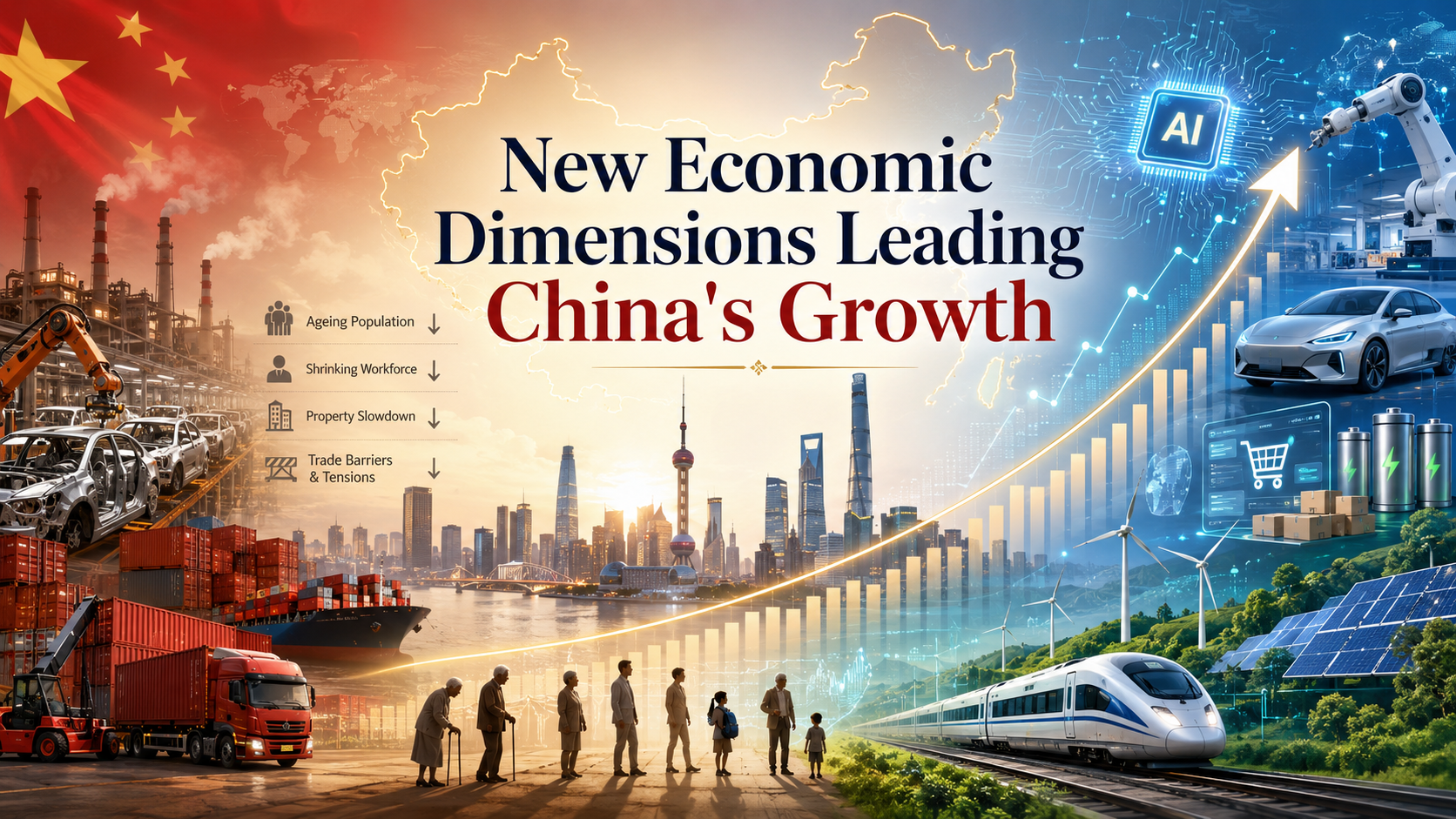
The second-most populous country in the world continues to weather vast, pressing macroeconomic domestic challenges, including a rapidly aging population leading to a shrinking workforce, which is collectively putting upward fiscal pressure, depreciation of property values eroding household wealth, and declining consumer sentiment and confidence, with aggregate consumer demand showing downward spending behaviour.
Aging Population
An aging population requires greater financial support amid rising healthcare costs. As a person moves from being employed to unemployed at retirement age, the government loses tax revenue from that person, and in turn, has to pay for their pension for the remainder of the person’s life. While there are varying payment levels in China’s tiered pension system, it still imposes a cost on the government. And with an ever-increasing aging population, China’s pension payments will continue to increase for a considerably prolonged period.
China has long been the most populous country, and its demographic trends indicate that its aging population aged 65 and older will put upward pressure on the government’s pension system as retirees continue to grow rapidly. At the same time, as more people reach retirement age, the number of workers the government must collect tax revenue from will decrease, placing even greater pressure on the government’s fiscal position.
Correlating to the aging population is a rapidly shrinking workforce. Effective policies could offer temporary relief to a shrinking workforce.
Given the likely policies aimed at temporarily addressing the shrinking workforce, the government could consider deliberately raising the retirement age. The rapid addition to the aging population brackets of the new retirees will shift by the exact number of years the retirement age is increased to, and at that point, the government will be faced with the issue again of an increasing aging population, at which point, the retirees will require both financial support and healthcare services.
To prepare for the increased welfare payments, the government should embrace innovative revenue stream sources beyond traditional tax revenue to cover a substantial welfare-related outlay for at least the next 2 decades, as the percentage of the aging population relative to the overall population increases dramatically.
Depreciating Property Value
Eroding property values further amplify macroeconomic concerns, especially when many property owners are nearing retirement and will rely on wealth derived from their property for future consumption. The aggregate diminishing value of property across China can inevitably lead to a nationwide financial crisis, especially when substantial property values are underwritten by a formal mortgage to a lender.
While China’s lending criteria are comparatively more stringent than those of Western economies such as the US, with higher deposit requirements, additionally, the state and government interventions play a major role in avoiding a hard landing property and financial crisis; however, the declining property values are heavily weighing down the country’s economic position and further slowing the economic growth momentum.
Declining property values signal to the people of China a looming crisis, further cautioning and discouraging consumer spending and deterring vital business investment in an unsettling economic environment. Consumer spending is important for supporting investor confidence, which, in turn, drives strong business investment.
Additionally, budgetary constraints at all levels of the Chinese government are a key driver of reduced fiscal stimulus in the key macroeconomic issues of deepening concern, especially as the aging population and declining manufacturing trend are substantially reducing tax revenue while increasing fiscal spending.
External Challenges
Declining Demand for Chinese Manufactured Products
Manufacturing has been a key driver of China’s economic growth. A persistent decline in demand for products manufactured in a leading, highly industrialized nation, such as China, distorts its domestic resource use of land, labour, and capital and, moreover, disrupts the historically traditional, exceptionally high performance of its manufacturing sector.
Consequently, the diminishing demand from international trade tensions creates domestic economic imbalances, with a negative flow-on effect on the wider Chinese economy.
Over time, the disequilibrium, driven by declining demand, leads to an undesirably excessive supply capacity relative to demand, thereby reducing production costs and decreasing the revenue of domestic manufacturers and suppliers of material inputs to the production.
A prolonged persistence of this trend poses major economic degradation concerns, a phenomenon that could trigger an economic downturn or at worst, a deep economic recession.
Low Productivity
Underutilized manufacturing capacity in a highly industrialized, manufacturing-led nation contributes to a decline in productivity, fuelling uncertainty and further weakening the economy, negatively affecting local businesses and consumers.
Unemployment rises as manufacturers are forced to reduce or pause production, disrupting their normal business operations.
International trade barriers continue to dampen China’s economic growth prospects as export markets face increasingly stringent economic sanctions, causing unprecedented financial devastation and a flow-on effect for the wider domestic Chinese economy.
International Trade Barriers
China’s international trading partner countries in major export countries are increasingly recognizing the economic losses of being a highly importing reliant country, and, in turn, countries such as the US are exploring opportunities to add economic value to its economy by protecting and promoting production of goods domestically that are being imported or foreign manufacturers are placed in a situation where, if they need to sell their products to the US consumers, they mandatorily need to move their production facilitates to the US.
This shift of the manufacturing plant from China to the US would inevitably affect the Chinese economy by increasing the unemployment rate and raising social welfare benefits for the unemployed, among other economic effects. Such offshore governments’ trade-disrupting policies create economic shocks for the Chinese government, threatening its economic viability.
A profoundly feasible, high-impact forward policy action for those export-partnering countries with China should be to enter into fairer bilateral trade agreements that support a fairer flow of economic value-added to all stakeholder countries to the agreement, thereby reciprocating comparative advantage with distinctively material, incremental economic and social benefits.
Nonetheless, the free flow of economic value-added is not always considered pertinent to international trade negotiations; rather, more materially influential factors, such as consumer demographics, are more prevalent in formulating trade agreements.
China, in strengthening its negotiating power, should position itself on certain high-end, enticing strategic parameters to attract lucrative trade agreements and secure an advantageous upper hand in trade negotiations for the long-term sustainability of its manufacturing sector, or risk continual disruptions to international trade from its economically powerful trading partner countries.
The strategic intent of securing new international trade agreements is not a paradigm but a clear, conscious direction for China to secure mutually equitable trade terms rather than being vulnerably positioned in international trade negotiations to the influence of its trading partners, with a balance of economic value-added favouring China’s trading partners.
Threat to China’s Past Legacies
These economic impediments threaten China’s foundational historical legacy and severely impair the momentum of future economic growth, requiring urgent, economically rational planning, effective policies, and immediate, outcome-focused strategic action as part of a remedial solution tailored to each identified pressing macroeconomic issue.
Economic modelling for each component of prevailing challenges and constraints cannot be conducted in isolation, as China’s primary economic issues are intertwined between domestic and offshore factors. China’s forward-looking, prescriptive policy designs are more challenging than those of most advanced economies, due to terms of trade stipulated by the coalition of exporting countries’ partners, which are increasingly raising barriers to traditional trade arrangements for China.
Prescriptive Policies to Domestic Challenges and Constraints
Resounding High Impact Policy for Rapidly Growing Aging Population
China has historically had a hardworking, low-cost labour force and consumers who were habitual money savers. Evidently, China’s growth has been driven by these 2 key factors, which have made China one of the world’s leading manufacturers and exporters.
Notwithstanding the challenges of the 20th century, China has outperformed leading and advanced economies in many fields and has tactfully earned global attention, compliments, and admiration for its authoritatively good governance, grounded in disciplined resilience.
By far, the present era poses greater challenges, requiring ever-increasing resilience and heightened intelligence, guided by fair, transparent, high-impact prescriptive economic policies to eradicate the impediments to macroeconomic problems.
China’s rapidly aging population is alarming with no other country facing a problem of this magnitude. China’s aging population, either in terms of headcount or as a percentage of its population would be by far the highest in the world and at its peak could exceed the US population today.
Therefore, the prescriptive policies should encompass the future fiscal outlay for the pension benefit and the increased demand for healthcare services, with cost allocations for these rising compulsory future fiscal commitments, with progressive expense provisioning on a year-on-year basis based on future cost values, with a contingency buffer raised to 150 percentage points.
In other words, if there are 20,000,000 pensioners today, in the next 5 years, if the actual aging data shows the aged population is expected to grow to 70,000,000, with the outlay required for pension and healthcare benefit at say USD1,400,000,000 per annum in the current year, the provisioning of the pension and healthcare services outlay should be multiplied by 150 percent, with provisioned outlay to be USD2,100,000,000 per annum in this given example and this figure must respectively be increased year-on-year basis aligned with the actual aging population growth figure.
For an effective prescriptive policy on funds allocated to pension and healthcare services from 2026 to 2031, the policy should, in each of these years, generate 150 percent of additional funds from sources, including tax revenue, to cover pension and healthcare payments without increasing the budget deficit. The previous sound budget positions have been attributed solely to a large labour force, which has generated higher tax revenue. But as the aging population grows, tax revenue will decline while pension payments and healthcare services fees will increase fiscal commitments.
Contingency buffers, of 50% for example, are critical to future fiscal outlays, especially as an aging population increasingly moves into the older age bracket, increasing the risk of epidemic-scale illness across the country.
To counteract an aging population and a shrinking workforce, a robust policy would target population growth by promoting birth rates among young families to fill the gap left by a rapidly aging population over the next 2 decades. Hypothetically, and in aggregate, if 370,000,000 will shift to sit in the retirement age bracket by 2046, there should at least be a reasonably large young population in their early 20’s to support China’s economy by 2050. While advancing technology may not require as many people to fill labour vacancies as AI is presumed to gradually take over many human roles, there will still be a substantial number of young people needed to keep the economy running smoothly.
The first policy solution should be directed at maintaining a certain number of newborns, sufficient to fill the gaps left by an increasingly high rate of retirements.
A second impactful remedial policy would be to gradually raise the retirement age for the aging population, for example, to 68 years progressively. The policy should target healthy living and a lifestyle that supports work-life balance to encourage ongoing workforce participation until age 68. To firmly support this policy initiative, the government should incentivize businesses to hire a mature-aged person without prejudice.
The third resoundingly effective policy should offer individuals who are willing and capable of working beyond the already increased retirement age of 68 years the option to voluntarily take a paid occupational role. A reasonable incentive for this policy to succeed would be to offer those aged 68 or older the option to work tax-free. The government would not expect people to work past 68; instead, they would be eligible for pension payments. However, rather than paying pension payments, tax-free income would encourage those who are health-wise able and willing to work, to be allowed to work and earn a far higher income than pension payments.
The government would save by not paying pensions to those who continue to earn a regular income through full-time paid work with no pension, or through part-time paid work with some level of pension assistance, thereby reducing the fiscal burden and diverting funds to fiscal stimulus that generates a greater economic return for China.
Additionally, this policy would greatly benefit those aged 68 and above, especially by encouraging them to maintain a healthy lifestyle and by reducing the need for healthcare services. Those over 68 years old with a regular income higher than the pension payment could also help their children and grandchildren financially while continuing to contribute to China’s economic growth.
A fourth forward policy would be for the government to offer free education to those at least 5 years away from retirement age to undertake any formal part-time study in emerging fields. For example, a factory worker who is good at mathematics and wants to study to become a data scientist and switch to remote work at retirement age should be given priority through fee-free education. Fast-evolving technologies are creating a high volume of global remote work opportunities, offering aspiring retirees the chance to continue working in their existing careers or switch to new, emerging career options.
The fifth solution-oriented policy option would be to assist workers contemplating starting a business later in life as they reach retirement. This policy would offer fee-free business advice and support, interest-free business loans, and fee-free formal business courses. The list of compelling incentives strongly suggests including the tax advantages of starting a business closer to or at retirement age, such as reduced taxes or a tax-free business opportunity. The extension of this policy benefits the younger generation with new job openings.
An added benefit of this policy is that retirees will use their lifelong savings to invest in options that generate further income rather than be compelled to spend on personal consumption.
Policy for Stabilizing Property Value
A vast majority of wealth is created through real estate acquisition. The rising value of the property increases the wealth of the property owner; conversely, a depreciating value reduces it.
Property value movements signal the good versus not-so-promising economic times, a mechanism widely known by common citizens. Good economic times increase economic activity and transactions, generating high returns for both individuals and businesses.
Consumer sentiment and investor confidence are relatively high, with consumer spending and business investment both rising, both of which contribute to China’s economic growth.
The inverse, however, holds when property values take a dive, creating economic chaos and uncertainty, poor consumer sentiment, and investor reluctance to invest, downgrading economic growth and even leading to an economic downturn or recession if time-bound, effective policies are not put in place to restore economic imbalances.
While managing the ongoing property decline is a sensible approach, returning the situation to normality is of far greater importance to reducing the escalating economic opportunity cost.
First, the government should offer incentives to increase property demand and revive property-related transactional activity. A short-term, immediate outcome-focused policy offering grants to people considering entering the property market, in partnership with the government to support property ownership, would begin to boost vital property demand. Grants should specifically target regions with high rates of property value decline as part of a strategic policy to correct property values.
Extension of this property market stimulating policy would include the state offering a maximum of 30% funding and acquiring 30% ownership, while the new property owner retains 70% ownership at the completion of the sale-and-purchase transaction, with the option for the owner to buy back 30% share from the state when they are financially sound in later years.
A second result-driving policy would extend to aspiring property buyers the option to take a government-guaranteed interest-free loan of up to 30% with a delayed repayment commencement date for up to 36 months. This policy would allow prospective property buyers who evidently meet lending criteria to enter property ownership.
The third arguably effective policy aimed at generating property investor interest would be to offer tax advantages for owning a portfolio of investment properties, enabling financially sound investors to acquire more properties and thereby boosting property demand, with a swift correction in property values.
The fourth highly effective, result-generating policy should incentivize wealthy Chinese nationals living abroad to purchase investment properties in China. This policy should be extended to include younger generations of Chinese descendants born overseas who have accumulated substantial wealth and could be prospective property investors in China. This respective policy should remove any barriers for overseas-born children of Chinese descendants to acquire property or even take citizenship in China, as it offers additional benefits to Chinese citizens.
A fifth high-impact policy would include rezoning and redevelopment of land to increase economic activity in certain demographics facing high levels of property value decline.
Modern infrastructure developments in areas for rezoning and permitting capital-intensive property development projects with commercial precincts would attract greater interest from Chinese living overseas, as this would be seen as a highly lucrative real estate investment opportunity.
An extension of this policy would allow wealthy Chinese living abroad to set up businesses and invest in China in emerging industries, with reduced tax obligations or a similar government incentive. The inflow of capital from overseas will further fuel China’s economic growth. While this policy is not directed to directly correct property value, it will certainly contribute to China’s economic growth and indirectly assist in China’s property recovery.
Counter Policies to International Trade Barriers
China needs to take a forward approach, managing ever increasingly international trade barriers. Export constitutes a material fiscal benefit to China, with its disruptions affecting the wider Chinese economy.
Trade-partner countries are deliberately working to safeguard their economic interests, a prerequisite for designing rational, outcome-specific international trade policies. The design of the policies by China’s offshore trade partners heavily weighs on their border’s economic protection and advancement, with a balance of negotiating powers vested in their interests.
By the same token, China should position itself to secure progressively advantageous trade agreements that safeguard its future economic sustainability, enabling it to continue increasing productivity and achieving double-digit growth. The policy should be designed with a predominant focus on implications and the flow-on effect on its domestic economy and the projected economic growth rate.
From China’s trade security perspective and in line with practical, results-driven policies, maintaining a sustainable level of exports should involve increasing production of vital components used in manufacturing high-demand products offshore. For example, if a particular part for a Toyota Hilux is essential to fully manufacture the vehicle in Thailand and is approved for production by a local Chinese manufacturer, that part remains vital to Toyota’s Hilux production until the vehicle’s production is halted. The China-based manufacturer would manufacture and supply an essential part for the Toyota Hilux built in Thailand.
Such trade agreements are generally locked in for a fixed long-term period and cannot be altered instantly due to foreign government interventions or biased international trade policies.
Furthermore, this policy has two segments. Firstly, the parts that are required to manufacture essential products, and second, the parts that are required to manufacture the world’s most in-demand or most sold products.
The value proposition that empowers Chinese manufacturers to secure such trade agreements in a highly competitive global market would be based on factors such as cost efficiency, allowing for far superior product pricing, quality of outputs founded on the use of high-quality material inputs, and adapting to innovative technological advancements to deliver high volume quantity, while maintaining the output benchmark quality standards with a stricter time-bound finished product delivery deadlines.
Essential products, such as medical devices and equipment, are important for hospitals and other specialized medical service providers. If a manufacturer of the product requires essential components of the devices and equipment to be manufactured in China, and these components are used to fully build the device or equipment offshore, such contracts are locked in for an agreed duration.
If products are categorized as essential, such as medical devices or equipment, and are fully manufactured offshore, the manufacture and supply of specific components are far less prone to disruptions and international trade tensions.
Innovative medical products and modern healthcare devices are in high demand.
Whether China opts to manufacture specific components for products that are fully produced offshore or fully manufactures devices and equipment in the medical space, it will face a low risk of disruption to international trade agreements.
High-demand product manufacturing or parts of high-demand products also reduces the risks of international trade disruptions. Smart devices and electronics are the most favoured products, with a huge global market presence.
Additionally, medical-grade home-based treatments are also experiencing growth momentum. The manufacture of such devices, gadgets, and equipment, or the parts required to build them, remains relatively stable and secure in the long run. Applying innovation to those high-demand products will further solidify the international trade agreements.
Chinese manufacturers, with government assistance, should consider targeting the production of essential or high-demand products. Alternatively, the manufacturers should consider providing parts and components to offshore manufacturers that produce those devices and equipment.
It is highly recommended that Chinese manufacturers and the government work hand in hand to build a solid foundation in a highly volatile global market, focusing on product lines that cannot be easily shaken by sudden trade sanctions or disrupted by one-sided policies from trading partners.
Offshore-originating policies pressuring Chinese manufacturers to move their production plants and facilities overseas should be reiterated, emphasizing readily available low-cost labor and a highly qualified, specialized team to drive innovation and deliver the highest product quality standards, thereby providing the predominant advantages of manufacturing in China.
Such a steadfast position will signal to offshore trading partners that China’s strategic foundation is grounded in its domestic resources. It explicitly represents an unshakeable, economically valuable proposition to the advantage of its export market, resting on its vast domestic resources.
China should work to develop robust counter-barriers and effective strategies that cannot be shaken by offshore trade sanctions or tariff adjustments, thereby preventing undesirable trade disruptions.
While the power of balance generally rests with buyers in a standard trade setting, the product’s relevance and demand would certainly give the supplier the envisaged weight in any negotiations, especially when price is not the only factor and a highly-skilled, innovation-driven, specialized workforce can outperform its peers worldwide.
China’s Perspective on New Economic Dimensions in Emerging Industries
China’s long-term future economic stability rests on concentrating on new economic dimensions. Advancements in technology are paving the way for new and emerging industries that appear profoundly profitable at scale operations. The pace of innovation dictates the terms of leadership in the surging global market for new products and services.
Digital is a new resource that is undisputedly a key to innovations, offering new products and services that amaze the world audience and continually create new markets for fascinating products.
Automated driverless cars, keyless entry, robotic technology, and artificial intelligence, together with machine learning, are creating unimaginable convenience in working and living, adding new comforts to the lifestyle year on year.
China, whilst at the forefront of innovations in various fields, from education, defence, high-tech gadget developments, to modernizing China’s infrastructure, remains relatively less prominent than its global counterparts, such as the US, in technology and high-tech driven services that are globally commercially used day in and day out. For example, whether we focus on transport, home delivery, finding short-term accommodation, or technology for personal or commercial use, it all originates from the US.
With its readily available resources and capabilities, China remains relatively short of the means to enter those rapidly growing, lucrative global markets competitively.
The once-traditional leader in manufacturing and global exporting is failing to regain its dominance in emerging technological sectors at the international level.
While China is vigorously aligning its economic positioning and integrating environmental and social factors, which is crucial to winning the global consumers’ trust, its long-term economic sustainability relies on transparency with global audiences in its product and service engagements.
Real-time data affords informed decisions around the clock and around the world. For China to effectively compete with its competitors and achieve some level of global dominance, it needs to bring finished, innovative products or services to global buyers on a trusted, transparent platform.
The digital era demands ethical conduct and a compelling strategy that aggressively persuades global consumers to prefer Chinese service providers over Uber, Amazon, Airbnb, and Netflix.
Traditional, tangible trade is rapidly shifting due to technological advancements, as e-commerce platforms are outperforming major retailers worldwide.
China needs to capitalize on a digital-oriented services value proposition, bypassing trade barriers by leveraging digital as its core resource to regain a global market-dominant presence.
Chinese manufacturers should strategically leverage digital resources to open new markets and deliver benchmarked product and service quality directly to consumers, bypassing the traditional export transactional model to generate significant revenue.
For rapidly evolving, heavily technology-reliant consumers worldwide, China is well positioned to expand further into new economic dimensions, delivering stronger, more sustainable returns in the long run, especially where absolute transparency in ethical conduct, environmental sustainability, and social factors are maintained as inherently core disciplines.