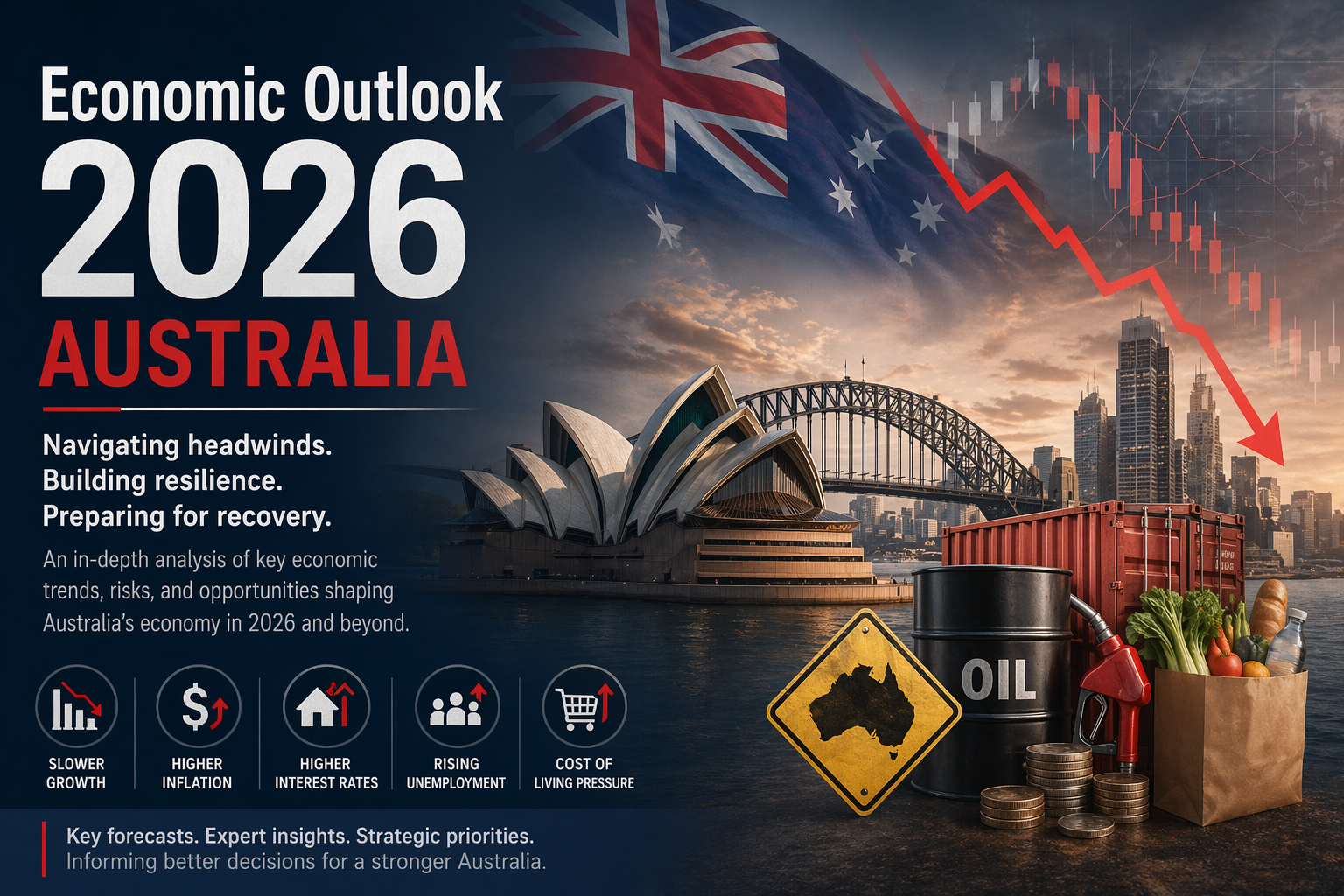
Australia’s economic outlook for 2026, according to SunX economists, has been downgraded due to the Middle East War, which has driven oil prices higher and negatively impacted the global economy.
Already burdened by cost-of-living pressures, Australia is facing high inflationary pressures as rising fuel costs push up grocery and other essential service prices.
Industries such as construction face an excessive cost burden as fuel and building material prices continue to rise at unprecedented levels, threatening the survival of well-established construction companies.
The Reserve Bank of Australia has been working as best as it can to reduce inflationary pressures in the pre-war era, with the inflation rate recorded in January 2026 at 3.8%.
As the war continues with no near-term end in sight and inflation is now projected to reach 6%, the central bank will have to implement increasingly aggressive interest rate hikes to contain it, risking a higher chance of a recession in 2026.
The recent salary increments given to the health sector in April 2026, whilst seen as compensation, will in turn add fuel to already high inflation. As more employees seek incremental increases in earnings to offset the cost of living, businesses will continue to face mounting cost pressure and reduced profits, discouraging further viable business investment as investor confidence declines.
The Australian unemployment rate was recorded at 4.1% in January 2026 and is projected to rise, with SunX economists forecasting it to reach 4.8%.
At the same time, the global economy faces a prolonged period of business disruptions across sectors such as retail, construction, and transportation, driven by the increasing adoption of technology replacing human labour and by rising business costs.
There are increasingly imminent signs of stagflation as inflationary pressures, combined with lower investor sentiment, continue to affect the market.
Australia requires sound policy guidance and strategic, practical, results-oriented decisions to navigate the economic challenges and restore economic stability in these economically uncertain times.
Key economic forecasts for the Australian economic outlook for 2026 include GDP growth, household consumption, employment, inflation, business investment, and export earnings.
GDP Growth Projection
External uncontrollable negative shocks play a pivotal role in Australian economics.
Amid a period of projected high volatility in 2026-2027, Australia’s GDP is downgraded from 2.4% growth to 1.8% according to SunX economist.
The closure of the Strait of Hormuz hinders the vital flow of resources to the global economy in a cost-effective, time-bound manner, disrupting it and the Australian economy alike.
The effects of the Middle East war will continue to impact Australia, regardless of whether the war ends in April 2026 or stretches to and beyond May 2026.
The aftermath of the US-Israeli-led Iran war will heavily impact the Australian economy, particularly as import prices rise, putting upward pressure on domestic prices.
The ongoing conflicts in Iran have led to a 20% pause in global oil supply, pushing oil prices per barrel to a new high. The direct consequences of oil price hikes are higher transportation costs and higher global production costs, with delayed production, hurting the global economy.
Australia faces higher agricultural product costs due to fertilizer and diesel shortages, which are raising the prices consumers pay at grocery checkout counters. The upward price pressure is projected to push the inflation rate above 5% and toward 6% if the war continues for a prolonged period without an agreed peace resolution.
The real dollar value decreases as inflation rises, leading to constrained household budgets, reduced consumer sentiment, and a decline in consumer spending, which, in turn, contributes to a material slowdown in Australian GDP growth.
The Strait of Hormuz is a vital shipping route used for international trade. The closure of the Strait of Hormuz has disrupted global trade in relatively high-demand resources, such as fertilizers and oil.
The shippers have to incur higher operational costs to reroute shipments and maintain the flow of goods worldwide. This rerouting increases the cost and time required to transport resources and goods to the destination, delaying production due to fuel and resource shortages and negatively impacting GDP.
Declining investor confidence and reduced business investments weigh down on GDP growth, further weakening the Australian economic position.
Household Consumption
Consumer sentiment amid surging fuel prices and cost-of-living pressure is projected to remain relatively low, affecting consumer spending behaviour.
Aggressive interest rate hikes expected in 2026 to contain the rising rate of inflation will further subdue consumer spending in the latter part of 2026 and into 2027.
Mortgage repayments and rents account for a larger share of a household’s overall expenses, and any increases in these payments reduce the funds available for consumption expenditure.
SunX economist projects at least 2 rate raises as a firm RBA measure, although a 3rd rate raise appears highly probable if inflationary pressures continue to persist in the 4th quarter of 2026.
To put things in perspective, high living costs and an additional interest rate hike will substantially reduce the purchasing power of many families, despite some seeing an incremental rise in income, such as health care workers given a recent pay rise in April2026.
To explicitly illustrate the effect of an interest rate hike, consider the highly anticipated 0.25% rate rise in May of 2026. It will affect an average mortgage holder with a $750,000 loan by increasing the monthly mortgage repayment commitment by $156, thereby reducing consumer spending by the exact same amount.
For many households, this additional $156 increase in monthly expenses will put them in a difficult financial position as cost-of-living pressures continue to weigh heavily on families, especially families with children.
A 0.25 basis point interest rate rise, 3 times from May to December 2026, would equate to an aggregate unwelcoming interest rate rise of 0.75 basis points. This would constitute a significant negative impact on households’ budget sustainability.
This increased dollar cost of mortgage repayments will add $470 per month, a significant burden for already-constrained consumer budgets, with some households reaching a breaking point as the cost of everyday living becomes increasingly unaffordable, deteriorating the quality of life.
For a larger share of Australian households with children, interest rate hikes coupled with rising cost of living will create an inevitable cash crunch that undermines their ability to maintain their standard of living, raising social welfare concerns.
Families will increasingly seek social welfare assistance to meet their daily living costs, placing a greater burden on government welfare spending.
A gradual slowdown in consumer spending is projected for 2026. As the real value of purchasing power declines, per capita spending will decline, prompting households to strictly prioritize needs over wants.
Labour Market
The current year, 2026, is marked by heightened uncertain economic times, with businesses facing increased operational costs.
Businesses will consider scaling back operations or avoiding business expansions as part of a cost-minimization strategy.
Productivity declines as resources are wasted due to underinvestment in the business, including the abandonment of an expansionary plan.
As a result, the number of new staff hires will decline, thereby raising the unemployment rate.
Certain business sectors, such as hospitality, will suffer losses as budget-constrained consumers cut back on leisure activities. The possibilities of employee layoffs in hospitality are much higher relatively.
SunX economist predicts the unemployment rate will spike to 5% in late 2026 and then gradually decline in early 2027 as economic conditions recover.
As unemployment rates rise, negatively impacting household spending, GDP is directly affected . A rising unemployment rate increases social welfare spending and reduces tax revenue, leading to a decrease in the federal budget surplus or an increase in the deficit.
Business Investment
Investments in businesses are vital to support economic growth and increase productivity levels.
Uncertain economic conditions reduce investor confidence, as we are seeing in 2026, which is largely correlated to global investor sentiments arising from the ongoing Middle East war crisis.
The aftermath of the war would require a prolonged period of recovery, further dampening investor confidence.
Australia is facing rising fuel costs, with a flow-on effect on the cost of production, transportation, and the cost of living.
Businesses affected by the Middle East war shocks would be highly reluctant to invest in an unsettled economic environment or defer undertaking business expansions. Rather, cost-cutting strategies to achieve cost-effectiveness, reducing the number of employees, and pausing new-hire hiring are almost the best fit strategic business practices.
The most affected industries include hospitality, transport, manufacturing, and construction, where operational costs increase substantially with rising fuel prices.
Declining investment reduces productivity, which, in turn, negatively affects Australian economic growth by wasting valuable resources.
However, large-scale investments in data centres, AI, and other technological businesses will continue to grow. These businesses, which are largely focused on high-return ventures, will continue to outperform other industries prone to uncertain economic conditions.
Inflation
An important topic of global interest, inflation continues to make headlines across the globe and in Australia.
Much like its global counterparts, Australia is experiencing high inflationary pressures.
The ongoing Middle East geopolitical conflict is driving energy prices higher amid global supply disruptions stemming from the closure of the international shipping route, rising concerns, and uncertainties about a prolonged global economic recovery in the aftermath of the US-Israeli-led Iran war.
Australia had controlled inflation at 3.8% with further steps to reduce it through interest rate increases prior to the Middle East conflict.
However, inflationary pressures from the war have now raised the probability that the Australian inflation rate will rise to 5% as production and transportation costs continue to surge.
SunX economist projects the inflation rate to surpass 5.5%, and approaching 6% if the war continues through or beyond April into May 2026 and the global recovery is prolonged, given the intensity of the economic damage.
Although it is not envisaged that the war will continue until June 2026, hypothetically, if the war were to continue until then or a peace deal has not been struck by then, the Australian inflation would certainly exceed 6.5%, approaching 7%.
While the central bank will exercise its monetary policy stance to contain inflation, it is unlikely to achieve the targeted rate in 2026.
Export Earnings
Australia is counted among the top 3 exporters of liquefied natural gas. The Middle East war has surged energy prices, driving up Australia’s LNG export earnings.
A significant boost to Australia’s export earnings from LNG, projected earnings are expected to exceed $10 billion, with prices further set to change depending on whether the war continues or ends with peace agreements.
The world order is fast changing, with new bilateral trade initiatives driving a new era of international trade, shifting away from the previous era when the US held global leadership and influence.
Countries are increasingly forming trade agreements independently, away from US intervention, to strengthen their international trading allies, resulting in greater economic stability.
While a recession looms, Australia is increasingly positioning itself by facilitating international trade negotiations with partners that offer better terms for bilateral trade agreements in a harmonious international trading environment.
SunX economist forecasts energy exports to remain sustainably high, supporting relatively strong export earnings.
Conclusion
Australia is inherently in a better economic position than other advanced economies, with a strong and influential monetary policy position and a robust economy.
However, effective time-bound policies are required to address evolving economic conditions amid unexpected global economic shocks.
SunX economist forecasts a much faster economic recovery for Australia than for most advanced economies at the end of the Middle East war.