Introduction
This research contributes to identifying strategic pathways to reduce the US National Debt from an unprecedented balance of USD 38 trillion to a possibly manageable balance, or even to a nil balance.
It is somewhat unimaginable at this point in time to reach a nil balance from a USD 38 trillion debt balance as of November 2025.
The years preceding the global crises of 2008 and 2020 substantially increased national debt.
Following the Global Financial Crisis and later the Pandemic Crisis, debt sharply accelerated as the budget deficit widened.
Managing the national debt is feasible, but reducing it remains elusive. The rising national debt balance emphasises the urgent need to address this fiscal challenge.
The continual rise in the National Debt Balance poses economic problems affecting every US citizen, problems that most Americans today do not envisage.
Certain known risks include the increased cost of servicing the National Debt Balance and a probable downgrade in ratings. These risks are more viewed as macro issues left to be tackled by government machinery. Other risks include an increased probability of a fiscal policy crisis. Spending limitations apply to essential sectors, including health and defence, as well as to investments in vital economic sectors such as infrastructure investments.
However, with rising National Debt Balance, America’s leadership status is at risk, a consequence that is unperceived by the American public.
While America is facing rising national debt, other countries are advancing economic growth and taking centre stage globally. The rise in economic status of countries like China and India will allow these new superpowers to one day offer global investors a stable and desirable asset suitable for foreign investment.
The problem in itself is not the increasing Balance of National Debt but a combination of other factors, such as the rise in the economic status of China and India.
While the USA is showing poor economic management in reducing its national debt, China and India are improving their economic status. A combination of economic prosperity, stability, and transparency, along with legal revisions that meet global investors’ standards and comfort levels, will, at some point, shift global investors’ interest toward countries like China and India.
Investors look for opportunities to increase their returns where there is a strong legal system to safeguard their investments ethically and honestly, and where transactions are conducted transparently. Collective factors such as these will threaten America’s leadership position as countries like China and India gain the trust of global investors.
Therefore, it is important for America to understand that collective factors, as outlined above, would weaken its ability to demonstrate its position to global investors, which should be a significant concern.
As it stands today, this threat is not widely seen as a real risk; however, other countries are surely working towards becoming the world’s number 1 economy.
America holds leadership status in defence and finance, and in many other sectors, and its legacy is enjoyed by every American citizen, including foreigners who want to visit the US for recreational or business purposes. For instance, USD is, by and large, a globally acceptable and one of the most trusted currencies.
America’s presence is felt globally, and with this power, it displays its authority and influences the world economy. Americans are seen as holding a superior status, with exceptionally high living standards, access to quality education, and excellent medical facilities.
For a moment, if we create a scenario in which the Global Economic Leadership Power Dynamics shifts from the US to a newly emerged Global Leader, say, Country A, the authority and influence shift to Country A would make the world look a whole lot different.
Country A would impose new trade deals and sanctions that may not be favourable to US manufacturers and US markets, negatively affecting American businesses and consumers. Further on, any unfavourable deals and sanctions would have negative repercussions on US employment, affecting employees in various sectors such as manufacturing, with a flow-on effect on the US economy.
For example, a higher tariff on US-made cars would reduce demand for US-made cars, leading to layoffs and, in turn, raising the unemployment rate. Those employees who are unable to secure work elsewhere will, at some point, start to default on their mortgage payments and cut back on their spending.
Similar impacts across other sectors and industries will push the US economy toward an economic downturn or a full-blown recession. The occurrence of such economic outcomes will heavily weigh on American consumers negatively.
These sorts of issues are not widely known or envisaged by US citizens today because there is no such information or predictions about the future cause-and-effect resulting from the escalating National Debt Balance.
Every US Citizen must know and be fully aware of the consequences of where the US economy is heading and what America’s position will be in the next 10 years, 15 years, or 20 years from today.
The legacy of the US economy would diminish for the future generates to experience and enjoy, more simply to say, if you are a parent of a 5 years old child or would be a grandmother in next few months, you would not expect your child or a grandchild to enjoy the same level of the standard of living today to the standard of living they would have in next 15 or 20 years.
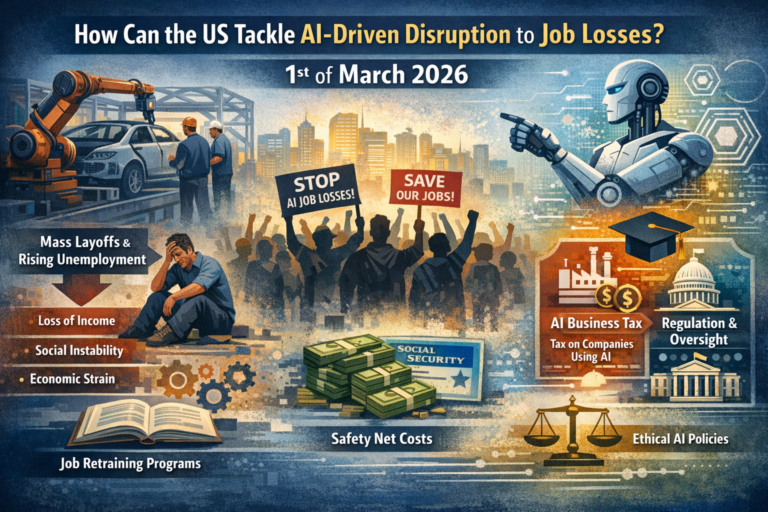
The rise in artificial intelligence and robotic technology has already begun to hit hard in some fields of employment, and this is just the start of the lifestyle disruptions for affected employees.
Advancements in artificial intelligence and robotic technology will further make many roles and jobs redundant. Adding to these disruptions will be a gradual decline in the standard of living due to a shift in the US Economic Leadership Power Dynamics.
A new American lifestyle would be more difficult and less comfortable. Few expect America to face such severe economic instability.
But today, Americans have a chance to stand United and work together with the Government to save America from an economic landslide that could lead to the loss of influential power, dignity, and the legacy America carries. Every US Citizen has a collective and mutual duty to save America’s status and its global economic position for their children, grandchildren, and many generations to come.
The sacrifices that the past generations after generations have made have contributed to shaping America as we know and see today, a prosperous country with an ultra-rich lifestyle for anyone who chooses to work hard and smart, a land full of possibilities and opportunities. The sacrifices that today’s generations will make will help shape America as future generations will see, live, experience, and enjoy it.
As every parent wants to give their children an inheritance of some shape or form, every parent’s dream should be to hand America over to future generations without a gigantic Balance of National Debt of USD40 trillion or USD50 trillion.
A time has now come that not one person, two or three people, but a country United as One will embark on recreating the new United States of America. America will be a country that will rise to write the history of moving from a National Debt Balance of USD 38 trillion to a National Surplus Account. America will stand as a country in modern history that demonstrates its citizens will unite to restore the economic lifeblood, recharging and reenergizing the American economy.
In that regard, a proposal is presented as a guide to quickly bring the National Debt Balance to surplus through the mutual and collective efforts of the citizens of the United States of America.
To reduce the National Debt Balance, the US Government needs to generate sufficient funds to offset the debt. To do so, all citizens will need to stand united and contribute to saving the American economy and its global economic status.
The first step towards this enormous project is to establish an independent institution vested with the powers and authority, whose primary objective will be to draft and present a plan of action to Americans, clearly articulating its purpose. In particular, the citizens must have access to real-time data at their fingertips to see the progress of the plan in operation and the reduction in the National Debt Balance.
This operational staff must be qualified, experienced, and motivated to contribute their expertise and work collectively and mutually with every citizen, exercise utmost honesty in the delivery of their professional service, be available to answer questions for any citizen, and duly acknowledge that every citizen is playing a part and making a sacrifice to maintain and improve America’s position in the world economy.
Accountability to every citizen for their actions will be an important part of their role and will help build greater trust among citizens in this newly created institution, solely charged with bringing the National Debt Balance to a surplus within a set timeframe.
Proposal
The US National Debt has risen to a significant balance of 38 trillion. This figure will rise year on year as the budget position remains in deficit. Year-on-year future budget deficits will further add to national debt, with our projections that national debt will surpass 40 trillion by the end of 2026.
This is a hidden economic issue that, if remedial policies are not introduced immediately, will lead to a full-blown economic crisis at some point in the future.
The answer is simply to develop structured repayment methodologies.
This paper provides those methodologies to a) stop the debt from rising further and b) advise officials on advanced steps to reduce the amount of debt with the end goal of bringing the US Federal Budget back to surplus.
However, it is important to understand where the economy is headed if the national debt is left at a level of balance, including allowing it to continue to rise.
What is the current national debt balance of 38 trillion costing the US economy?
Unlike servicing any debt, the US government has to service the current debt. These are the funds that could be used to add value to the economy, including the future of the US economy.
In other words, the funds lost to servicing the current debt affect both the current and future generations.
But this is not all; the debt position is rising, putting more pressure on the federal government’s position to service future borrowing.
US Economy Today
The US is a leader in many sectors, including international trade, technology, and defence. To remain a leader, the US needs funding to cover rising costs across essential sectors such as Health, education and defence.
Rising debt levels require increased debt servicing, which in turn will divert funds from essential sectors of the economy.
The US Economy into the Future
Does this mean the US will probably lose its present leadership position?
Unfortunately, the answer is a yes if the national debt is left to grow.
Therefore, future generations in the US will be much worse off than the present generation, given that the national debt is rising. Future generations may not have the same legacy or enjoy the status the US has today.
Does this mean that another nation will step up to take over the reins from the US?
The unfortunate answer is yes.
World Leader Status
Assume for a while that at some point in time, servicing the budget deficit becomes a crisis for the government, or the ratings are downgraded, or borrowing further debts becomes harder and more costly, given the national debt balance signals a risk to the funder.
The next possible contender to take over the leadership role will be, for instance, China. As the status shifts from the US to China, life in the US for American citizens will look very different from what it is today. For example, if there is an international dispute, China will dictate the terms of conflict resolution. China can impose sanctions and issue international orders that harm the US. Unfavourable trade and tariff settings can be introduced.
Americans will move from setting policies and trends to becoming a receiver of orders from a superior country. If the above scenario becomes a reality, imagine the life of an ordinary American citizen.
Every household in America will feel the pain from losing the status and the legacy that is presently enjoyed by all.
Remedial Steps and Policies
America is for Americans, and losing the status of the world’s number 1 economy to number 2 is something every American should take seriously.
The path to national debt reduction requires full participation from every American citizen, and their efforts will solidify and hand over a strong US economy to the next generation.
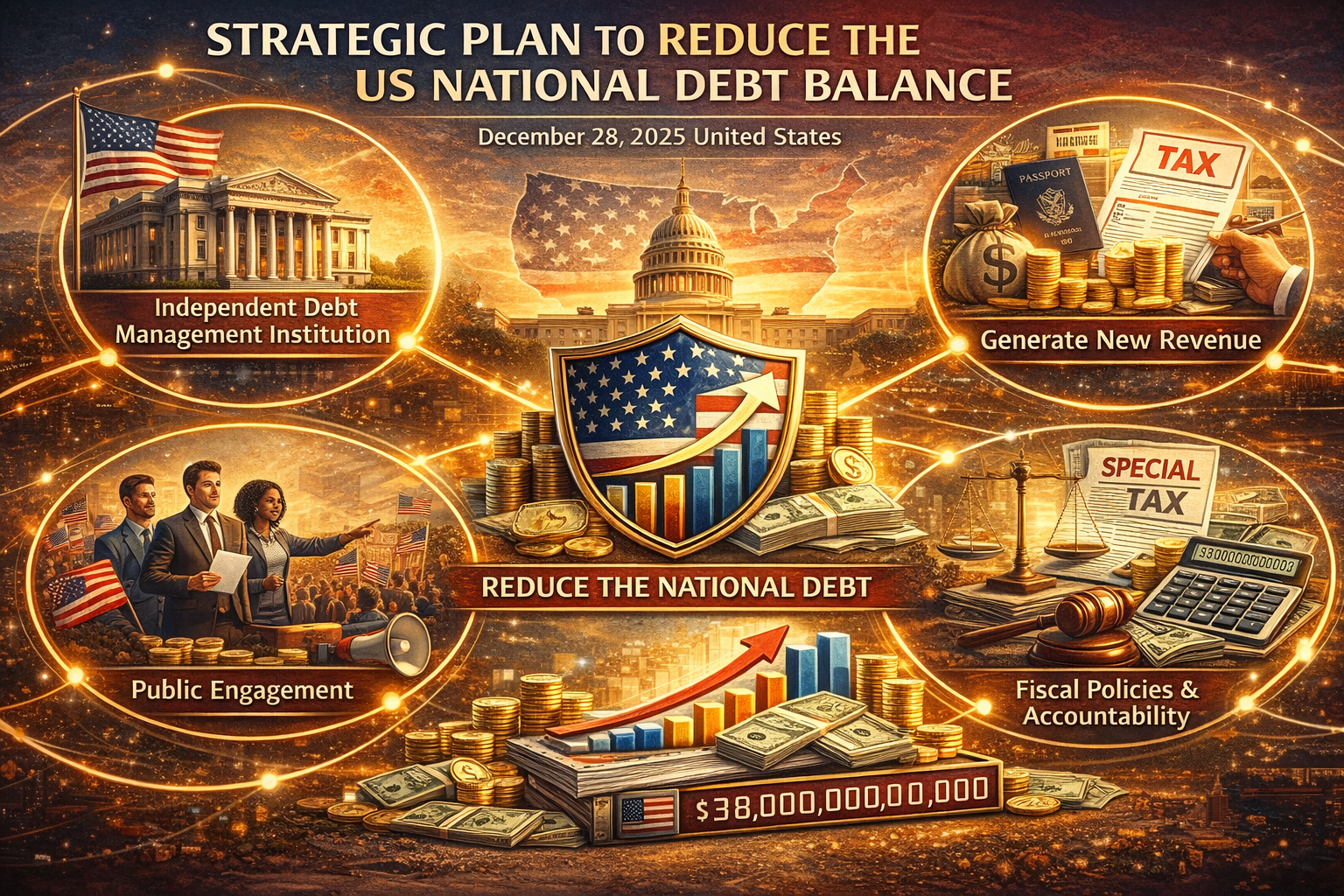
Proposed steps and policies that may assist in reducing the level of national debt may include:
- Step up of a standalone government institution with a primary focus on managing national debt. This institution will assume ownership and accountability, with the authority to operate independently of other governmental departments/institutions.
- Managing policies directed at reducing national debts by putting adequate resources to monitor the effectiveness of the policies.
- Engagement with the general public to generate interest and coordinate action plans.
- Introduce policies to generate funding by formulating a special tax to reduce the national debt.
Special taxes must be fair and balanced without hurting Americans.
At the same time, the Special Tax rate must generate sufficient revenue to substantially reduce the level of national debt; debt reduction must be significant on a year-on-year basis.
All future spending must be managed by this standalone government institution with nil intervention from any other government agencies or officials.
Step up of a standalone government institution with a primary focus on managing national debt.
This institution will assume ownership and accountability, with the authority to operate independently of other governmental departments/institutions.
Set up a National Debt Management Institution, a newly formed government institution.
The operating powers of this institution may include, but not be limited to, the following:
- Formulating operational systems, policies, procedures, and processes for delivering the results of national debt reduction.
- Preparing a structured National Debt Reduction Budget Plan.
- Devising effective strategies in line with the Budget Plan.
- Communicating the National Debt Reduction Budget Plan and effective funding-raising policies to the American public.
- Engaging with the American public, motivating the public, and keeping the public informed of the progress towards the National Debt Reduction Program.
- Monitoring the effectiveness of the policies.
- Assessing new spending requirements and making decisions on new spending requests independently.
Accountability and Responsibility in approving new spending and communicating the approval criteria to the public by posting relevant information for the public on the National Debt Management website.
Declined spending requests must also be published on the website.
Provide up-to-the-minute, real-time national debt balances for public information.
Managing policies directed at reducing national debts by putting adequate resources to monitor the effectiveness of the policies.
Policies are only effective if, after implementation, results are monitored, and if the outcome does not meet the desired forecasts, steps must be taken to achieve the outcome that meets the projections in a timely manner.
The effectiveness of the policies requires:
- Systems in place to monitor results achieved in real-time.
- Immediate actions taken to revise policies, or revise the policy implementation processes, or adjust projections against the actual results.
- Allow for the general public to view results in real-time.
- The public must be given an opportunity to review the effectiveness of policies and make comments actively.
- Policy makers within the institution must be held accountable for ineffectiveness in either drawing the policies or their ineffectiveness in implementation processes.
- Zero tolerance towards misinterpretations, errors, or omissions in the achievement of National Debt Reduction Budget Plans on a year-on-year basis.
- Engagement with the general public to generate interest and coordinate action plans.
- Broad public support is essential for the National Debt Reduction Program.
Plan for public engagement should invariably include, but not be limited to:
- Advising the American public as to why support is sought for debt reduction. For instance, the public must be made aware of the consequences of the rising national debt, including how this large debt is costing Americans today and its implications for future generations.
Rising national total debt is increasing debt servicing costs, which in turn divert large amounts of funds that could be used for further economic growth or spent on essential public services such as health care and education.
The rising national debt balance means the cost of servicing is gradually increasing, thereby placing greater burdens on the federal budget.
But most important of all, at some point in the future, total national debt will reach a level where servicing costs will be exceptionally high, and reducing the debt from that level will be almost impossible in the long-term.
There is a probable risk of losing ratings and the power and position that America holds in the global economy today.
Potential threat from another advanced economy, for example, China taking the reins of power and assuming the position of a global leader. Assume for a few minutes that the transfer of power, position, and privilege that America enjoys today is shifted to China, and that China becomes the new financial hub and defence powerhouse. Americans will not enjoy the lifestyle they have today, and this is something the present generation will deliver to new generations, a lost legacy of being the world leader.
The country that takes over the reins of power will influence the world, including America, and America will become a follower of another superpower. Every American citizen will see their everyday lives worsen as power shifts to another country, such as China.
The fact of the matter is, Americans will live a life nowhere near the legacy of today. No one likes to think of such episodes unfolding, but given that the national debt has no other means of reduction, the path to losing the number 1 spot as a world leader will lead to diminished standards of living and quality of life.
Introduce Policies to Generate Funding by Formulating a Special Tax for National Debt Reduction
Reducing national debt is not easy. However, as it stands, it is critical today to draft policies to generate funds for debt reduction.
An indicative plan of action will include:
- Introducing a special fair new tax to individuals and businesses across America to generate funds directed at specifically reducing the National Debt balance.
Based on projected tax revenue directed to National Debt reduction, the managing authority must clearly advise the American public of the number of years it will take to reduce the National Debt and achieve a Debt Surplus or a manageable debt position.
Create additional streams of revenue by introducing taxes and levies payable by international businesses and foreign nationals, whether visiting the US for pleasure or business. The legacy of America, while enjoyed by those foreigners, should automatically be liable to contribute towards the National Debt Reduction program. Those same foreigners would not visit the US either for pleasure or business if the US were to lose its position as the World Leader in trade, commerce, and technological front.
New foreign investments must be allowed only through special tax and residency pathways with tax and levies similar to those within a border plan to generate funds.
Policies should allow generous contributions from any individual or business with a patriotic attachment to the US and its legacy, including both local and foreign companies operating in the US.
Special taxes must be fair and balanced without hurting Americans.
Whilst this proposed new tax seemingly will be a financial burden across the country, knowing the consequence of national debt blowout to the point where servicing debt will become painful to the federal government, with extended risk of losing creditworthiness and ratings, and losing its World Leadership position, the subsequent flow-on effect will be unbearable for all Americans.
With this knowledge of the consequences, the financial burden of this special tax will not be seen as a burden but rather as an opportunity to contribute to the country that has given American citizens a quality of life and standard of living far greater than those of many nations worldwide.
A true demonstration of patriotism and goodwill, the people of America will have the chance to collectively serve America and prevent the country from falling into dust in the future.
The managing authority must act at all times in full transparency, advising the Americas on the state of the National Debt balance and maintaining close contact with the public.
Comprehensive and detailed transactions records and account reconciliations must be available for public viewing.
The public must have an opportunity to interact with officials on critical topics and provide their comments in real-time. Top-level authority figures must be willing to work with the American public and put the people first in the process of generating funds.
Each authority figure must be fully accountable for its actions and contribute towards serving America and the Americans.
With a balanced and favourable approach, promoting collective actions, the path to National Debt Reduction, while seemingly a difficult task today, will in fact roll out to be a smooth sailing process as long as the American public sees a value worth their time and monetary investment that will have a flow of benefits to future generations.
No parent would like their future generations to lose the legacy Americans enjoy today, and every effort put in by each and every individual American today will contribute to making the lives of their future generation better than leaving the future generations to collect the pieces of their lives living in a country with trillions in national debt.
At the same time, the Special Tax rate must generate sufficient revenue to substantially reduce the level of national debt significantly on a year-on-year basis.
Just imposing a Special Tax will not suffice if the amounts collected are not substantial enough to significantly reduce the National Debt Balance and make a material difference.
Special Tax will not be a tax forever; it is designed to bring the National Debt Balance to a surplus.
At the same time, the Federal Government will have to introduce a Bill that specifically stops the unwarranted use of funds if the spending does not bring a material benefit to America.
The Choice that every American makes to contribute their hard-earned income towards the Special Tax must be seen as a privilege by the US Government. And to equally reciprocate on their part, it will be an essential act for the Government to become responsible and reasonable in its national spending.
For the Special Tax to be effective in reducing the National Debt Balance, the current National Debt Balance will be transferred to the newly formed authority as of a particular date. The managing authority will not be responsible for new spending from then on; this will be managed by the government, which will be responsible for maintaining a budget surplus. In other words, the balance of the National Debt will shift to the newly formed institution with authority and responsibility for national debt reduction, while the new spending will start fresh and be managed by the government for repayment.
However, the revenue received by the government will be proportionately split between managing current spending and reducing the Balance of National Debt. This split will be formally agreed upon with the execution of formal documents to avoid the system breakdown, as Americans’ trust must be honoured.
At the same time, the National Debt Balance transferred to the newly formed institution will become the sole responsibility of that authority to bring it to nil.
And upon full repayment of the National Debt balance managed by this institution, it can then wrap up its affairs and cancel the Special Tax and any other taxes and levies that were put in place to generate the funds.
National Debt Balance & Operational National Account
To differentiate between the National Debt Balance of USD 38 trillion that will be transferred to the newly formed institution and the current revenue and spending accounts, the current accounts must be designated as the Operational National Account.
An Operational National Account will either have an Operational National Surplus or an Operational National Debt. The Operational National Account will be fully managed by the US Treasury.
All current spending and revenue must be overseen by the new institution for assessment and simultaneously reviewed by the Treasury, with spending approval powers transferred to the new institution to avoid reckless spending behaviour.
This institution will be solely charged with managing and reconciling the Operational National Account. Most importantly, this institution’s role will be to keep the Operational National Account in surplus or allow a reasonable deficit that will be manageable to reduce.
US Total National Account Balance for reporting purposes will then comprise the Balance of National Debt administered by a newly formed authority charged with fully repaying USD38 trillion, plus the Operational National Balance Debt/Surplus administered by a newly formed institution in close consultation with the Treasury.
Since the Operational National Account will start with a fresh account with a nil balance, managing this account will be easier for the government and, at the same time, help keep the debt from ballooning.
All future spending is to be managed by this standalone government institution with nil intervention from any other government agency or officials.
Treasury will have operational capabilities of Operational National Account; however the account management powers will solely be vested with the new institution.
The Operational National Budget and Operational National Account balance must never reach levels that make it almost impossible to bring the budget back to surplus.
To exercise care and caution, the new institution independent of the government must comprise of qualified and experienced professionals with capability to undertake the government’s expense and revenue analysis and weighing the benefits against the costs of new spending. Where there are projections of an increase in the National Debt, this institution will be responsible for managing revenue and payments, and for reducing the balance to a surplus or to a level of debt that is manageable in terms of repayments.
Such an institution must have a set of well-documented rules and regulations that allow office holders to make financially sound decisions without pressure from any U.S. government officials, regardless of the position or office held by those officials.
Independent decision-makers of this institution must maintain a balanced operational budget and operational account, or, if the budget has gone into debt, implement a speedy recovery plan to restore surplus.
America has grown accustomed to the National Debt, and this culture of spending must be turned around so that government spending serves the good of America rather than gradually increasing the servicing costs of the National Debt.
It would be unreasonable and unjustifiable for the Americans to help bring the National Debt balance to a credit position only to let the budget slip back to deficit.
Each and every American will commit to Special Tax payments provided that their individual sacrifices go toward making the lives of future generations of Americans better, debt-free, and that future government spending leads to responsible investment in America’s major sectors, such as health, infrastructure, and education.
A true strength of America is demonstrating a sound financial position, implementing economic policies and strategies to maintain a National Account Surplus.
The spending culture, once rewired with new strategies and economic policies, will deliver the best and showcase America’s superior economic management capabilities to the world.
Additional source of revenue streams such as establishment public enterprises is highly recommended and the ground work warrants a separate research publication