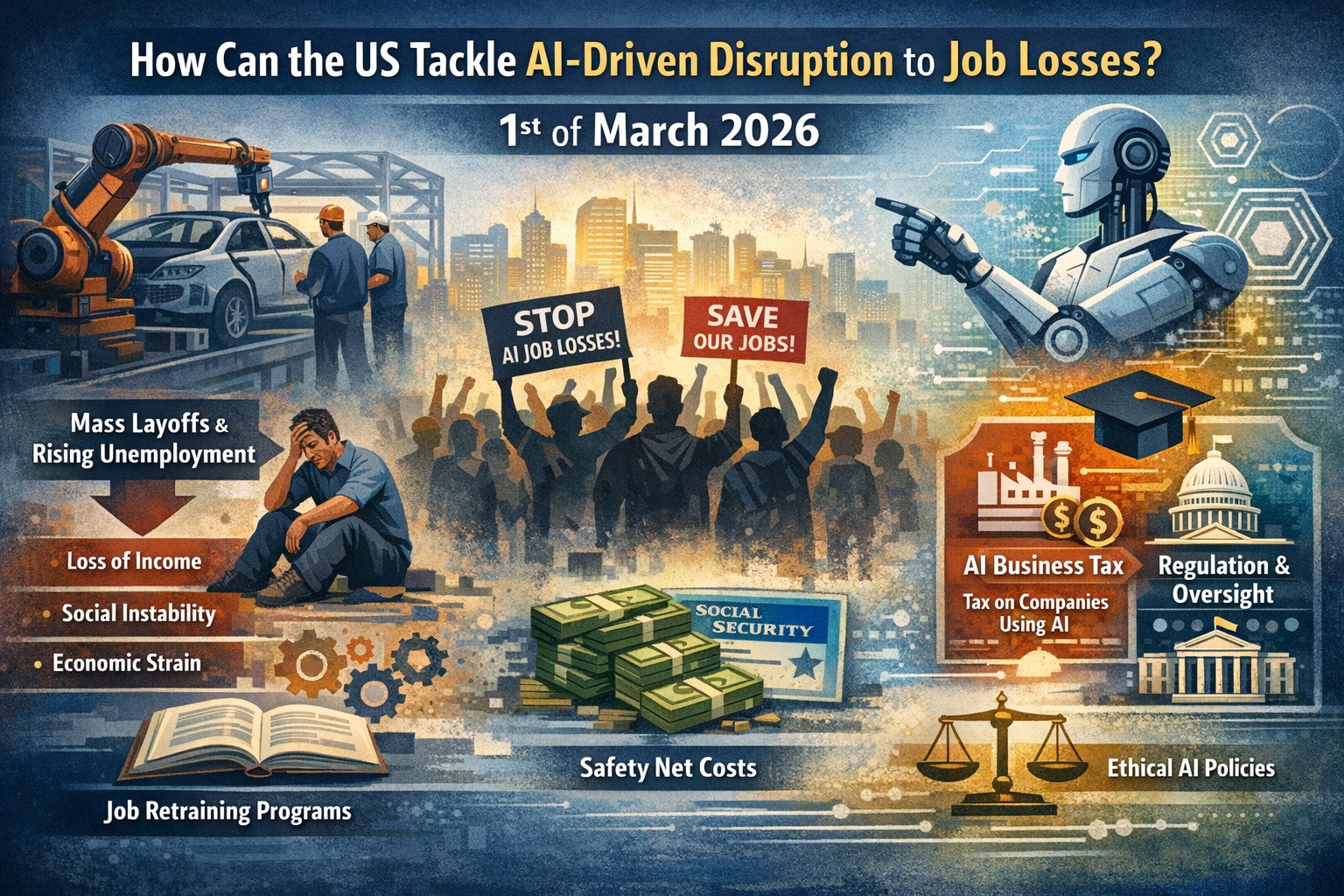
AI is rapidly advancing across industries, replacing tasks that are performed by humans and displacing thousands of workers.
Robotic technology has significantly advanced manufacturing, particularly in vehicle production, enabling humans to work alongside machines to boost productivity and efficiency.
The current era of AI promises high performance and efficiency, delivering precise, reliable, and rapid results. Unlike humans, AI-powered machines minimise errors and improve accuracy.
The drive to develop machines capable of performing more human tasks is accelerating. AI is increasingly used in medicine, healthcare, business, finance, law enforcement, food preparation, transport, logistics, and other sectors.
While AI adoption is an exciting development, it raises concerns about rapid job losses. For example, the modern warehouses now rely on AI-powered robots, with new facilities designed for advanced automated robotics and existing ones increasingly integrating robotic systems.
Major international brands are adopting AI-powered tools, leading to significant job losses. As AI becomes more accessible, businesses of all sizes are expected to reduce the number of job openings.
Most workers who are displaced may not be able to find a job relatively quickly or a job that pays a comparable wage to what they used to earn in their previous job.
For those redundant workers who have time and money saved to cover their expenses while unemployed, they can be retrained for a new role. However, a larger number of workers may not be able to be retrained quickly due to financial pressure, or their mindset may not be in favour of further studies.
A growing number of job losses is an imminent threat to the financial landscape and the stability of the banking and monetary system on which our society operates, in a coordinated effort based on good faith.
People earn money when they work, and they either save it or consume it. Money that is consumed becomes someone else’s income, and they choose to save, invest, or consume. This cycle keeps the free-market economy in motion.
As more people are laid off and struggle to find jobs with comparable incomes, their standard of living declines. Social issues such as domestic violence, separation, and divorces create an unhealthy living environment for kids, raise mental health crises, leading to possibly robbery and crime committed for survival, which will eventually lead to a disastrous situation for the government to handle.
New jobs are certainly created, but not enough to employ all those unemployed. For example, a cashier in a retail outlet who has worked for 35 years may not have a mindset to study Data Science, AI, Machine learning, or similar jobs that require formal study.
The US is experiencing a high rate of layoffs, with prominent businesses projecting even higher levels of employee displacement. This is the trend, a wave of the new AI era that we all have to get used to, but acceptance from the global workforce is limited to a certain level.
Advancing AI into the 2030s, 2040s, 2050s, and 2060s will be highly sophisticated, almost capable of doing most jobs or disrupting many professions, displacing millions of workers globally.
But we should first focus on the AI impact over the next 10 to 20 years. Most workers today, at least in their late 30s and into their 50s, have debt repayments and family commitments.
If many workers in this age group lose their jobs, it could seriously harm the economy, possibly causing economic damage far greater than job losses recorded in history. A threat to human survival will lead masses of people on the streets to protest, causing riots and violence against the rapid rise of AI, displacing human workers.
Government Intervention
Balanced regulations will prevent the escalation of adverse effects and promote equitable outcomes for businesses and employees, achieving long-term economic stability and resource sustainability.
Regulatory analysis should embrace advancements in AI, with the benefits outweighing the risks.
Balancing the pace of innovation with the benefits it delivers will become an empirical task for policymakers and regulators as AI evolves rapidly.
Let’s examine policies and regulatory stances that achieve AI market equilibrium while enabling continuous advancement.
AI-Driven Economic Cost
Analysis focused on human labour displacement and its effects on society is a crucial starting point for analysing and devising strategies as we work through this new era of AI adoption in the modern community.
For instance, based on a hypothetical assumption that 80,000 workers were displaced from the American workforce in 2025 and replaced by Smart Technologies driven by AI advancement, the questions pertinent for evaluation could include:
- How many people were successful in securing employment with comparable or higher income?
- How many of those laid off enrolled in courses to get upskilled in the demand-driven or skill shortage roles?
- What was the total number of people still unemployed after 30 days, 60 days, 90 days, and beyond 90 days since they became unemployed?
- How many of these unemployed people applied for Social Security benefits?
- Was there a quantifiable figure for an increase in social problems?
- Which US state suffered the most unemployment?
- Can a cost be attributed to lost labour and its impact on society?
- Can a figure be ascertained for outlays required from the government to stabilise the economy?
- What are the projections for future job losses to AI and its implications for a wider American society?
- What are the remedial plans for the government to resort to as unemployment accelerates, driven by the AI expansion?
There are several other questions that form part of a full-scale analysis to understand the depth of costs and benefits, based on which future projections can be accomplished with a view to designing effective strategies and policies to achieve desired balanced outcomes.
If the costs outweigh the benefits in the given analysis, policies should be designed to restore economic stability.
In the given hypothetical context of 80,000 lost jobs, if 50,000 workers were unable to secure comparable-paying roles, only 5,000 could proceed with a formal study; 10,000 retired from the workforce; 35,000 of those unemployed applied for social security payments; and the government would had to outlay USD700 per fortnight to cover the unemployment social security benefit of those 35,000, equating to USD24,500,000 per fortnight.
Further assumption-based calculations show that if those 35,000 remained unemployed for the next 12 months, the yearly social security benefit outlay would amount to USD 857,500,000,000, a sum that would add to the already stretched National Debt Balance.
Additionally, assume that of those 35,000 still unemployed, they were paying an average annual tax of USD10,000, inclusive of Federal & State taxes, as well as other compulsory payments such as Medicare and Social Security. The total government revenue lost would be 35,000 multiplied by USD10,000, equating to USD350,000,000.
For the computation of the aggregate cost, incorporate lost tax revenue of USD350,000,000, plus social security payments to the unemployed of USD857,500,000,000, and quantification of societal costs, which is unknown at this stage, including allocations to social welfare issues, which is unknown at this stage; this computational model will show the true cost of unregulated AI sector to the government on an year-on-year basis.
This model, however, will fail to include costs such as family disputes arising from financial constraints, leading to separations and children affected by financial distress. Children living in financially distressed families will be faced with violence, a poor financial position will lead to unhealthy eating, all adding to a child growing to adulthood with trauma, mental disorder, and lack of functional capacity, a future cost burden for the government.
AI Business Tax
An actionable remedial plan would be to tax businesses based on certain criteria, so that the qualification for the tax does not deter innovation but rather compensates for the loss of tax revenue and helps mitigate other associated costs incurred as a direct consequence of AI.
To be fairer to businesses, the tax modelling must consider the costs businesses incur in adopting AI Smart Technology and the benefits to society. Further, as businesses reduce their employee headcount, their profits would increase proportionately, thereby increasing their tax payment obligations.
Implementing, testing, and streamlining AI will incur costs. However, as businesses adopting AI gradually settle into the new working environment, they will save on past employee costs, thereby increasing their profits proportionate to those savings.
Businesses taxed on higher profits will not compensate for the taxes that employees paid to offset the lost tax revenue.
Revised tax payments must be adjusted to devise a realistic new tax on businesses to generate funds to compensate for the outlay on unemployment social security benefits, inclusive of any other associated expenditure.
In a scenario where government outlays increase while tax revenue declines, the National Debt Balance would increase.
Introducing a new AI tax for businesses would also slow AI adoption and deter some businesses from delaying massive employee layoffs.
The AI business taxes we are discussing here are specifically aimed at the loss of tax revenue from employees who remain unemployed for more than 90 days. The new tax will also include other related established costs to society as a direct consequence of AI.
Such tedious data capture, monitoring, and analysis would demand time. Therefore, the modelling would be better introduced as an approximation, closer to realistic tax impacts, with the actual tax rates adjusted as more data become available and the modelling finalises.
This tax would apply only to businesses that are reducing their workforce due to AI innovations.
Regulating AI
AI is advancing rapidly, with job losses compounding, requiring the AI sector to be fully regulated to support AI innovations and businesses adopting AI in their operations.
Regulations will focus on the impact study of innovations, the introduction of an AI product licensing system, and the monitoring of AI post-adoption in business operations.
Innovators of AI and businesses adopting AI will be subject to AI Regulations requiring them to apply to the regulator for appropriate approvals and set up annual compliance and monitoring protocols relevant and applicable to them.
Regulations outlined to incorporate a fairer advancement of AI Smart Technology, ethically generating tangible benefits to the economy.
Special regulatory powers must be introduced to safeguard people across various groups from AI products that could otherwise cause harm.
Penalties for the misuse of AI must be sufficient to deter innovators and businesses from engaging in improper behaviour. Additionally, when scrutinising product approvals, the approach must be to analyse any potential negative use of the AI product to prevent future harm.
Ethical Codes of Conduct must be released for the innovators and businesses to adhere to and conform to its standards at all times as part of the product licensing or product adoption compliance framework.
Regulations Promoting Licensing Approvals
AI and advanced automated robotic technologies are increasingly shaping how people work, live, and get along in their daily lives. Such a significant impact from products and services requires governmental intervention to prevent the misuse of rapidly advancing technology that is driving mass unemployment.
The Federal Government should consider establishing an institution with the power to approve AI and robotic innovations and to ensure AI innovations comply with established standards, using a set of standard processes, procedures, and practices that must be followed by AI innovators and businesses that adopt AI technology.
Escalating AI advancements demand a regulatory framework, similar to that of many other established professions, products, and processes that require testing and impact studies, such as in medicine and engineering.
AI and robotic technology both rely on software and hardware, which must be classified for Federal Government approvals under a structured licensing protocol.
Regulation must be applied for an in-depth, full-scale review, including impact studies prepared by an accredited professional that quantifies costs and benefits to all applicable stakeholders.
A set of compliance and audit protocols should be established, with a particular emphasis on data integrity. Performance monitoring and annual reviews must be conducted to assess the impact of AI innovations adopted by businesses.
A risk-based analysis focused on the coherent economic implications of future job displacements by AI should be constructively mitigated without hindering value-adding, whilst advancing AI Smart technological innovations.
The pace of AI advancement should be controlled by value-adding, strategically conducted evaluations of each new innovation, with a set of formal guidelines that stipulate how the present and future benefits and costs are to be derived and quantified to ascertain economic impact. An impact study must explicitly detail each affected stakeholder and how the impact is mitigated for them.
Based on the outcome of extensive case-by-case evaluations, the decision must be made with accountability and authority, ensuring that the innovation does not interfere with societal functions in line with economic stability, which remains at the core.
Where an approval of the innovation is unsuccessful but could contribute to betterment and meet value-added criteria with some adjustments, or where an applicable special AI-related tax would allow for approval, such decisions must be justified by documented benefits to the economy.
The focus must be on controlling the speed of AI Smart Technology, which is advancing at an uncontrolled, undetected pace, displacing many jobs and quietly setting a stage for major economic problems in the foreseeable future.
At the same time, the Federal Government register would record the number of AI products released, their consequences and impacts on identified stakeholders, and their licensing and compliance requirements, including full details of innovations released to the market.
Additionally, the AI sector will adopt a fully established code of conduct and proper product licensing to deter unethical product innovations.
The economic impact study will help authorities anticipate any hidden surprises, allowing regulators to plan for mass employee layoffs and implement strategies to upskill affected employees.
All application submissions to the regulator will require a formal impact study, including measures to mitigate mass job losses and to work with the government to ensure a seamless transition for those who lost their jobs.
Interestingly, the free market, if left unchecked in the era of AI innovators’ race to create better and more functional products, would eliminate many human roles. Ultimately, pushing unemployment to staggering levels triggered societal unrest.
Survival of humans presides over innovation, especially that which threatens to dismantle the established norms of a standard lifestyle.
AI Compliance
Annual ongoing AI compliance for both AI innovators and businesses adopting AI will ensure that businesses do not have to add features after initial AI product implementation, which could lead to undesirable outcomes.
Fear of penalties will deter those who would ideally otherwise engage in unethical conduct.
The licensing register will record each innovator and business’s product approvals and compliance history on a year-on-year basis.
As part of annual compliance protocols, innovators and businesses will be required to standardize documents in accordance with set criteria to continue using the AI products.
Special audits will form part of the compliance framework where the regulator has information of misconduct.
Feature add-ons and enhancements, including major upgrades to the AI product, will require regulatory approvals and compliance with standard requirements as part of the mandatory process.
Business Should Become Responsible Employers
The purpose of this research is to promote AI that increases productivity and complements human workers to achieve efficiency. Smart technologies are increasingly seen as providing a pathway to better outcomes in healthcare, education, and the medical field.
Employers that are adopting AI and knows beforehand that mass employee layoffs will occur at some point in time in the future, rather than holding such announcements for a later time, they should inform the affected employees of a possible redundancy in the future with a likely timeline so as to provide them with an opportunity to choose potential paths.
For example, if employees are aware they will be retrenched in the next 12 months, they may take up part-time studies to upgrade their skills in a skills-shortage field. Other options include finding suitable part-time jobs, changing careers, or even starting a small business. If the would-be affected employees were looking to go on vacation or use their surplus funds for other purposes, such as home renovations or putting a deposit down on a house, they would make wise decisions.
The second option employers can choose is to retrain or offer fees, either wholly or partially, towards formal external education and training that will help some employees switch to new roles within the business.
Retrenched workers will secure better opportunities, avoiding the need to seek social security benefit payments.
Responsible behaviour would enable the business to work more strategically with employees who may be affected by layoffs as they prepare for employee layoffs.
A sudden redundancy shock does more harm than good, especially when, in a short-notice timeframe, the employer creates panic for a vast number of people all at once.
Some employees could go through a panic attack only to lose their family or face domestic problems as their mind doesn’t function at the worst times, such as when losing a job.
Off-Shore Innovation Threats
While domestic manufacturers of AI and Robotic Smart Technology will be regulated and taxed by the US government in this context, it is equally important to focus on AI and Robotic Smart Technology manufactured overseas.
Foreign innovators and US businesses adopting foreign AI products will be required to submit applications for product approvals and will be subjected to annual compliance.
However, foreign businesses adopting the US-based AI products will not be subjected to any regulations. They would need to comply with their country’s regulatory requirements to conduct business.
On the contrary, if the foreign business has either a physical US presence or an online business of selling products or services to US consumers, it will be subject to the US regulatory requirements.
Hidden AI Agenda
Job losses are slowly increasing, leading to a gradual downward shift in people’s standard of living. Social welfare crises are also increasing at a proportionate pace to job losses.
Up until now, there have been no clear, formal records of total job losses due to AI, as there is no formal framework in place. For example, a few staff losing their jobs to AI in a small- to medium-sized business goes undetected and is less well known in the study of AI’s economic impact.
One way to find the true number of workers displaced by AI would be to analyse the number of new social recipients applying for social security benefits after a mass employee layoff by large scale operated business. Generally, a proposed or actual mass employee layoff by a large corporation is announced in the media.
This data will ideally reveal a significant impact on workers. Data should be collected on crime, mental illness, reported separations, and divorce applications in the state where a mass employee layoff has occurred or is expected to occur within 30 days, 60 days, 90 days, or beyond 90 days.
Unless a proper regulatory framework is established, a task force should be created in the interim to undertake AI-led redundancies and compile an impact study report for the federal government.
As the AI race continues, job losses will accumulate into a fully-blown crisis.
AI innovators and businesses alike can operate in an unregulated environment without standardized codes of conduct.
The true cost of AI is, by and large, unknown to any government bodies. However, the speed of AI should alert government agencies to commence setting up a regulatory framework.
AI is also reducing the number of workers required compared to today’s processes, slowing job openings in certain industries.
Unless there are clear regulations, AI will cause a surprise wave of mass unemployment as it disrupts many industries and jobs.
While AI is increasing efficiency, productivity, and the accuracy of outcomes, the costs to society cannot be fully addressed without regulations.
Most businesses use the term “Business Restructure” to avoid true AI-led employee layoffs and the negative publicity and brand damage that come with them.
While AI is gaining momentum, we are seeing job displacements that are only headed to get worse. AI-displaced jobs are not being replaced by an equivalent number of layoffs, adding pressure on the government as it continues to cope with other issues, such as an aging population.
Conclusion
Our research is concentrated on achieving long-term economic stability and to promote equitable outcomes for all stakeholders on each AI product release. The regulatory framework, with a strong legal foundation, will set the rules for how innovators and businesses operate to achieve the best outcomes.
In light of AI advancements, it is highly recommended that the authorities review opportunities to formulate the regulatory framework for the AI sector.
In doing so, AI will gain integrity and official validation through product licensing and compliance, aligning the sector with other professional industries.
A coherent policy framework is required to optimise AI sector outcomes and generate tangible benefits in a regulated environment.
The US government will have greater control over this emerging sector, which urgently requires some regulatory intervention. The performance in the AI sector will be lifted to a certain professional and ethical level that will conform to national standards raising the bar to meet codes of conduct.