
Introduction
Recent global impediments, trade barriers, and counter-strategies have emerged, fundamentally altering the international economic order and creating profound, lasting effects on international trade arrangements and agreements, export-oriented investments, and the pace of global economic growth.
International trade has seen recent upheavals, harming more countries. Domestic controls cannot quell external shocks, as these shocks block international trade, weaken domestic business confidence, lower capital investment, and tighten consumer budgets. All these effects, in aggregate, dramatically slow the global economic growth.
The recent increase in US tariff rates has specifically affected targeted countries and regions, reducing exports from those countries and pushing domestic retail prices for US consumers higher on high-tariff products, thereby constraining the US consumer budgets.
US consumers are invariably becoming worse off as competition from foreign manufacturers gradually diminishes.
Exporting countries affected by the US tariff stipulations saw a sharp drop in manufacturing output.
Goods intended for the US market were cancelled due to higher tariffs. These tariffs raise US retail prices, significantly reduce US consumer demand for those goods, and cut the number of orders US importers place.
As a result of tariff rate increases, offshore manufacturers in affected countries experienced substantial production declines due to decreased demand, steep employee layoffs resulting from cost-cutting, and excessive unsold stock.
Wider effects on those nations could be greater. Higher unemployment and increased social welfare payments may follow. Layoffs hurt employees’ standard of living.
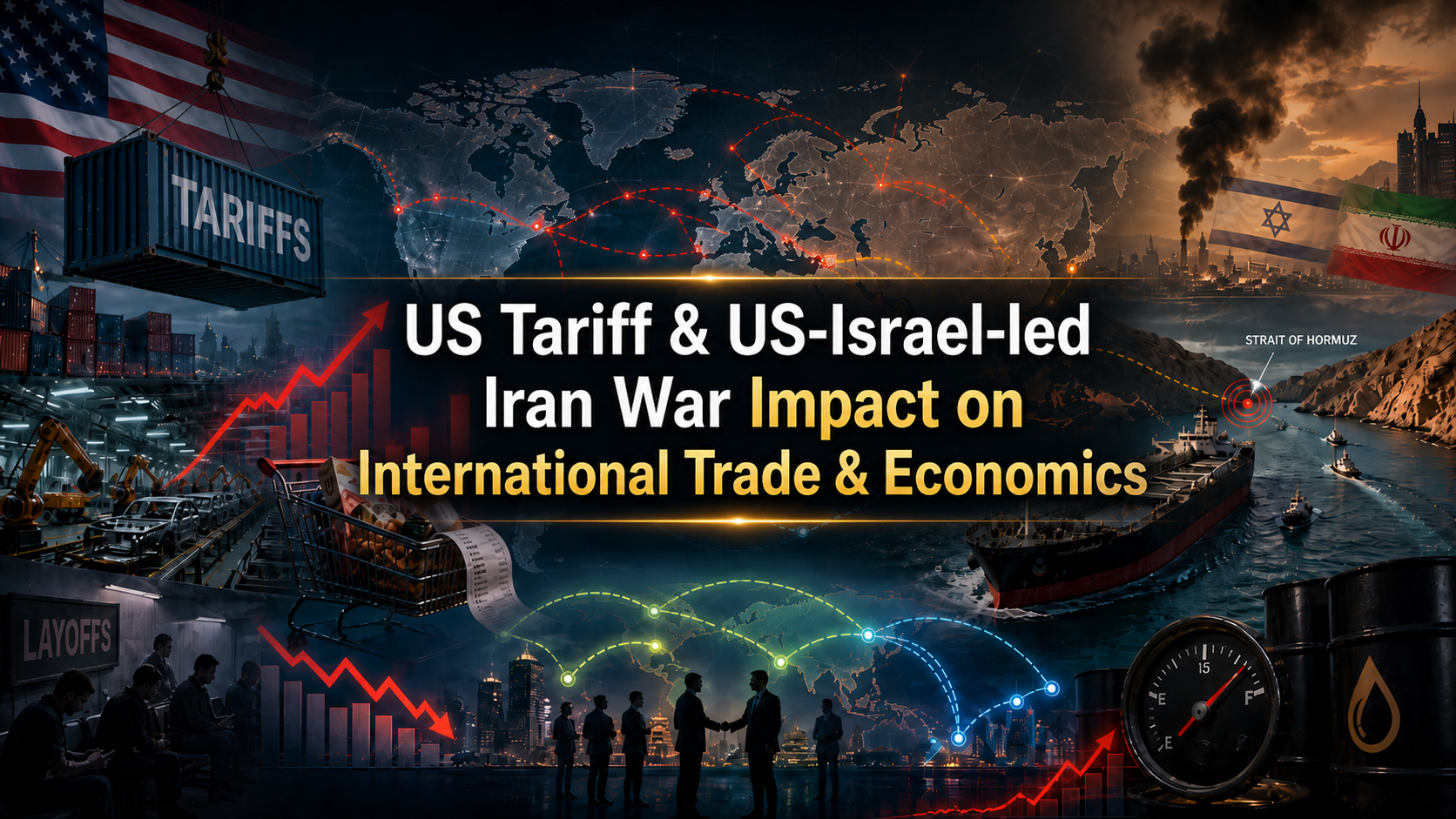
The US-Israel-led Iran conflict was a second external shock, worsening economic disruption.
Uncertainties surround the war’s length amid escalating tensions between the US and the Iranian regime, and the ongoing closure of the Strait of Hormuz, a major trade route for international shipping vessels in the region. The conflict disrupted fuel supplies and essential resources imposing high costs on many interdependent nations trading with the Gulf region.
First, we address US tariff shocks. Then we examine the US-Israel-led conflict with Iran. The ramifications of both these global shocks are rapidly reshaping the global economic order.
Global Impediments Shifting the Order of International Trade and Economics
The US Tariff Impact
Tariff threats have produced serious external shocks for trading partners whose policies or expectations are imbalanced and misaligned with US policies or expectations, at least according to US officials.
Such high-impact influence on international economics at the global scale illustrates the complex repercussions that global economic managers, policymakers, and world leaders must navigate to achieve domestic economic prosperity and stability while managing their relationships with the US.
For the US, setting tariffs became a highly effective tool for addressing key domestic challenges and for signalling to offshore trading partners the need to promptly meet the US’s evolving policy requirements. This use of tariff settings directly influenced the behaviour of trading partners with a hard, head-on impact.
The effectiveness of recent US tariff rate adjustments is largely enhanced by the vast US consumer base, which provides foreign manufacturers with access to a large, lucrative market with high-income potential in comparison to other trading partners.
The US imports large quantities of goods from around the globe, providing opportunities for its offshore trading partners to generate significant annual revenue. As a result, most countries view the US as a crucial export market and aim to maintain close trade ties with it. Their need to maintain a good working relationship with the US further amplifies the global impact of tariff changes on countries targeted on some basis of relevance.
In this climate, tariff rate increases ranging from 15% to 50% were an economic blowout, substantially impacting the affected countries by raising the cost of their exports.
Developing economies, such as Bangladesh, Thailand, and Laos, has experienced exponential tariff hikes on apparel exports. This has caused significant material impacts and a drastic reduction in sales revenue, highlighting the broader reach of US trade policy.
The European car manufacturers are unexpectedly and innocently facing enormous increases in tariffs on vehicles exported to the US, with intense upward pressure on operational costs to maintain export levels of approximately 800,000 cars per annum.
Absorbing the increased tariff costs could be a short-term interim measure for affected manufacturers while they develop a long-term strategic plan to mitigate the impact of high tariff rates.
However, for manufacturers to absorb such high and immediate costs would amount to millions of euros. This tariff rate increase is projected to cause losses exceeding 6 billion euros, creating significant economic ripple effects throughout Europe, notably in Germany.
Under intense cost-versus-revenue pressure, the European manufacturers face a difficult decision between absorbing additional tariff costs indefinitely or pursuing a capital-intensive strategy to relocate production to the US and close part of their production plants in Europe. The decision is complicated by tariff volatility, which requires detailed analysis, as future tariff changes could render either choice less viable over time.
Such dilemmas lead countries and manufacturers down conflicting and confusing paths. As car sales volumes erode, the risk of losing US market share to competitors willing to take calculated risks—such as relocating plants versus waiting—underscores the complexity of balancing and managing increased costs versus capital investment.
Governments are increasingly dealing with ramifications and heightened uncertainties arising from the US tariff-increasing policies. For example, if European automakers choose to relocate plants to the US, this could lead to imminent, immediately significant unemployment spikes in Europe.
Conversely, lower sales volumes resulting from increased US import tariffs will reduce the automaker’s sales and revenue and, in turn, reduce corporate tax revenue for the European Union’s respective governments. Either scenario can significantly slow a country’s economic growth, collectively threatening its economic stability.
Other countries affected on a large scale, including Malaysia, Canada, China, Mexico, Taiwan, Cambodia, Vietnam, Japan, and South Korea, have also experienced significant tariff increases on their exports, further damaging their respective economic position.
This displays the US’s power of balance by illustrating the widespread, high-impact effects of changing trade dynamics.
The shifting order of international economics is prompting a change in global trading norms, as countries recognize that mutual stability in the trading environment—supported by responsible domestic policy initiatives—can drive stronger bilateral trade agreements, benefiting citizens both at home and abroad.
The US-Israel-led Iran War Global Impact
The US-Israel-led Iran war has been driving increasingly significant changes in global trade trends and patterns, as well as fostering the formation of new international trade partnership arrangements and strengthening existing trade relations.
These shifts directly result from altered regional stability and new economic alliances driven by the unceasing conflict, which are significantly impacting the established, long-standing international economic order.
Because of changes in international trade based on comparative advantage resulting from the conflict, the US’s influence on the world stage is declining. Countries are prompted to negotiate and secure trade agreements amid rising global uncertainties about the war’s duration, which are influencing their trade decisions.
While America continues to hold the power of balance over imported products entering the USA by adjusting tariffs to suit its forward policy initiatives, Americans, on the other hand, are faced with either the high cost of imported goods or a lack of supply for those items disrupted by rising fuel costs.
Another consequence for the American economy is the excessively high cost of war engagement, driven by the deployment of a wide range of defence resources, which adds pressure on its already elevated fiscal spending.
The deployment of American air, naval, and ground forces to the conflict region increases war costs exponentially, when calculated on a daily expenditure basis, to billions of American dollars. This increased expenditure directly raises the financial burden on American taxpayers and add to the national deficit, raising the question of how these funds could have been used to meet the growing needs of those essential services for citizens domestically and to better serve Americans.
Costs rise because large weapon systems, ongoing military operations, and continuous logistical support—without a definite end in sight—require persistent funding that is utterly unrealistic. These expenditures drive out-of-budget costs higher as the conflict endures, extending the cost burden on American public funding.
These US military actions were seen as somewhat unjustified by the major US allies. As a result, major allies have withheld support on the war front, requiring US forces to carry out large-scale military operations on their own.
Because the conflict appears to continue indefinitely in the near term without a clear outline of a peaceful resolution, growing tensions among stakeholders, and rising operational costs for American businesses and the cost of living for US consumers, the impact is correspondingly a global crisis.
This widespread cost increase stems from economic disruptions caused by the war, affecting people worldwide with similar intensity and a prolonged period of uncertainty.
As a result, the war has significantly increased American consumers’ budgetary constraints due to upward pressure on fuel prices, which in turn has led to higher prices consumers pay for goods and services.
Worsening global cost pressures, fuelled by ongoing uncertainty and the lack of conflict resolution, are driving shifts in global attitudes toward international trade and commerce.
The far-reaching ripple effects of this conflict manifest in disruptions to fuel and fertilizer supplies, rising fuel costs, higher operational costs in the agricultural and manufacturing sectors, and surging transportation costs—all contributing to the high cost of goods and services worldwide.
Furthermore, the list of disturbances in everyday life globally is increasingly complex and devastating, with businesses and consumers struggling to survive amid real income disparities.
The disproportionate effect on low-income households is driven by rapidly rising inflation, as they spend a high share of their income on everyday essentials such as food and fuel.
Thus, real disposable income has been gradually declining despite nominal wage gains from pay rises in some sectors around the world, due to regressive taxes from persistently high inflationary pressure.
This erosion of purchasing power and savings for lower-income households is largely due to rising fuel costs, which translate into higher production and transportation costs to the point of sale. As a result, imminent price increases for essential goods and services are projected to persist for at least the next 12 months after the US-Israel-led Iran war ends.
Accordingly, the guiding ideology of the new school of modern thought on global trade is to secure bilateral international trade agreements that support the free flow of goods and reduce reliance on sources with a higher probability of territorial conflicts that impede vital trade links.
The rationale for pursuing prioritized, highly sustainable trade deals in the long run is to ensure a steady, reliable supply of goods between countries that share mutual interests in achieving them.
Consistency in supply chains across international trading partnerships helps prevent supply disruptions and limit cost pressures arising from prolonged, undesirable territorial conflicts that strain global supply chains.
Ultimately, the world at large has learned a great deal about risks in the international trading environment through these recent experiences.
A rational, collective adoption of bilateral trade agreements can leverage comparative advantage, ensuring better pricing, steady supply, and less dependence on regions at risk of conflict. This approach reduces vulnerability to disruptions caused by events like the recent war.
Finally, self-sufficiency in essential resources is seen as a rational mitigant, as a growing chorus of citizens’ calls on government officials to consider tapping into resource-rich reserves. Taking this constructive step can help eradicate and mitigate the risks of supply disruptions to vital fuel and energy sources.
Counter-Strategic Solutions Shifting Order of International Trade & Economics
Bilateral Trade Agreements
Sustainability in international trade requires several bilateral trade agreements among aligned regions, territories, and countries, allowing for broad coverage of essential goods and vital service exports. By ensuring they are proportionately spread across the globe, these agreements help eliminate the risk of being perceived as hostile in global trading.
For example, the closure of the Strait of Hormuz halted trade for countries using the shipping route or sourcing fuel and fertilizer from the Gulf region. Without a secondary contingency plan, several nations experienced domestic chaos as officials worked vigorously to reach new trade agreements with both existing and new partners to remove obstacles to the free flow of essential products.
In this context, the recently concluded Australia-European Union Free Trade Agreement in March 2026 was a much-anticipated and highly welcomed trade agreement for both businesses and consumers in Australia and the European Union.
It was a progressive step to a bilateral trade agreement that benefited all parties, aimed at eliminating tariffs and strengthening economic ties, thereby generating high economic returns.
This agreement provided relief to European automakers and other manufacturers affected by US tariff increases, offering opportunities by diversifying trade options and opening additional markets for car and other product sales, thereby contributing to long-term economic security.
Additionally, the mutual agreement supported both the Australian and European Union businesses and consumers. By covering a wider range of goods and services, including tariff removal, it enabled greater trade volumes between the trading partners.
As a result, businesses have new market opportunities for cross-border trade, attracting high export sales revenue from a larger client market. At the same time, consumers have benefited from tariff removal on certain products, thereby lowering relative retail prices and relieving them of rising cost pressures.
Furthermore, the agreement encourages manufacturers in each of these countries to increase capital investments and hire new employees to boost production. This expansion is largely in response to increased demand and sales opportunities projected for their respective products in newly accessible cross-border markets between Australia and the European Union. For the consumers, this market offers a wider range of products at comparably lower prices.
For the government, these changes mean that, although revenue from tariffs and duties has substantially declined, increased profits from trade—stemming from new-market sales by manufacturers and exporters of goods—will help offset those losses. Individuals’ tax payments from new employee hires will further increase the government’s tax revenue.
Finally, a major highlight of the agreement was the inclusion of investments in renewable energy to support long-term environmental sustainability. With a clear and distinct focus on clean energy technologies, including solar and wind, this emphasis aims to help tackle climate change at its core and advance environmental sustainability as a top-priority agenda, both of which are central issues in the current era.
Fast-tracking Oil Resource Exploration and Extraction
A key highlight of the US-Israel-led Iran war was fuel disruptions, which demonstrated how conflicts can cause major disturbances to a country’s essential mobility.
Consequently, countries with oil reserves should seriously consider and prioritize the rapid construction of oil refineries, since extracting these resources will help achieve self-sufficiency during volatile conditions and reduce reliance on traditional supplier countries.
Relying predominantly on high-risk classified and identified imminent conflict-affected regions for essential fuel supplies in material quantities, without a contingency plan to quickly secure fuel during heightened emergencies, increases a country’s vulnerability to external shocks from supply disruptions. It follows that the unexpected economic cost arises exponentially during crisis points because fuel supply disruptions jeopardize stable fuel access and pricing.
Thus, it is irrational to view electric vehicles or electric machinery as a medium-term solution for emergencies stemming from fuel supply disruptions, because current global fuel use patterns show a continued high reliance on petrol and diesel in agriculture, manufacturing, and transportation, meaning EV adoption will not quickly offset these levels of heavy dependencies. The vehicles, machinery, and haulage transportation industry is slow to adopt electrified technologies, which will take time.
While setting up refineries at oil reserve sites would be costly, such investments will arguably generate immediate, high-volume sales revenue from domestic demand or expanding the domestic fuel storage security levels, with the possibility of fuel exports. Following the projection of high domestic fuel demand, revenue, and profit can entice private investment, encourage public investment, or generate mixed investment, potentially offsetting the initial cost through rapid revenue inflows.
To address these challenges, governments around the world should prioritize advancing policies to fast-track site approvals for exploration and oil refinery development projects.
As an additional measure, governments should consider providing financial assistance to experienced private enterprises, as this support can enable them to establish refineries more rapidly and efficiently.
Promoting domestic sufficiency in vital energy is imperative for economic security in every country with a readily available oil reserve for extraction.
By increasing fuel production at existing domestic refineries through policy initiatives, countries can boost their stock levels in the short to medium term. This additional production mitigates the uncertainty caused by global fuel shortages and price distortions.
Comparative Advantage
Due to US tariff threats and the US-Israel-led Iran war, international trade suffered enormous impacts, as these shocks caused trade disruptions and uncertainty in global markets.
As a result of past disruptions, the majority of the world’s economies should have acknowledged that indefinite pauses in international trade or sudden tariff surges directly threaten their economic stability, highlighting the need for better trade arrangements as part of contingency plan B.
Comparative advantage plays a role in countries’ decisions to initiate bilateral trade discussions with prospective trade partners.
Building on the concept of comparative advantage, a highly effective systematic approach would be to invite new trade partners to the table and open new trade discussions with countries that may offer products at a comparatively lower cost, thereby enabling cost savings.
In return, these countries would consider importing products that offer consumers benefits in terms of quality and pricing. These mutual benefits make such trade discussions advantageous. Elements of such discussions should include tariff waivers and other duties and taxes, as well as quicker business visa arrangements to facilitate in-person business meetings.
The shift from traditional product sources and markets to new import sources and export markets will strengthen economic ties with new countries, regions, and territories, while adding more products to existing trade agreements will increase export revenue and lower import prices.
Such initiatives that invite new trade discussions and expand into new territories, regions, and countries create opportunities for further economic expansion and growth. For illustrative purposes, hypothetically, if Canada opts to export fuel and inorganic chemicals to South Africa and, in turn, imports new agricultural produce that were not previously on their import list or premium wine, this would create a new trade arrangement between them.
Assuming reduced or eliminated tariffs makes exported and imported goods relatively competitive in a given market; this price reduction, in turn, signals and encourages the exploration of comparative advantage. As a result, these developments support the formation of new bilateral trade agreements that reciprocate products with comparative advantage, adding an extra layer of economic security.
Within the context of comparative advantage, each country should consider expanding its import sources and export markets to mitigate the risks posed by relying heavily on a single major trading partner, or a group of trading partners, particularly when those partners are clustered in a single region or when territorial risks of conflict are higher in that region.
This mitigating strategic approach can help ensure economic resilience amid uncertainties.
Promoting Agricultural and Manufacturing Expansion
Some countries have experienced erosion in their agricultural or manufacturing sectors because they relied heavily on offshore production, driven either by government policies encouraging such trends or by insufficient government intervention to sustain these industries.
This erosion may have resulted from explicit government policy choices, such as environmental sustainability policies that promoted offshore production, or from a lack of active government intervention, for example, tax concessions or competitive import protection, and adjusting tariffs or financial assistance offered to help these industries survive and operate domestically.
Commercially, each country should align crop production with weather patterns that support sustainability.
An extension of the policy initiative should incorporate specific non-traditional crops that would inevitably generate high export revenue, provided the weather permits their cultivation.
From a commercial perspective, increased agricultural export revenue can drive robust economic growth for any country, which, in turn, can raise the standard of living and quality of life in the local agricultural sector. These improvements in living standards could encourage younger generations to enter the agricultural sector and boost agricultural production.
Introducing new products based on comparative advantage for export could facilitate the negotiation of new bilateral trade agreements. Such agreements enable the free flow of new domestically manufactured goods from country A. Thereby, consumers would benefit from accessing products more affordably overseas in country B due to diversified import sources, while domestic producers in country A would benefit from opportunities in new export markets.
Governments should consider policies to promote the manufacture of essential products domestically. Examples include processing food items, pharmaceutical products, and electric motor vehicles for both the domestic and export markets.
The preferred goal of any government is to facilitate its domestic market with high-end, quality, low-priced, locally manufactured products to reduce reliance on offshore supply.
However, higher domestic labour or material costs can make local products less competitive against imported low-priced products from countries with lower labour costs, potentially undermining the key domestic manufacturing advantage.
In such cases, targeted government policies are necessary to achieve price benefits for domestically manufactured products relative to imports by imposing tariff rate adjustments to reduce import competition.
This helps protect local producers and manufacturers from being undercut by inexpensive foreign alternatives, thereby supporting their continued operation and future expansion.
Conclusion
It is thus essential for countries to adopt strong, strategic measures to protect and expand domestic industries, following the example of leading economies, to secure robust economic standing in international trade.
Aside from politics and political party debates and differences, the major political parties in each country should take a firm and decisive step to reduce their vulnerability to external shocks by collectively pursuing expansionary policies that strengthen their economic positions.
Economies rushed to secure alternative fuel supplies and other products whose supply was disrupted by the closure of the Strait of Hormuz.
Countries are rapidly forging new trade deals and increasing reciprocity to ensure self-sufficiency and safeguard guaranteed supplies, as these remedial steps become increasingly vital.
While the US remains a major consumer market with advanced technology, other countries should collaborate on trade agreements to strengthen their positions.
Minimizing the exposure to and impacts of external shocks should be achieved through decisive economic actions.