
Introduction
India has, in recent years, achieved unprecedented economic growth, strengthened its economic position, and is counted among the world’s top 5 economies.
One of the key factors contributing to its exponential growth has been high demand for services, driven by foreign companies establishing India-based operations and rising demand in the agricultural sector.
Increasingly, private investments through local and overseas investors have contributed significantly to India’s growth. India’s role in exporting services, such as IT and software development has made it a world leader in these fields.
Monetary policies aimed at stimulating the economy favoured fast-tracked growth, allowing the economy to reach an optimal level. Increased economic activity consequently increases household savings and consumption. This creates an opportunity for further new business investments to meet the ongoing increases in demand for goods and services. In simpler terms, when more people have access to money, savings and spending increase, creating a cycle of further growth.
Favourable tax reforms added to escalating growth, generating high returns on investment and allowing for the development of infrastructure to support vastly increased economic activity. Well-developed infrastructure is a crucial factor in attracting foreign investors.
If India were to remain competitive in global markets and attract investors, it had to meet the requirements and offer robust policies and strategies, which it successfully delivered to global investors. Effective, structured policies have favoured India in overtaking Japan and becoming the 4th-largest economy in the world, an achievement that shows India’s commitment and dedication to taking on the global economy at an ultra-high rate of growth, a highly probable outcome with sound economic management of its resources. For example, devising strategies to fast-track agricultural growth accelerated overall economic growth, contributing to the country’s national output.
India’s track record shows that, with effective policies, it can over time, overtake Germany and become the world’s 3rd-largest economy in a relatively short time. However, India’s focus should be on improving its economic performance and becoming the world’s 2nd-largest economy. China’s policy emphasis is to become the world’s number 1 economy, as every nation would ideally like to overtake the country ahead of it.
No doubt, India can reach the top 3, or even the top 2 spot, with a balanced policy between growth and sustainability. To achieve continuous economic growth, India must eliminate constraints that would accelerate it.
Economic Reform Plans
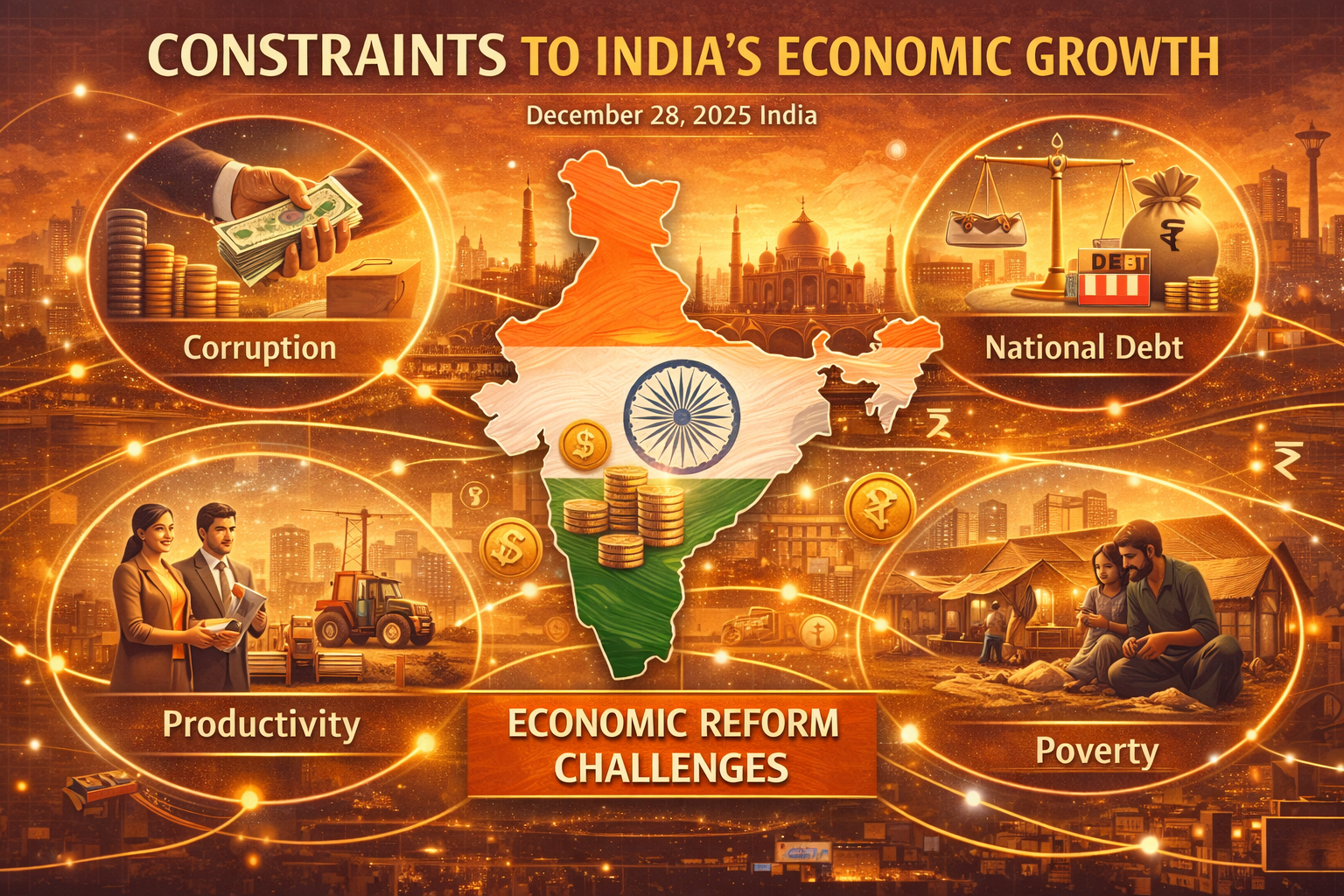
The Economic Reform Plan should address key economic challenges faced by India that require further study to develop remedial solutions. Without an effective plan, India would underutilise its resources or fail to take full advantage of them.
The Economic Reform Plan needs to be administered by an institution with a vested responsibility to improve India’s economic position on the global stage. Such planning requires documented, timely progress in accordance with a constructive timeline.
Corruption Eradication Plan
One of the biggest constraints that hinders domestic growth to the next level is corruption within its system. Corruption deters economic advancement for a broader group of people who may have credentials and the willingness to contribute to the economy, but are restrained either because their consciences prevent them from participating in corruption or because they are not financially stable enough to engage in it.
To eradicate corruption in its entirety, the government needs to implement tougher legislation to combat it from top to bottom across public institutions. Legislation on its own will not drive out corruption; rather, effective procedures and processes must be mandatory components of a broader Corruption Eradication Plan. Surveillance 24/7 must form an integral part of the plan.
For example, implementing legislation prohibiting enforcement officers from engaging in corruption will not deter officers from committing such offences. In fact, the officers will devise their own system to avoid being caught in the act, but nothing would deter them from engaging in corruption.
However, if the enforcement officers on duty are made to wear a body cam (camera), that would immediately change behaviours towards achieving the desired outcome. Similarly, in a government institution where corruption is presumably high, implementing internal compliance protocols as part of anti-corruption procedures would reduce or deter public staff from engaging in corruption.
India could benefit from the experience of other developed nations with robust anti-corruption legislation, processes, procedures, and surveillance systems to counter corruption.
Whilst achieving 100% elimination of corruption is highly unlikely, even in a highly legislated and regulated nation, achieving maximum control is a progressive step forward than leaving corruption to run its course.
India could engage foreign institutions and agencies that are proficient in delivering anti-corruption culture. One such country India can resort to is Australia, which is known to operate its legal system with a high level of transparency, utilising surveillance to promote visibility of wrongdoing and punishing those involved in an act of corruption within the confines of law and order.
Such orderly, structured procedures and processes, along with intensive surveillance, deter most who would otherwise commit such an undesirable act of lawlessness. In such an environment, people can conduct their daily affairs and engage in economic activity without fear of corruption that would work against them.
Established businesses or professionals of high rank, unlike in a highly corrupt environment, will not be able to, through their influence or power, discourage people from taking up roles or setting up businesses that create direct competition to them.
Creating an anti-corruption environment fosters new business establishments. More businesses create competition, driving efficiency and prosperity. New businesses create employment opportunities, and as more people take up employment, aggregate savings and consumption increase, leading to new growth cycles.
Anti-corruption environments are attractive to foreign investors as they would value a sophisticated legal system and a demonstration of absolute professionalism, trust, honesty, and a law-abiding nation. High-net-worth investors value such credentials when seeking options in the global market.
Productivity Growth Plan
The Productivity Growth Plan should serve as a centerpiece and be integrated into a comprehensive Economic Reform Plan.
Bureaucratic red tape needs to be simplified, especially for large-scale project development. Large-scale project developers are generally required to navigate bureaucratic hurdles to secure project approvals. The complex processes and time required to finalise project approvals cost the economy, as delayed project development carries high opportunity costs for the nation’s economic advancement.
In-depth studies must be conducted to shorten the timeline for large-scale project development and streamline processes and procedures, enabling project developers to contribute to the development of new complexes to meet growing housing demand.
Regional/Rural Development
Developments in underdeveloped rural areas are central to increasing productivity. An initiative aimed at rural development paves the way to increase employment rates in these areas.
Rural development policies must include:
- Development of modern towns through large-scale redevelopment projects.
- Infrastructure development to connect rural areas to cities.
- Construction of modern amenities.
- Create employment in the region by encouraging domestic private investments.
- Provide incentives for foreign investors to set up businesses in redeveloped rural areas.
Law enforcement agencies must have upgraded protocols to provide business investors in the region with a sense of security and demonstrate law and order for public safety.
Tax reforms must offer tax breaks to businesses that set up operations in this redeveloped region to serve as an attraction.
As new businesses open in the region, local jobs will be created, increasing productivity. The government’s revenue will increase as new businesses and the unemployed join the workforce. Consumption will increase, motivating private investments in rural/regional areas.
The government should offer full tuition for those living below the poverty line to upgrade their skills and become job-ready in in-demand professions. People living below the poverty line will have the opportunity to upgrade their skills and find employment opportunities. The living standards of people living in rural areas will significantly improve.
Social problems in these areas will decline as more people join the workforce and become fully engaged in advancing their lives. These reforms will reduce the government’s social welfare burden and increase revenue for the gradual, sustained redevelopment of rural areas, thereby uplifting the living standards of the rural population.
The growth rate in this region will contribute to the country’s overall growth and advance its global economic position.
National Debt Position
India faces a unique challenge among advanced nations: rising national debt threatens to undermine economic reform efforts. Prioritizing debt reduction is essential for sustaining growth.
Fiscal policies must be formulated to drive government revenue whilst scrutinising outlays that add value to the country’s economic position.
For example, a rural regional development plan will require the government’s investments in infrastructure and other development-related costs. However, as the redeveloped rural economy takes shape, the government will earn revenue from property sales transactions, employer and employee taxes, and sales taxes.
One of the government’s core focuses will be to attract foreign investors to rural redevelopment areas by offering incentives, such as reduced taxes. Strategies should be aimed at attracting industries with a stable future. This will ensure that those employed remain employed in stable industries rather than volatile industries prone to AI and robotic technology disruptions. This also solidifies the government’s position on generating stable tax revenue from this region.
There must be a ceiling introduced for the national debt balance, for example, USD3 trillion. This prohibits reckless spending behaviour, and officials responsible for approving expenditure must demonstrate their value add in explicit reports.
At the same time, revenues must be managed and funds allocated to reduce the national debt balance. Increases in the national debt are generally ignored, or the increments are not given much emphasis.
There must be public awareness of the national debt to increase accountability and consequences for misusing funds. The public must be given access to national debt information to increase transparency in government operations.
If national debt continues to fuel growth unchecked, India’s economy will face long-term strain. Transparent fiscal management is crucial, as public scrutiny motivates officials to be diligent.
To reciprocate the efforts of excellence in the management of financial affairs, officials must be equally rewarded when innovative methodologies are applied to financial affairs that benefit the country. For example, if a senior treasury official implements a fiscal strategy that generates funds to reduce national debt by 20%, this must not go unnoticed. This will set a precedent for officials to explore innovative ways to generate revenue, which will be utilised to substantially reduce national debt.
Effectiveness of Fiscal Policy
Fiscal policies shape economic futures: strong policies drive growth, while weak policies risk severe downturns.
The fiscal stimulus package should be directed at generating maximum economic benefit and aimed at a sector, industry, or class of people that maximizes the return. It is important to note that funds are limited and therefore cannot be spent on experimenting with economic returns.
In India, the middle class is growing faster; they are workers who earn a weekly wage, spend, and save. Policies should be directed at increasing the economic returns for this class of people, as they are actively exploring ways to raise their standard of living. If the policies fail this group that constitutes an economic driver, it suffers from deficits.
Additionally, directing policies to a growing group will generate higher revenue than directing them to a smaller group.
Eradication of Poverty
In this modern era, having earned 4th place in the global league table of top economies, India must place emphasis on improving the living standards of people still living below the poverty line.
The policy formulation should seek to provide fiscal stimulus to eradicate people stuck in poverty by upgrading their skills, providing education that emphasizes the importance of valuing their time, and explaining how they can contribute to India’s growth plan.
For example, if a person lives well under the poverty line, he/she would be under immense financial pressure. His/her life will entail struggling to make ends meet. If he/she is given an opportunity to upgrade his/her skills and secure a fixed job in the manufacturing sector, he/she could use the earnings to improve their family’s lifestyle, send the kids to school, save funds for a house deposit, and so on.
Similarly, stimuli such as tax breaks offered to employers to incentivise them to hire employees and provide on-the-job training to people living either below or on the poverty line should form part of strategic plan.
These initiatives will significantly reduce the number of people living in poverty in slum areas. Active campaigns and one-on-one coaching sponsored by the government will not only change the lives of the people living below the poverty line, but they will also reduce social issues such as crimes and mental health issues for this group.
With proper coaching, these people will become an asset to the government, paying taxes on their earnings and contributing to economic activities.
The government should offer grants to people in this group as they upskill and enter full-time employment, assisting them with grants to contribute towards deposits for purchasing their primary residence.
Similar policies will motivate others living below the poverty line to use their time constructively and accept offers to improve their living standards.
This remains an area where much progress can be made, which in due course will add value to India’s economic position.
If I work off a modest figure, which is highly incorrect, of just 20 million people across India living in poverty, assume these 20 million people get an upgraded lifestyle and start to work full-time.
What would the tax revenue and economic transactions be for this huge number of people?
Not everyone in this 20 million will work; some are elderly and kids. However, one or two people working in a family unit will suffice to generate significant economic activity, as this group moves from the poverty line to the middle class as their earnings gradually increase.
They would allocate income to consumption and savings, with the savings portion used for future investments.
The government will collect taxes on property acquisition, on employee earnings, and on other revenues, such as sales tax.
India has vast room for improvement and earnings potential with the right policies and strategies.
International Trade
Recent US tariff tensions have created unwarranted upheavals worldwide. It is a signal for high-volume manufacturing countries to consider opening new markets for their supplies.
India should work with other potential trading partners to strike deals that allow Indian manufacturers to trade with newer countries.
Contingent plans should focus on shifting away from the US as a major trading partner, thereby diversifying trade risks across a wider set of countries. It will also be beneficial for domestic manufacturers to spread risk across new countries.
Consideration should be given to reciprocal trade opportunities. Opening markets for domestically manufactured goods with countries from which Indian businesses or governments buy goods and services. Such policies will strengthen bilateral trade and relations, creating a solid foundation for the future.
New export market opportunities are crucial to India’s economic advancement if it wishes to secure higher foreign exchange earnings.
International trade studies conducted by the government should examine key aspects, including the extent of India’s influence, the benefits of trading with India for the partner country, the market size, the political risks involved, and the projected revenue to be generated from trading with this country.
If India wants to expedite its economic growth, expanding its international trading partners will be an important element in achieving that goal.
Service exports have been a major source of revenue for India. Taking advantage of its Information Technology and Software exports, India must focus on inbound international students. This is an underperforming area with significant growth potential. Revenue from inbound international students could become an attractive economic driver; this is an untapped area requiring further structured investigation.
Therefore, it is highly recommended that India undertake comprehensive work to increase its inbound international student numbers. This is a lucrative market widely enjoyed by the US, Canada, and Australia.
Scope for India
India has economic challenges that demand comprehensive studies as part of the Economic Reform Plan. Each of those challenges requires independent in-depth investigations. The final findings or solutions must be communicated to the public so that they are engaged if officials are to derive tangible projected outcomes.
Each of those challenges could be turned into economic advantages, generating economic benefits and increasing government revenues.
If India is to take an economic progression approach and move up the ladder from the 4th-largest economy to possibly reach 2nd place, it needs to review its economic challenges.
However, the order in which those economic challenges are to be addressed must ensure that solutions to challenge A create a flow on benefits and do not create issues in other key economic areas.
For example, rather than placing excessive emphasis on attracting foreign investors, the government should first work to eradicate corruption. Foreign investors are largely interested in investing in countries that manage corruption to the lowest possible level.
Likewise, eradicating poverty or significantly reducing the number of people living below the poverty line will generate benefits across many sectors of the economy. This requires not just fiscal stimulus, but also a track record of improvements, with invested funds accounted for in this policy.
Data must be collected and reported through a real-time platform to ensure high-visibility progress outcomes. Officials must be held accountable for their actions, and this can be achieved through real-time public access.
Hidden agendas must become a practice of the past for sound economic progress, hidden agendas generates regressions.
Public engagement and involvement in key economic initiatives will yield high tangible outcomes.
Real-time data and the public’s ability to provide feedback on the government’s actions will encourage Indian citizens to remain committed to the government’s action plan. This is crucial is the government wants to maximise policy outcome.
Public contributions will enable faster growth and expansion of the Indian economy. If the public is made aware of the government’s economic plans, public support will yield better outcomes than expected.
For example, India had taken the initiative to keep public places clean. The public offered exceptionally strong support for this cause because it resonated with them. People took to streets as part of active Clean India campaign, a true demonstration of public’s engagement in a course that advances India’s position.
India has the largest population, with a larger number of people in the working-age group.
Compared to other nations, this is an economic advantage for India. Therefore, utilising technology to engage with its people will yield a highly progressive economic position.
Resources should be deployed to generate higher returns for these working-class people by offering modern infrastructure that encourages private investment. Effective fiscal policy should reduce unemployment, especially for those living in poverty.
Transparency in government affairs will reduce confusion between the people and their representatives. If people trust their government and see material progress in addressing key economic challenges, they will support policies that address their common and mutual needs.
Without the support of its people, India will suffer from poor policy outcomes, creating more social burden on its system.
In our professional opinion, India has the resources to achieve the status of a world number 3, 2, or even 1 economy, with a stable, democratically elected government operating with absolute transparency, especially by making available data for public viewing on essential areas such as the real-time national debt balance.
India 2050
As India has the largest working-class population, polices must be directed at maintaining consistent birth rates. India is projected to remain a highly advanced nation if it focuses on its labour market and works on its key economic challenges.
An ageing population is negatively impacting most advanced economies today.
As India has the highest proportion of working-class people, many of them will reach retirement age in the next few decades. If the birth rate continues to decline, the Indian economy will suffer sharply.
Overall, our assessment of the Indian economy indicates significant opportunities for future economic growth. Whilst an ageing population is adding a cost burden to most advanced economies, India has a sizeable workforce to its advantage