
Introduction
Fiji, a small island nation in the South Pacific about 3250 miles from Sydney, Australia, has experienced significant challenges to its economic growth, particularly following military coups since 1987 that caused significant economic harm and emigration.
The economic landscape has been further eroded by a combination of a lack of high-skilled professionals leaving the country for better prospects overseas and ineffective policies.
Impediments to a harmonious legislative framework persistently obstruct Fiji’s economic growth, leading to policy failures.
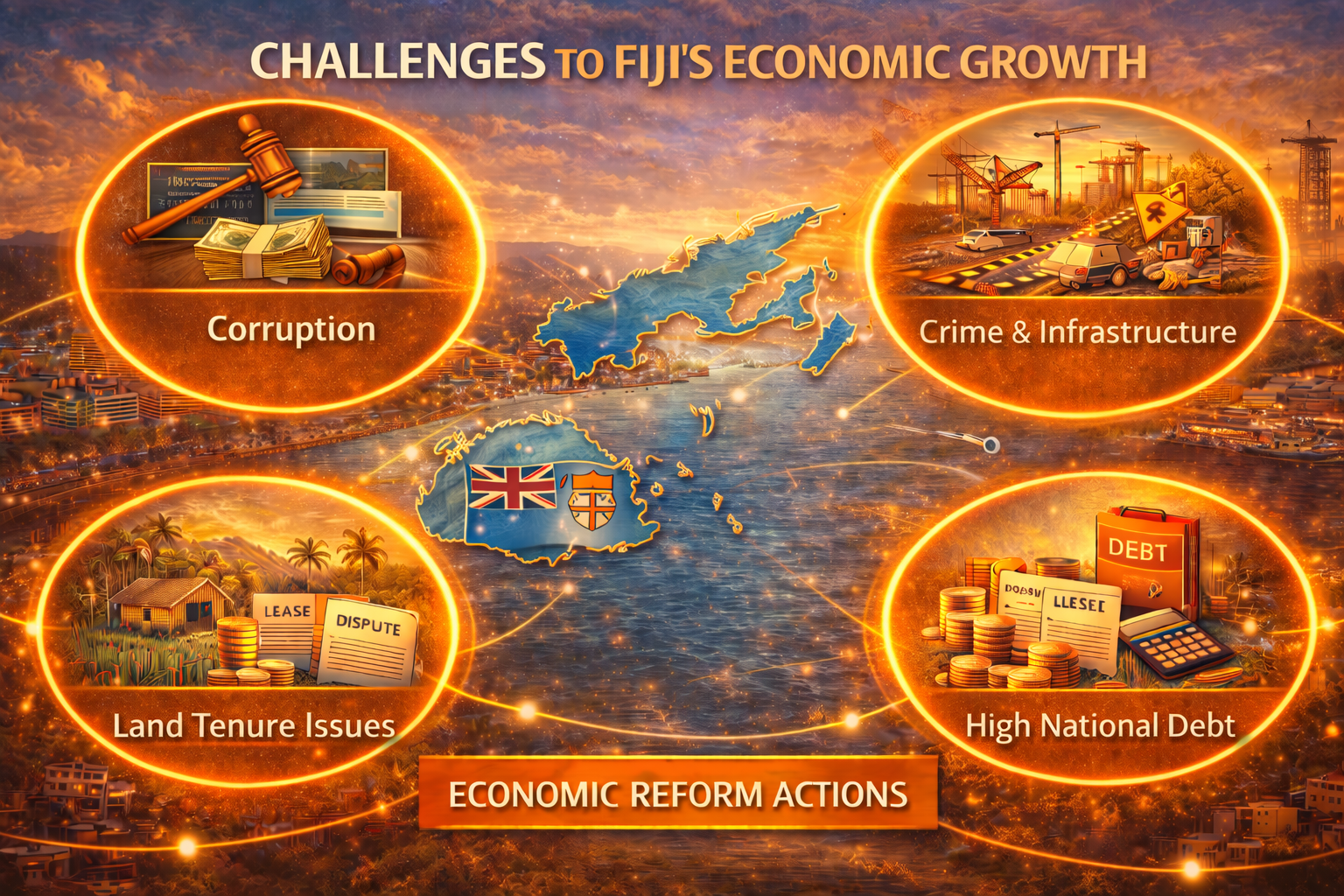
A resource-rich country with high economic growth potential has also suffered from rising crime rates, a lack of digital and information infrastructure to support emerging industries, deteriorating physical infrastructure, land tenure issues, and a large national debt.
To drive economic growth, the Fiji government must acknowledge its incumbency and urgently formulate and implement a legislative framework that addresses domestic challenges and enables effective expansionary policies.
The following core recommendations are essential for creating a pathway for economic growth:
- Design a solution-driven, harmonious legislative and compliance framework specifically targeting critical economic barriers to growth,
- Tackle major domestic constraints impeding growth, such as land tenure, infrastructure, and corruption, and implement targeted reforms,
- Develop policies that actively foster growth, incentivize investment, and ensure better economic outcomes for all stakeholders.
Each recommendation should be actionable and measurable to achieve tangible progress.
The introduction of robust data-capture platforms should include clearly articulated protocols for data collection and reporting, primarily with a focus on transparency in public administration.
Additionally, a unified legal system should be established specifically targeting anti-corruption measures.
Public officials should be appointed solely through transparent, merit-based selection processes.
Institutions similar to a corruption watchdog should be formally constituted with explicit mandates to investigate and report each and every corruption case.
As part of a stringent regulatory compliance framework, a comprehensive real-time data-capture, monitoring, and reporting system should be implemented to track and deter corruption, and standards for promoting honesty, integrity, and public trust should be defined and enforced across all public institutions.
To enhance productivity in public administration, productivity measurement frameworks implemented for proactive regular evaluation of key performance indicators should be mandated as standard operational practice.
These strategies should be regularly evaluated to ensure significant improvements in performance and accountability, with measurable outcomes for all reforms.
To attract foreign investment and generate employment, Fiji should pursue legal reforms focused on:
- Strengthening the rule of law,
- Ensuring anti-corruption enforcement, and
- Providing clear policy incentives for investors. Policies must explicitly promote a transparent regulatory environment that supports consistent economic growth.
Economic Constraint Impeding Growth
Land Tenure Problems
A major economic constraint faced by Fiji is largely an issue of land ownership and land-leasing contractual agreements, which create complex disagreements and disputes between landowners and tenants and lack a coherent system to restore confidence in farming operations.
In Fiji, the vast majority of land is owned by native landowners, administered by the iTaukei Land Trust Board. The primary role of this institution is to safeguard landowners’ interests, with no consideration given to maximising economic returns for either stakeholder.
For example, tenants are reluctant to invest in high-income generating land development projects due to uncertainty about the outcome of the lease expiry decision.
Disputes arising from fair and equitable compensation for developments on lease expiry act as a major deterrent to undertaking feasible investment-intensive, high-return-generating developments during the land tenure period.
Such irregularities and ineffectiveness of land management tend to undermine productivity and promote the underdevelopment of viable, potentially, high-revenue-generating land use.
Enforcement Agency Ineffectiveness Amidst Rising Crime Rate
Crime rates are accelerating at a faster rate, requiring authorities to stretch resources to uncover crimes originating from domestic and international sources.
Domestic crimes have in recent years somewhat evolved from domestic violence, theft, and robbery to illegal substance trade and consumption.
Although justice prevails, the rising crime rate is largely undetected, and the rapidly increasing availability of illicit substances in black market settings endangers Fiji’s future.
The onset of the illicit substance trade and the easy availability of the substance are a serious threat to the future of Fiji, as the rise in the consumption of the substance is seen in younger generations and the elderly.
Immediate concerns for the authorities would not just be the increase in crime, but a strain on the future of the public health system, as consumption of illicit substances leads to lifelong health crises.
If these issues are not addressed by an effective legislative framework, the future economic position of Fiji will be threatened by a decline in quality of life and economic prosperity.
Public health crisis following the rising crime rate inflicted by a continuous increase in illicit drug trade, and consumption will foreshadow the economic growth of Fiji.
While not visible, corruption certainly undermines the benefits of a good working environment. A public administration system can operate efficiently only if its staff and management work ethically in a transparent working environment.
Public administrations’ primary role is to serve the people across various operating settings, such as healthcare, education, and law and order. A system breakdown occurs when corruption prevails, undermining public trust in the system.
People receive poor-quality services, or services provided fail to meet their needs.
Tackling such immoral issues is difficult, given that their presence is unseen, and most victims of corruption or those aware of it intend to stay away, as they see no sense in reporting such demeaning actions.
A cost cannot be quantified for the victims, given that there are no protocols for data capture that account for the possibility of system breakdown.
It is the government’s responsibility to implement processes and procedures and to take bold action to introduce effective compliance frameworks to scrutinise and appropriately resolve such issues.
Lacking Essential Infrastructure
An undeveloped digital and information infrastructure and deteriorating physical infrastructure hinder economic growth.
Business investments decline as physical infrastructure deteriorates, discouraging local and foreign investors from viable business investments.
Fiji has failed to keep up with road maintenance and the development of new highway routes connecting towns and cities, reducing travel times.
Inadequate infrastructure that fails to support growth hinders new industrial and emerging technological business investors from either setting up new ventures or scaling existing operations.
Lacking utilities upgrades, such as power grids and water supply, further constrains Fiji’s ability to take advantage of emerging businesses in technological sectors.
In the absence of high-speed internet connectivity, particularly a fiber-optic network, and 5G support for large-scale, emerging technologically intensive business operations such as data centres, highly lucrative international businesses are discouraged from setting up operations in Fiji.
Fiji critically fails in environmental management, particularly in flood management, especially in towns with high economic growth potential.
Balance of National Debt
Fiji’s national debt position is relatively high, requiring a decade to bring the national account into surplus, provided the balance does not further balloon.
However, an increased level of debt requires funding to service the national debt and repay the balance down gradually.
The cost of servicing debt drains available funds that could be spent on other essential sectors, such as health and education.
Interest expenses do not add value to the economy; they are a waste of funds.
Poorly designed fiscal policies and irresponsible spending have eroded the government’s financial position, leading to rapidly rising debt and a worsening situation.
The rising national debt balance hinders Fiji’s economic growth by diverting resources to debt servicing.
Economic Growth Reforms
Fair Land Tenure Framework
A fair, decisive, and harmonious land management framework should be established and incorporated into the initial agreement between landowners and tenants.
The documents’ inclusion with the lease agreement should clearly articulate the contractual term of the lease, the specific uses of the land during the land tenure period, the terms of renewal of the lease, the compensation calculation methodology for developments and improvements to land where the lease will intended not be renewed by the landowner, or where the tenant does not seek to land lease renewal.
Equitable rent calculation methodology to form part of the inclusions documents, which promote fair rentals to landowners and restore a balance between the landowners and the tenants. A fair rental scheme will encourage landowners to continue offering land leases, enabling maximum land use by tenants backed by a standardised legal foundation.
A special court specialising in land-related disputes should be established to manage disputes between the landowners and the tenants in a cost-effective and timely manner.
The land and tenancy governing legislatures and policies should be administered by this court, with simplified processes for either party to present their case, with or without legal representation. This will cut red tape and give tenants a structured platform to expedite compensation claims, without the need for costly legal dispute resolution.
Such an institution will instill trust and integrity in the land management sphere, encouraging tenants to adopt optimal land development and land use strategies.
The tenants will be clear about the possible outcomes of lease renewal, the probable compensation if the lease is not renewed, and the methodologies used in compensation calculations. Proactively implementing a systematic approach will provide a basis for both landowners and tenants to maintain a cohesive record-keeping system and produce documents to the court if there is a dispute.
The explicitness of the inclusion documents outlining the terms of the lease agreement will avoid disputes, encourage maximum land use, and provide quick, cost-effective, and seamless resolution of conflicts, thereby promoting land use for high-revenue-generating projects.
Organic Products
Government intervention focused on helping farmers produce high-quality organic products could open international trade opportunities for local entrepreneurs.
A welcoming proposition for proponents considering economic advancement will ideally encourage farmers to continue investing in high-value, feasible projects.
Foreign income is an essential component of economic advancement in a highly interconnected world, and Fiji should actively pursue projects that generate it.
Positioning as an organic producer of agricultural products, specifically high-demand vegetables, meat, and poultry products in the international market, will generate high-end revenue for the local farming sector.
Fiji has an abundance of organic fields, grazing land for pastoral-scale developments, and farmland with an accessible water supply. Water irrigation systems are readily available to support large-scale, export-oriented organic farming while adhering to environmental sustainability.
Producers should adopt modern farming tools and strategies aligned to minimise costs and maintain high-quality products, thereby ensuring that product pricing remains highly competitive in the international market.
Opportunities should be offered to foreign businesses with the resources to set up processing plants in Fiji to process vegetables, meat, and poultry for sale in international markets, meeting international production standards.
Local farmers could get their products, such as vegetables and raw meats, further processed into canned vegetables or processed meat products for export to offshore markets.
The Fiji government should actively conduct high-level negotiations to secure better trading terms with foreign governments and proactively form trading partnerships for its primary products, thereby opening new offshore markets.
The benefits of rapidly increasing offshore trading will lead to higher land rents for landowners and higher returns for tenants from product sales, creating new employment and entrepreneurial opportunities.
An increase in economic activity will lead to the government generating higher tax revenue.
Strengthening the Enforcement Agency to Deal with Escalating Crime
Overshadowing the rising crime rate, strengthening the enforcement agency is a competing issue for the government to address alongside investing in other sectors.
The time-driven demand calls for the establishment of a new institution with the powers to conduct high-level high-surveillance and law enforcement, thereby eradicating illicit substance-related crime in Fiji.
Result-oriented task force with special judicially authorized powers backed by a legislative framework to handle local and internationally originated illicit-substance related crime, working with and alongside international enforcement agencies.
A total clean-up of the illegal trade market will bring stability to the nation and promote a healthy lifestyle and long-term economic prosperity.
The nation’s governing body must intervene with a priority agenda to undertake rigorous work, in coordination with the enforcement agency and the special task force, to achieve the desired mutual outcome.
The judicial system is strongly recommended to impose heightened penalties to deter new entrants into trade or the consumption of illegal substances.
Despite being a small island nation, Fiji is vulnerable to international opportunists, who see Fiji as an easy gateway to dump highly dangerous illicit substances.
Additionally, Fiji should seek assistance from highly skilled enforcement agencies in overseas countries, such as the US, Australia, and New Zealand, to monitor international ships entering Fiji’s waters.
Coordinated efforts at the international level will strengthen surveillance, as these offshore enforcement agencies have advanced technological systems and know-how to disrupt highly organised crimes.
If Fiji is to make material progress and keep its shores safe from illicit substance trade, it’s time to act now rather than delay high-level enforcement and incur irreversible damage to the nation.
At the same time, the government should focus on tackling domestic crime rates to restore law and order in the country. Repeat offenders should be provided with appropriate assistance, while increasing punishments should deter people from committing crimes.
Further, if the country is to prosper and achieve high-level economic growth, the government’s intervention to address this disastrous problem requires an immediate, remedial, actionable plan.
The economic reform package must focus on eradicating crime related to illicit trade rather than on managing and reducing crime.
Effective Governance on Corruption
Corruption, while not widely known, is largely undetected, giving perpetrators the advantage of carrying out their actions.
Good government services intended for the public don’t reach their rightful recipient in their intended manner.
Public services are delivered through public institutions and are intended to provide necessary services to the general public. However, where corruption is prevalent in the public administration system, the services may not be delivered as intended in the normal course of public administration.
A simple yet powerful strategic compliance plan should be established, and within this compliance framework, post-implementations should allow the public to air their concerns about poor services or acts of corruption through a standard reporting protocol, either by email, text message, or traditional letter writing, to a special officer authorized to address such anomalies.
Identification of such unacceptable behaviour should be made public and recorded in a register, such as a name-and-shame register. Creation of such a publicly accessible register will deter those who are corrupt or intend to act corruptly, instead encouraging ethical conduct and upholding a high level of public administration integrity.
In addition to publicly naming and shaming, a severe penalty and punishment should follow after intensive review, while compensating those affected.
Trust in public administration and the workings of government is a benchmark for service delivery to its people.
Key performance indicators and service-level agreements must be introduced to public administration staff, along with training to promote efficiency, higher performance standards, and productivity across the administration offices.
Recording and reviewing daily performance, promoting regular staff and management engagements, and having productivity-related discussions to raise the standard of service delivery and introduce cost-effectiveness in the public administration system.
For the nation to experience long-term economic stability and growth, the government must offer transparency and assurance of goodwill to its people, regardless of race, culture, and religious belief.
Where there is a disconnection between the people and the government, policies and legislation will not achieve the desired outcomes.
Effective governance requires transparent operations in the normal course of service delivery, and those who engage in unprofessional conduct must be swiftly identified and removed from the office.
Fiji should consider adopting such professional standards and promoting its staff to uphold ethical standards across all its public administration offices and in the delivery of services.
Infrastructure Upgrades
Sound infrastructure is essential to attract new business investments and scale existing business operations. Foreign investors focus on sound infrastructure in selecting offshore countries to set up feasible business operations.
The economic reform package should place heavy emphasis on physical infrastructure, digital and information infrastructure upgrades, and the development of effective environmental management policies to address flooding, especially in towns and cities.
Foreign investments in health, education, agriculture, manufacturing, the technology sector, and service-oriented business will support Fiji’s growth, with a focus on attracting skilled migrants through new visa schemes.
Emerging technologies require highly skilled professionals in data science and information technology, as advances in machine learning and artificial intelligence continue. Such industries should be a focus of government policies if Fiji is to achieve economic growth.
The government should consider partnering with international businesses that have experience and resources to develop highways and freeways connecting faster routes between towns and cities.
Road maintenance to address major damage is already part of the government’s fiscal policy; the work must be managed cost-effectively to expedite repairs.
Likewise, partnering with experienced, knowledgeable, and highly-resourced foreign firms to upgrade power grids, water supply systems, and high-speed internet connectivity to facilitate technology-oriented businesses, primarily targeting data centre operators and emerging artificial intelligence businesses.
Undertaking land planning and rezoning to enable the structural development of new homes for a projected highly skilled migrant workforce will further generate higher tax revenue from land rezoning, land sales, and construction-related activities in the future.
The government should acknowledge that, by its own means and resources, it cannot create opportunities for high-level economic growth on a scale that would reshape Fiji’s economy.
Managing National Debt Balance
Managing the national debt balance requires structured changes to the management of the national account and the annual budget preparation.
Policies aimed at reducing national debt should be a top government priority, while ensuring that the balance does not increase substantially to further deteriorate debt and servicing levels.
To avoid a repeat of past economic management failures, a special task force should be appointed with the necessary powers and authority to approve or decline government spending that does not meet the standard benchmarks set by the incoming authority.
Independent of government operations, the sole purpose of this institution must be to focus on responsible government spending, explore the scope for revenue growth, and repay the national debt balance within a pre-set timeframe.
Cost-benefit analysis, feasibility studies, and other advanced modelling tools must be used to assess the effectiveness of policy-driven large-scale government spending.
Appointed officials must take responsibility for their actions and be held accountable, and responsible economic managers must exercise the highest level of professional conduct in carrying out their duties.
Working within the confines of stringent ethical standards, this institution should provide public access to real-time data on the balance of national debt reduction.
Transparency will add a layer of public scrutiny and pressure on officials to adopt a results-driven approach to achieving the desired national debt reduction.
Effective economic management of public finances and responsible spending will drive Fiji to unprecedented economic growth, prosperity, and lasting stability.