
Introduction
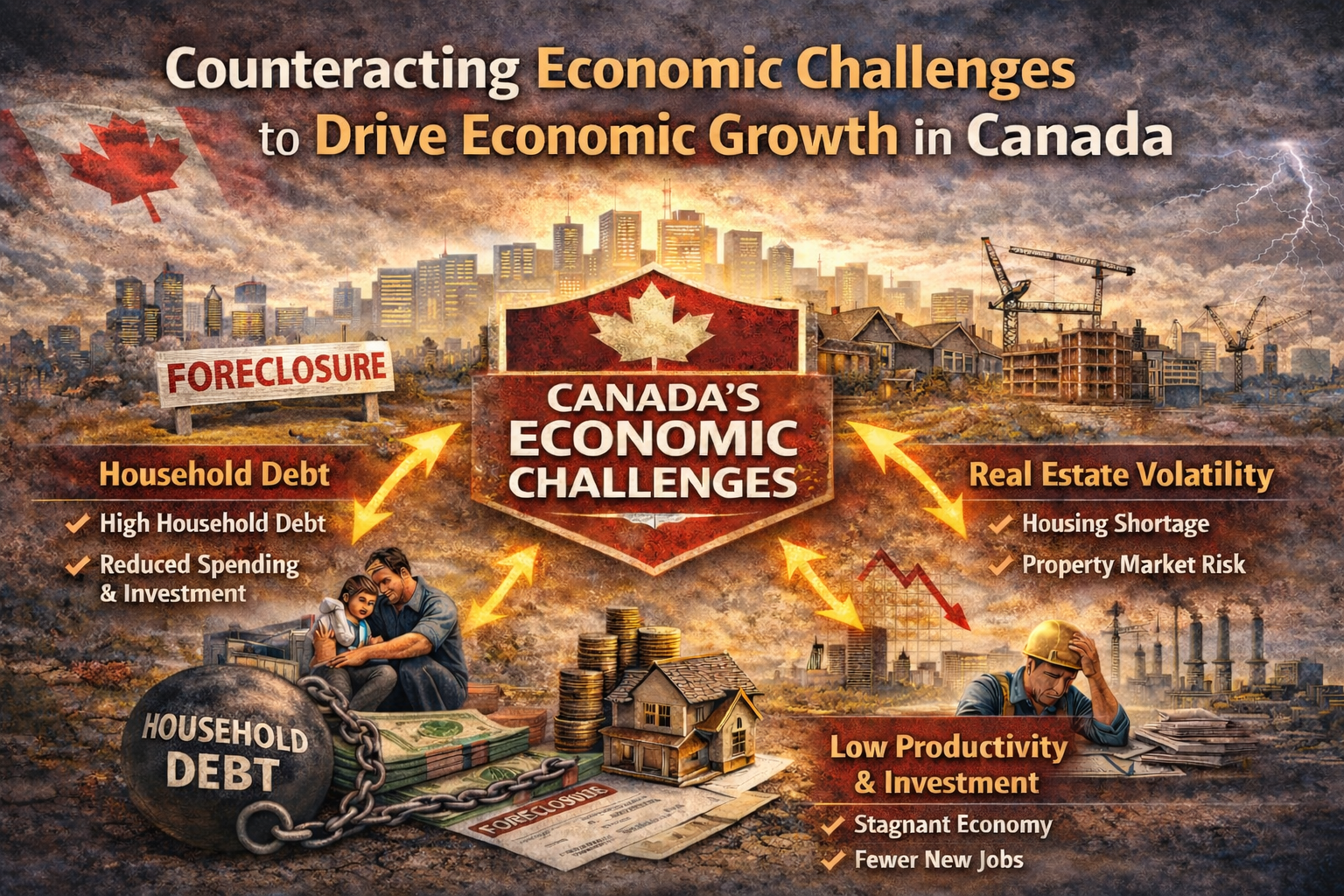
Canada is one of the advanced economic countries. However, unlike other advanced nations, Canada faces economic challenges that affect its growth.
Solution-based strategic economic policies are critically important for managing and implementing remedial measures to address identified challenges and steering the economy towards growth-oriented modelling.
Prolonged delay in devising and implementing result-driven strategic actions will, by and large, cause irreversible economic damage to the Canadian economy.
The strength of the Canadian economy depends on how economic managers and political leaders work together to promptly devise the best solution-oriented course of action.
The time-bound ingenuity of the policies will drive the Canadian economy to the next progressive level of growth seamlessly.
While there are apparent economic problems requiring immediate remedial planning and solution, the future poses far greater challenges that, although not yet readily apparent, will further drain resources from the Canadian economy.
Proactiveness in addressing identified economic issues requires active commitment and participation in a highly structured policy planning environment.
Apparent Economic Challenges
Household Debt
High levels of debt heavily weigh down on current consumption and savings, including the future scope for investments. Prolonged high levels of indebtedness lead to a household cash crunch, which eventually affects the standard and quality of lifestyle.
The economic impact of high levels of debt cannot be easily quantified, and the damage to an individual, family, or community cannot be easily verified with reasonable accuracy.
At an aggregate macroeconomic level, consumer spending behaviour, however, reveals the economic distress arising from the direct effect of high levels of debt.
Individuals and families with high debt are vulnerable to further economic shocks and face a high risk of social welfare challenges if household expenditure rises marginally.
In such a situation, the government faces a high probability of a rise in demand for urgent public service assistance, such as a law enforcement intervention to prevent physical harm to a family member. This is a cost to the government resulting from the mishandling of a well-known economic problem. Essential public resources are diverted to contain an escalation of the problem, which could have been prevented by addressing the economic issues that lead to family crises.
For example, when families live on a constrained budget, even a small increase in daily expenses can trigger a life-threatening domestic dispute. The level of risks associated with a series of domestic disputes increases, especially when children are involved, which requires government agencies to provide immediate critical services to offer relief and restore safety.
Government agencies are left to address domestic issues through a series of actions and standard processes that further add to the mounting cost of ongoing assistance required for those involved in the situation.
Real Estate Volatility
The housing market remains highly volatile, posing a risk of a property market crash.
Property valuation and debt ratios are somewhat concerning, especially where property values are overvalued.
Economic shocks that directly affect property valuation could lead to substantial value adjustments, signalling a potential crisis for the overall Canadian economy.
Banks lending against higher property values in the past will result in an increase in the loan-to-value ratio than the initially recorded value. The problem will deepen, especially when the loan amount exceeds the property’s adjusted value and borrowers default on those debts. The lender will be exposed to a costly debt-recourse process, leading to property foreclosures and, inevitably, the sale of repossessed properties in a depressed market at a loss.
Accumulating a large, debt-balanced position, the combined Canadian lenders could result in millions of dollars in debt being written off, negatively impacting the overall economy.
The housing crisis is further deepened by a shortage of housing relative to demand.
This housing shortage increases the risk of further house price rises in an already inflated housing market, eroding housing affordability.
Interest rate rises can further exacerbate households’ cash crunch, especially those facing rising cost-of-living pressures or unexpected shocks such as surging fuel prices due to the war in the Middle East.
Added to the problem are the hurdles to constructing new residential dwellings at a constant pace to meet increasing housing demand.
Canada lacks federal or provincial regulations to support a national framework and facilitate coordinated interventions to increase the housing stock.
Productivity and Investment
The Canadian economy is experiencing persistent low business investment. The low business investment poses a significant threat to economic growth.
A lack of business investment persistently impacts employment, as demand for labour diminishes over time, thereby reducing the quality of life and overall standards of living.
The much-needed, urgent government intervention to promote business investment, supported by creating a competitive market, is lacking at the federal and provincial levels. The government’s failure to act promptly derails future economic prosperity, instead increasing the burden on the government to address future social problems.
Lower productivity drives the economy into the future, leading to deteriorating work and long-term living standards.
Workers are demotivated and disengaged, which contributes to a lower standard of output. They are frustrated because they lack sufficient training and have lost skills that would enable them to achieve greater efficiency and productivity.
Reduced investments in training and technology adoption lead to ongoing poor employee performance, with inefficiencies persisting and affecting the quality of output.
Persistent low productivity constrains future economic growth and increases unemployment rates, in turn creating social issues for the government.
During a prolonged period of low productivity, the cost of living rises as the cost of goods and services increases faster than employee incomes, further restricting consumer budgets.
Wage growth slows as business profits gradually decline, reflecting low productivity.
The long-term effects of persistent low productivity affect future generations, as economic prosperity declines, exacerbating the situation. The government’s ability to provide quality health and education services are hindered by reduced tax revenue, which further deteriorates public services.
Trade Uncertainty
Trade uncertainty surrounding US tariffs is further impeding Canada’s current and future economic growth.
Trade with the US and Mexico is crucial to Canada’s economy, which is constrained by ongoing US tariff increases, underscoring Canada’s vulnerability to external shocks.
Long-term effects of threats from tariffs or similar shocks from its trading partners will undermine Canada’s growth prospects, leaving it susceptible to external shocks and further weakening its economic position.
The renegotiation of the trade agreement places additional pressure on the government, especially if the outcome of the discussions fails to materialize in Canada’s favour.
Working on Plan B in that case is more feasible, strengthening Canada’s confidence and displaying a stronger negotiation position rather than being placed in a highly dependent and vulnerable state.
Monetary Policy
Canada’s cash rate is relatively low, with less provision to stimulate the economy in a distressed economic situation.
Increases to the cash rate are virtually zero, given the high debt position against elevated house prices, thereby avoiding the risk of a property crash or a potential financial crisis.
Additionally, a weaker economy will not be able to sustain interest rate rises, leading to a further economic downturn that would be disastrous for the Canadian economy.
In such a situation, the monetary policy is almost ineffective in achieving any material positive outcome for the target policy initiative.
Population Constraint
Canada’s rapidly aging population is headed towards imposing a long-term strain on social welfare benefits. To the contrary, tax revenue is on track to decline gradually due to various economic factors, thereby increasing the national debt balance over the longer term.
The rising costs of health care and pension payments will gradually place a heavy burden on the federal government’s budget, requiring higher levels of outlays to meet the aging population’s growing needs.
Unprecedented workforce shrinkage is projected as the aging population continues to grow year over year, contributing to reduced tax revenue and increased government spending, widening the budget deficit.
Other aging-related demands will include rising care costs for the elderly and in-home care, which are expected to increase substantially in the coming years.
Canada is experiencing a decline in non-permanent migration, further implicating policies aimed at boosting tax revenue and increasing the workforce.
A shrinking population, a reduced workforce, and the gradual decrease in tax revenue will collectively lead to an increase in the social welfare problems in the future, placing the government on edge as spending increases.
Remedial Economic Reforms
Strategic Solution Household Debt
Canadian households are seeking urgent reforms to ease the rising cost-of-living burden and burden of debt.
Remedial policies should be directed at easing the consumer cash crunch in the short- to medium-term, while simultaneously prioritizing the advancement of other key economic policy initiatives to stimulate the Canadian economy.
Emphasis should be placed on implementing urgent reforms to address household debt levels, especially where the households are reaching a breaking point.
Potential options to ease cost-of-living pressure include practical measures such as tax breaks, a one-off household cash boost, caps on essential costs, such as energy bills, interest-free federal government loans to support households with constrained budgets, and cash vouchers to help households make ends meet.
Firstly, offering tax breaks to targeted households by applying means-testing eligibility criteria and appropriate revised rates to reduce cost pressure.
Reasonable cash handouts as part of one-off cash boost programs to help those households in urgent need of cash will be a welcome relief.
Providing caps on essential costs, such as energy bills, will offer relief to most families facing rising energy costs.
Interest-free unsecured loans for eligible budget-constrained households to support the families where most assistance is required.
Offering one-off cash vouchers for families, especially with school-aged children, for added relief towards the rising cost of everyday living.
The support package should aim to provide temporary relief to families struggling financially to meet their needs, with the support program aiding them materially.
Real Estate Reforms
High levels of debt need to be addressed strategically, without causing a property market crash or negatively affecting current high-debt borrowers.
A result-driven strategic solution would be to apply regulatory restrictions on both owner-occupied and investment property borrowing by raising the debt servicing ratio for new loan applications as a medium-term measure.
Simultaneously, the government should commit to simplifying and streamlining new dwelling approval processes coordinated across the federal and provincial governments, enabling new residential housing construction to commence as soon as practically possible.
Where rezoning is required, the process should be fast-tracked to enable development projects to commence without delay.
High-rise development approvals should be a top priority to boost new housing supply and meet the increased demand for residential dwellings.
While demand for housing exceeds supply, the government should raise the bar for investor property loans, thereby deterring investor buyers while opening new house stock supply to owner-occupier residential property buyers, as part of the policy reform to reduce the gap between property demand and supply.
An added effective policy to deter investor buyers would be to raise interest rates on investment property loans above those for owner-occupied loans.
Construction of stand-alone dwellings could take up to 6 months or more, in which case, the government should take a proactive step to simplify the processes for new residential construction.
High-rise property development could take 18 to 24 months, depending on the project’s size.
The Canadian government should consider developing high-rise apartments to add new housing in and closer to the city centres, such as Surrey in Vancouver, BC, to support the growing housing demand.
The increase in new-home supply will gradually moderate the much-anticipated rise in property valuations, leading to market corrections in overvalued properties.
Strategies to Support Productivity and Investment
Expansionary fiscal policy targeted to incentivize business investments will stimulate the business sector.
Specific business grants should be made available to the private sector for new employee recruitment, in-house employee training, and the adoption of advanced, innovative technologies, thereby driving business investment.
Additional grants should be made available for businesses that hire a person who has retired and is capable of and willing to work. The grant would facilitate the business’s recruitment and provision for on-the-job training, a scheme that would encourage willing and able retirees to enter the workforce.
A full depreciation write-off up to a specified limit for new business vehicles or equipment purchased in the financial year of purchase would further motivate businesses to replace their existing vehicles or equipment, thereby stimulating economic activity.
Lagging vital business investments, a direct outcome of fiscal policy stimulus, will accelerate economic activity and increase productivity, collectively driving economic growth.
The government should place a high emphasis on businesses contemplating expansion with a minimum additional employee headcount of 100 or more, those businesses that adhere to environmental sustainability, and that adopt advanced technology in AI, Machine Learning, and Data Science.
As part of an expansionary fiscal policy, the government should also consider offering attractive tax incentives to encourage international businesses to open operational centres in Canada.
International Investors
Where Canada has exhausted resources or faces limitations that local Canadian businesses encounter in creating employment to sustain a certain level of tax revenue, the federal government, in close consultation with provincial governments, should consider drafting international investor packages to enhance economic activity.
The trade-offs of offering international investor tax incentives are offset by the increased tax revenue from individuals as more employees secure high-paying professional work.
International investor package for businesses employing more than 100, 200, and 300 employees, with a tax structure that incentivizes businesses to consider Canada as a potential business location; headcounts of 500 and over 1000 to receive a higher tax advantage and added government benefits, including faster business and other business-specific licensure approvals across more than one province.
The package should target specific countries, including, but not limited to, China, India, Europe, and US businesses in manufacturing, technology, and service-oriented sectors, as well as sectors that are inevitably set to boom within the next 3 to 5 years.
Canada should position its economy in high-demand, emerging sectors, particularly in the data centres and EV manufacturing, while focusing on greenhouse gas-intensive industries.
Strategic Solution to Trade Uncertainty
As Canada continues to face trade uncertainty, the future trade ambition should concentrate on opening new trade opportunities with countries other than Mexico and the US as part of a contingency plan.
Preference should be given to factors such as reciprocal trade agreements in both exports and imports, to facilitate the creation of stronger bilateral trade agreements.
Bilateral trade supports better relations with new markets for exports and higher-quality, more competitively priced imports; both types of trade transactions benefit both countries.
As part of its expansionary economic policies, Canada should actively attract and welcome manufacturers of products in demand in its trading partner countries. For example, demand for EV cars is on the rise, a product that will continue to experience high demand in the future.
Alternatively, Canada should also consider expanding its services offshore, including professional services such as legal, engineering, and consulting, which are in high demand.
Other equally viable sectors include the financial services, education services, and IT and communications.
These services are a feasible source of secure, foreign-generated income and new employment creation.
Foreign income is vital for sustainable economic growth and job creation. Canada could consider allowing international financial institutions to open a head office or back-office operations, operating at scale to support job creation and position Canada as a new financial hub.
Effective Monetary Policy
Monetary policy is a highly effective tool for managing the economy. As the current cash rate offers limited scope for incentivizing economic expansion, the Reserve Bank should monitor the economy closely as it recovers with the assistance of the expansionary fiscal policy, paving the way for appropriate rate rises to strengthen its position.
While the Reserve Bank of Canada can use unconventional monetary policies, such as yield targeting or quantitative easing, it is strongly suggested that the bank remain vigilant about the country’s economic performance and allow expansionary fiscal policy as part of the fiscal stance to stimulate the economy.
Fiscal policy will be far more effective, given the current state of the economy, and will generate better economic outcomes.
Policy for Population Sustainability
Immigration policies should align with Canada’s evolving sustainable economic requirements and future feasible growth projections.
A smarter approach would be to design investor immigration policies that enable foreign investors to establish businesses in Canada. For established offshore businesses, the policy should provide incentives for them to open businesses in any province in Canada.
Incentives should focus on emerging industries expected to boom in the next few years and on industries that will generate a high rate of local, Canada-based employment.
Technology-oriented businesses, including those involved in artificial intelligence and machine learning, should be prioritized for expedited application approval.
Policy should target degree-qualified and experienced professionals who can enter Canada as job-ready migrants and contribute to Canada’s economic prosperity in skills-shortage occupations. This policy should also promote young professionals aged 25 to 35 to strengthen Canada’s workforce and fill gaps left by aging retirees by establishing fast-track processing for visa applications.
Immigration policy should aim to diversify migrant intake from a broader range of countries rather than focusing on a handful.
A special class visa should be offered to migrants who can bring wealth to Canada; for example, a degree-qualified person aged 36 with a net worth of CAD500,000 should be able to gain a permanent visa relatively quickly, subject to meeting full visa eligibility criteria.
An employment-related visa for skill-shortage occupations should include additional features that strengthen Canada’s economic position, such as preferential processing times for visa applications. For example, if a medical doctor from Europe with CAD1,000,000 in wealth, aged 40, intends to migrate to Canada, a preferential visa application processing time should be allocated, giving the application priority and a decision turnaround time of 3 months.
To the contrary, if a 40-year-old medical doctor with no assets wants to migrate to Canada, the visa application process could take 6 months.
The immigration department should focus on high-net-worth individuals with professional qualifications and grant priority to their visa applications. Such a visa scheme would generate intense interest amongst wealth professionals worldwide in choosing Canada as their future home.
Immigration policy should be designed not only to address labour shortages but also to attract wealthy applicants seeking a Canadian permanent visa who would contribute more quickly to Canada’s economic advancement and prosperity.
Conclusion
Canada’s economic managers and senior policymakers should cautiously implement progressive, expansionary economic policies. An effective monitoring system is to be implemented to assess policy outcomes that promote economic growth and stability and advance the country towards higher living standards.
The country is well-positioned to achieve unprecedented levels of growth and prosperity with the right mix of practical policy solutions and strategic guidance to navigate through the economic constraints and challenges.