
Introduction
Monetary policy is a powerful tool for the central bank. It is a key mechanism that policymakers and economic stakeholders use to manage and guide a country’s economy. This policy is an essential framework to regulate the money supply. Macroeconomic managers in developed economies, such as Australia, utilise monetary policy to address core challenges such as rising inflation and unemployment.
In recent years, most economies have experienced persistent increases in consumer prices alongside slower economic growth rates, creating a complex environment for policymakers to navigate challenges.
However, the modern-day economies are continually evolving due to the availability of real-time data. Despite its benefits, the use of predictive technology with advanced modelling introduces challenges, such as rapid decision-making pressures and increased complexity, across key sectors as they forecast interest rates. These challenges affect how the wider economy adjusts to market rates.
Transitioning from traditional to modern-day economics requires a modernized monetary policy that serves different segments of the economy with varying degrees of rate settings. Instead of a traditional single-rate approach across all sectors, rate settings should be tailored to different segments of the economy.
This research paper argues that revisions to the monetary policy segment-based rate-setting approach will yield a positive outcome for the entire economy. By focusing on each key segment, tailoring monetary policy rates to target specific economic segments, such as households, businesses, or the financial markets, policymakers can directly stimulate a particular segment by applying specific segment-based rate settings according to its unique requirements.
How Monetary Policy Affects the Key Sectors of the Economy
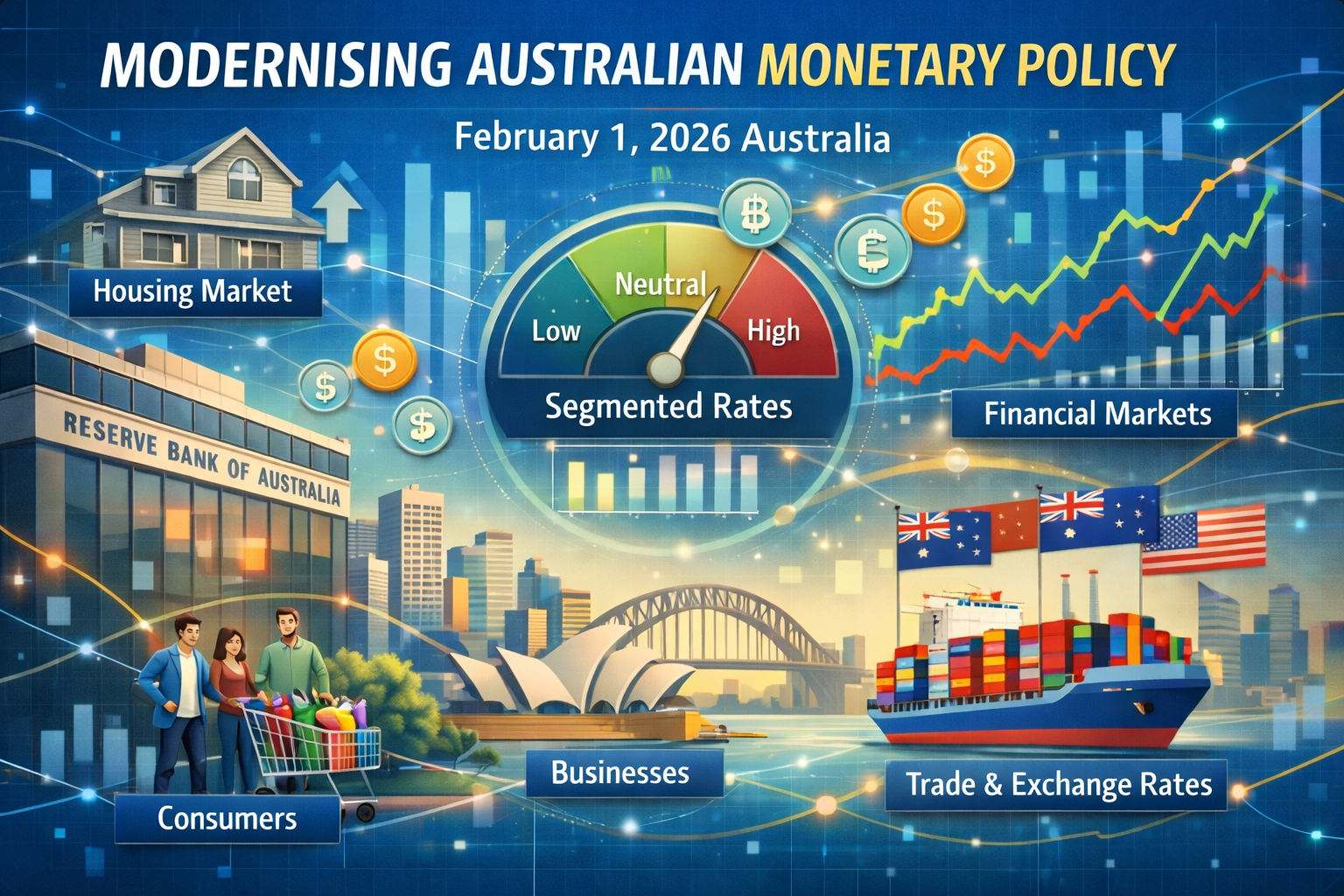
The key areas predominantly affected by monetary policy include consumers, the housing market, exchange rates & trade, businesses, financial markets, and the government.
Monetary policy influences consumer spending and borrowing. The housing market responds to changes in mortgage rates and home buying. Exchange rates & trade fluctuate with currency shifts, impacting imports and exports. Businesses adjust investments and expansion in response to rate settings. The financial market responds to the movement in stock and bond prices. Changes in the cost of public debt affect the government.
Conventional monetary policy interest rate settings affect every key sector of the economy.
However, one or more key sectors may not require monetary policy intervention at a given time; the policy should be sector-focused, targeting sectors with economic imbalances.
Policies should be designed to address the need for rate adjustments in the specific sector rather than to impose a single rate across the entire economy. Applying uniform measures across all sectors indiscriminately creates universal, inefficient blanket interventions.
Consumers
Rising interest rates increase consumers’ mortgage and debt payments, reducing money available for spending and saving.
Consumers would be inclined to reduce spending on non-essential items and discretionary purchases, as their cash position is impacted.
Conversely, when interest rates fall, lower mortgage and debt repayments provide more funds for spending on leisure activities, entertainment, and personal savings.
Lower interest rates make credit more accessible, encouraging consumers to increase spending on durable goods, such as refrigerators, washing machines, and vehicles. Consumers may also invest in real estate, as borrowing for property purchases becomes more affordable.
Housing Market
One of the key areas highly influenced by the monetary policy rate movement is the housing market.
Interest rate settings not only affect the volume of home-buying transactions but also influence property valuation and the sale price. More specifically, when property values increase, rather than selling a property to access funds from property sales proceeds, equity could be accessed through banks, subject to meeting their lending criteria.
Demand for properties increases as borrowing costs decline, fuelling higher property sale transactions. Economic activity picks up as more houses are constructed and sold, leading to increased sales and revenue across services such as real estate, property conveyancing, financing for borrowers, and other services that support the broader economy.
As property demand persists for some time, the economy continues to grow until it triggers higher inflation. As inflation rises, the central bank intervenes to slow the economy by raising interest rates.
And as interest rates rises, so do debt repayments, leaving consumers with less money for non-essential spending.
At some point, the central bank acts to contain rising inflation, property sales slow, and economic activity declines in response to changes in the monetary policy rate.
This clearly demonstrates that effective monetary policy rate settings reshape the direction and health of the economy as desired by the economic managers. It underscores the far-reaching and foundational influence of monetary policy on both the housing market and overall economic stability.
Ultimately, the strong and responsive monetary policy reinforces the foundation for long-term, achieving sustainable economic growth and actively drives stability for a robust economy.
Businesses
Monetary policy rate settings have a significant impact on businesses’ operational costs and new business investments. Higher borrowing costs lead to a decline in business borrowing and, subsequently, to a reduction in business investment.
Rising operational costs prompt companies to explore strategies to reduce costs and offset rising day-to-day operational expenses.
Consequently, the unemployment rate rises as businesses undertake strategic cost-cutting measures, revising the funds allocated to their daily operations and workflow capital, which refers to the working capital funds needed to support routine business processes and short-term obligations.
A rising unemployment rate reduces aggregate demand for goods and services, thereby helping curb downward pressure on the inflation rate.
In contrast, when inflationary pressure eases, interest rates decrease, and businesses are induced to borrow and invest, in turn creating employment opportunities.
Economic activities resume at a faster pace as businesses seek to maximize earnings from higher sales volumes. Demand for goods and services increases, thereby creating opportunities for consistent supply growth.
During this economic cycle, businesses’ earnings rise as consumer demand increases, leading consumers to spend significantly more on goods and services.
The central bank can chart a trajectory for a resilient economy as it navigates challenges affecting specific sectors, rather than relying on a single rate-setting solution for the entire economy.
Exchange Rate & Trade
Currency fluctuations can significantly affect imports and exports. Such fluctuations lead to reshaping the behaviour of domestic producers and consumers. When the domestic currency depreciates, foreign buyers find exports relatively cheaper.
As a result of this depreciation, the prices of imported goods rise, making products relatively more expensive for local consumers.
Consequently, local producers have an opportunity to promote their products more aggressively in the domestic market to boost sales.
Conversely, when the currency strengthens, foreigners must pay more for exports, thereby reducing demand for locally manufactured products abroad. At the same time, local buyers find imports more affordable, intensifying competition for local producers. The shifts in trade dynamics explicitly demonstrate the impact that exchange rates have on producer competitiveness.
A weaker currency boosts exports, reduces imports, and improves the trade balance. A stronger currency reduces exports and increases imports, potentially causing a trade deficit.
Changes in currency strength directly affect global market competitiveness. For example, a weaker Australian currency against the Canadian dollar lowers the prices of Australian-manufactured goods in Canadian markets.
In addition to trade impacts, the cost of production is also affected by exchange rate fluctuations.
Specifically, when the currency is stronger, the cost of goods manufactured in Australia declines, and the prices of imported materials decrease. This situation allows local manufacturers that use imported raw materials to become more competitive in their product pricing.
Taken together, these points demonstrate that, given the influence of exchange rate movements on trade and production costs, economic growth is affected as the prices of domestic and overseas products change, thereby impacting both inflation and unemployment.
Financial Markets
Changes in interest rates directly influence financial markets, altering demand for bonds and stocks and disrupting their functioning.
Conversely, when interest rates fall, new bonds offer lower yields. Thus, the new bond becomes less appealing to investors. As a result, investors often reduce their demand for less appealing, lower-yielding new bonds. However, the value of existing bonds appreciates because their higher fixed interest payments become more attractive relative to newly issued bonds.
Additionally, during periods of declining interest rates, stock prices rise as investors seek opportunities in the market. Investors explore cheaper borrowing options to fund investments in high-yield opportunities such as stocks.
In contrast, when interest rates rise, investors switch their investments to optimise returns. Rising interest rates increase yields on new bonds, thereby depreciating the values of existing bonds.
Subsequently, high interest rates signal a slowing of economic growth. Businesses experience revenue and profit declines and explore cost-cutting strategies to maintain profitability.
Consequently, the unemployment rate rises as businesses implement cost-cutting strategies to reduce operating costs and stay afloat.
As a result, stock markets are negatively affected as the rate rise slows economic activity, diverting investors to other high-yielding options, such as bonds, thereby increasing demand for new bonds.
In summary, understanding the impact of interest rate fluctuations on financial markets is essential to swiftly implement a remedial investment plan and maintain investors’ confidence.
As discussed, changes in interest rates affect the value of stocks and bonds and further influence corporate investor behaviour, and play a key role in determining the broader economic environment.
Recognizing these relationships helps corporate investors and large corporations make informed financial decisions as economic conditions change, in response to interest rate revisions.
Ultimately, monitoring interest rate trends and patterns allows stakeholders to respond proactively and adapt strategies for long-term financial stability and growth.
In conclusion, by staying alert to shifts in monetary policy interest rates and understanding their effects, investors and corporations can navigate financial uncertainties more effectively and prioritize a solution-based approach.
While at the same time, they can capitalize on emerging opportunities as economic conditions evolve. This awareness builds resilience and enhances success regardless of market fluctuations.
Government
The government’s borrowing costs decline, reducing interest payments on its debt when the interest rates is decreased.
Similarly, when interest rates rise, the government’s interest payments on its debt also rise. As expenses go up, the government must find ways to raise revenue to avoid reducing its surplus or increasing its deficit.
If the government is committed to a certain fiscal policy stance—such as spending more on essential sectors, for example education or health, reducing taxes, or raising taxes—higher interest rates will worsen its net balance. The balance is the difference between government revenues and expenditures.
Therefore, it is important to apply monetary policy where it is most effective. This is better than using a single interest rate for all sectors in today’s era.
Modernised Monetary Policy
Consumer Sector
To understand consumer decision-making, it is important to begin with a focused analysis of the core consumption equation relevant to policymakers.
Equation 1
Disposal Income = Gross Personal Income – Taxes – Compulsory Payments
Given certain economic conditions, individuals direct resources to assets such as stocks and real estate. Policymakers should note that returns from these investments contribute to wealth, raising disposable income and expanding both consumption and saving capacity. These savings can be reinvested, affecting broader economic outcomes.
Non-wage wealth should be separated from Gross Personal Income, which mainly includes salaries and wages from employment and income earned from self-employment.
Fluctuations in monetary policy interest rate settings affect both wealth returns and real income.
This, in turn, influences immediate consumption levels and savings, altering savings patterns and long-term savings position.
Equation 2
Disposal Income = Gross Personal Income + Wealth – Taxes – Other Payments
Consumers exercise discretion when allocating their disposable income across competing uses, such as personal consumption, saving for future consumption, and investing to generate wealth.
These competing options are influenced primarily by personal circumstances. Additional factors, such as lifestyle preferences and long-term financial goals, help make smart choices. This process underpins the concepts of Marginal Propensity to Consume and Marginal Propensity to Save.
Equation 3
Marginal Propensity to Consume = Change in Income / Change in Disposable Income
The Marginal Propensity to Consume quantifies the fraction of each additional dollar spent on immediate consumption from disposable income.
Equation 4
Marginal Propensity to Save = Change in Savings / Change in Disposable Income
Similarly, the Marginal Propensity to save is the share of each additional dollar allocated to savings from disposable income.
The consumer category encompasses a diverse group spread across age, educational background, occupation, income, savings patterns, and residency status.
Policymakers should concentrate on policies to increase savings among the working population.
Given the urgency of policy outcomes, especially as the population ages, and the need to reduce future reliance on public social security benefits, interest rate adjustments should be prioritized as the key monetary policy tool directed at the consumer sector.
Specifically, setting explicit sector-based criteria for selecting which interest rate mechanisms to adjust and for determining how these adjustments will encourage personal savings without unduly suppressing consumption amongst the targeted consumer groups.
As part of the process, it is necessary to establish clear methods to monitor and evaluate the impact of these adjustments on both savings and consumption over time.
To reduce social security pressures on retirees, consider a fiscal measure, such as eliminating taxes on post-70 employment income. This approach encourages able retirees to re-enter the workforce, increasing financial self-reliance. The intended outcome is increased participation in retirement employment and reduced burden on support programs, helping meet fiscal policy objectives.
In this context, prioritize reducing the fiscal burden of pension payments rather than maintaining immediate tax revenue. Focus policy efforts on minimizing future government spending instead of maximizing short-term tax receipts. Specifically, raise interest rates on savings accounts to incentivize pensioners to save more for future consumption, directly supporting fiscal objectives.
Enabling pensioners in their 70s to work tax-free helps them build more savings and achieve financial independence, thereby reducing their long-term reliance on public support systems. At the same time, recognising their efforts is crucial to achieving optimal policy performance outcomes.
Economic managers should set clear metrics to measure savings growth and reduced dependency on social security benefits, and regularly review the policy’s effectiveness.
This policy approach presents a trade-off between immediate tax revenue from employed retirees and longer-term reductions in government pension obligations. Policymakers should outline criteria for evaluating this balance, including financial impact projections and timelines for reviewing policy effectiveness in promoting fiscal sustainability.
Instead of a single, uniform rate monetary policy, sector-based savings rate adjustments would increase the probability of achieving policy outcome. The economic managers should adopt performance-based approaches that encourage higher workforce participation among retirees.
Policymakers are advised to specify program structures and monitoring procedures to ensure that increased savings and reduced fiscal pressure are achieved across the consumer sector without unexpected disruptions in other sectors.
To better align with policy objectives, policymakers can enhance monetary policy by creating high-yield savings products available only to citizens and permanent residents. They should clearly define eligibility, specify sector-based rate criteria, and establish processes for tracking whether these targeted products advance national savings and fiscal goals.
This analysis argues that sector-based interest rate criteria can make monetary policy more effective by targeting savings rates without unintended effects on other sectors, such as exchange rates and trade. This focused approach supports specific policy goals.
By aligning fiscal and monetary policy, the intended medium- to long-term outcome is to meet policy targets. Monetary policy acts as an incentive within this actionable framework, which is a key to the argument.
To further illustrate how these policies can work together, the following figures examine a practical policy outcome.
For illustration, assume Australia has 4 million retirees, with 100,000 added in 2025. All figures are assumed and serve to illustrate a policy outcome.
As a direct effect of fiscal policy, eliminating taxes on post-70 employment income, off 4 million retirees, assume 500,000 retirees immediately opt to re-enter the workforce.
Within the next 12-month timeframe, the pension burden will drop by 500,000 social welfare recipients. For calculation purposes, we will use a fortnightly pension payment of AUD2000.00,
The pension payment reduction over the next 12-month period will simply be 500,000 multiplied by AUD2,000.00, equating to AUD1,000,000,000.
Further, sector-based, consumer-targeted monetary policy rate setting that increases the savings interest rate will boost retirees’ savings balances. This will incentivise more retirees to re-enter the workforce, significantly increasing their employment participation rate.
Assuming a further 100,000 retirees join the workforce, that will generate an additional AUD200,000 in savings on pension benefit payments.
The policy must target healthy retirees and new retirees entering the workforce, aiming to reduce the number of retirees leaving the pension system and entering active employment to 2 million.
At this rate of employment participation, the annual pension benefit scheme savings would be 2,000,000 multiplied by AUD2,000.00, which equals AUD4,000,000,000.
Eliminating taxes will increase the participation rate, achieving an optimal policy outcome. At the same time, a rising savings rate will lead to a high level of savings balance accumulation for future consumption.
Retirees will enjoy a healthy lifestyle, be around people, and be valued for their skills, allowing them to explore full-time, part-time, on-site, hybrid, and remote work opportunities.
For those retirees seeking a challenge with an active mindset, they can take up further studies to upskill and address skills shortages, thereby reducing the government’s reliance on temporary foreign workers who send much of their earnings back to their home country.
To maintain a healthy lifestyle, retirees will race to build their savings portfolio by working in the early years of retirement and engaging socially with colleagues. Maintaining a healthy lifestyle will reduce illness, and for retirees earning a good income, they will continue to pay for private health insurance to access better medical services.
All in all, this group of retirees will reduce the burden on the public health system and save the government from incurring additional costs.
Those retirees with savings may consider starting businesses, creating employment opportunities.
For those nearing retirement, these policies will allow them to plan their work-life ahead, with some continuing in their roles, others exploring study options to switch to remote, high-paying roles, and, for those with an entrepreneurial mindset, plan to start a business.
The central argument is that taxing retiree income, even at a reduced rate, will undermine the desired policy outcome of a targeted participation rate.
If the core of the policies were to reduce pension benefit payments, it is highly unlikely the policy would generate significant outcomes.
At the same time, fiscal policy on its own would achieve a certain result level, while, when combined with strategic sector-based monetary policy rate settings, would generate a highly desirable policy outcome.
A traditional single-rate approach would not achieve a desirable outcome without altering performances in other sectors that would not require rate adjustments.
Disrupting one sector to resolve issues in another, as in traditional rate-setting, is highly ineffective in a well-informed modern economy.
Effective policy outcomes require coordinated actions by fiscal and monetary policy managers to navigate macroeconomic challenges that impede the nation’s economic prosperity.
Housing Market
Prolonged upward pressure on property prices can trigger a property market crash impacting negatively across a wider economy.
Such an undesirable event would trigger a series of negative consequences across a broader economy, affecting the overall economy and a country’s economic position.
Countries that consistently experience higher rates of migration inflows avoid prolonged property market crashes, fuelling high demand and driving continuous property value appreciation.
Maintaining a consistent high level of migrants’ inflow is practically impossible, as it creates additional macroeconomic issues, such as high unemployment or higher inflation.
At the same time, property prices appreciate to dangerous levels of growth, sparking future market crash.
Property price increases are influenced by supply and demand. If property supply is less than demand, property prices increase. Conversely, if property supply exceeds demand, property prices decline.
In a modern, practical economy, a surplus of properties over demand is rare. This is attributed to rising property demand for income-generating investment properties. Investment properties held for a long term create wealth as property prices appreciate over time.
In a hypothetical economy, purchasing property solely for owner-occupation would be totally unrealistic. However, assuming this was an option for argument’s sake, there would be a substantial reduction in the imbalance between property supply and demand. Such assumptions would be highly undesirable for property investors, significantly distorting property valuations downward and preventing excessive price appreciation.
A possible policy-driven strategic path would be to regulate investment property ownership by imposing a limit on investment ownership by a single person or a couple. However, such a regulation would evade free-market choices and be seen as a discriminatory policy that prohibits a willing investor from exercising his free choice to purchase a property that meets his investment goals.
The housing market is largely managed through a uniform, single-rate, traditional monetary policy rate-setting approach, which may not fit a modern, affluent society.
Sector-specific rate setting, applicable to regulate the property market, generates far greater benefits for the sector without disrupting other sectors.
We will illustrate the advantages of sector-based rate settings through a case study.
Assume that property values are accelerating rapidly, rents are rising, and budget constraints are placing pressure on households. A sector-based interest rate rise of 0.25 basis points on the investment property portfolio loans only would not affect already financially stressed households with owner-occupied property loans.
The purpose of the sector-based rate rise is to slow the rate of investment property acquisitions, thereby slowing property price appreciation. Applying rate adjustments to this targeted group within a sector will gradually slow investment property demand whilst allowing for increased owner-occupation property sales.
Alternatively, if the housing stock can be increased to meet demand, this would ideally restore balance in the market and allow price controls to be effectively implemented.
A traditional uniform single-rate adjustment would impose higher repayments on owner-occupied property loans, causing greater harm across the economy.
The rate at which investment property softens would be impossible to determine. For example, if a 0.25 basis point rate rise does not lead to the desired policy outcome, further rate adjustments would be applied until the desired outcome is reached or is more achievable.
However, a single blanket rate setting would invariably slow other sectors of the economy that did not require rate adjustments. Uniform rate adjustments could raise the cost of borrowing for businesses, slowing business growth, in turn increasing the unemployment rate. Other sectors of the economy would also suffer from undesirable rate-setting.
Fiscal policies such as grants for owner-occupied properties raise property values, diminishing the chances of home ownership for a larger share of would-be home owners.
As more people become owner-occupied homeowners, reduce mortgage debt during their working lives, and accumulate equity, they will become more self-sufficient in retirement. The effectiveness of a policy should be analysed to justify its long-term benefits, rather than short-term problem fixes that generate far more economic mess in the long term.
Most importantly, the effectiveness of a policy should be measured by the benefits it delivers to a targeted sector without disrupting other sectors.
A tiered rate adjustment within a target sector would bring greater benefit spread across a wider spectrum of the population.
Property investors have the added benefit of rental income and tax advantages when determining their borrowing capacity, while an owner-occupied borrower would be assessed for borrowing capacity without income projections for the new purchase.
A rate reduction in owner-occupied borrowing would enable a larger share of first-home buyers to enter property ownership. A balanced approach would be to decrease the rate for owner-occupation borrowing and simultaneously increase the rate for investment property borrowing without fiscal policy intervention.
This is only possible if a sector-based rate-setting approach is adopted, in which tiered rates are targeted to various groups within the sector.
A valid argument here would be a decline in government tax revenue from investment properties as investment property sales slow.
On the contrary, there are several benefits of foregoing a marginal reduction in the immediate tax revenue. Savings from fiscal policy, such as funding first-home owner grants that raise property prices and reduce the number of people who could otherwise enter home ownership, and slow the pace of the property price appreciation, which could trigger a devastating property market crash, are among the advantages.
At the same time, as property values appreciate and new owner-occupied property owners accumulate equity, these new owners will enter the investment property market at some point, thereby increasing tax revenue.
In the long-term, as more people enter home ownership, there will be a significant decrease in the number of people seeking housing assistance through public housing assistance program.
Business
Unintended disturbances to the business sector as a direct consequence of applying a uniform-rate monetary policy rate setting, corrections in other sectors, are detrimental to the economy.
The government should support businesses rather than create obstacles that lead to a large number of business failures.
A strong business environment is crucial to a nation’s growth. For example, an overheated property market correction should not impede business-sector growth by raising interest rates on commercial loans, as in a single-rate approach.
A combination of fiscal and monetary policy should encompass business growth opportunities, including paving the way for new business establishments in emerging, profitable industries.
Automobile sales are increasing globally, with opportunities for new car manufacturers to enter the industry. The government should offer opportunities for local businesses to diversify into this lucrative market.
Australia is well-positioned to create a few new car manufacturers in the EV space, as the sales for EV vehicles globally surge. Despite being an advanced nation, Australia lags behind in manufacturing.
A sector-based interest rate setting approach, such as reducing the interest rate on commercial borrowings, would allow established businesses to raise capital for entering into industries such as EV car manufacture.
Other similar industries that the government should focus on to provide opportunities for local businesses include pharmaceuticals, robotics, tech, and e-commerce.
Driven by ongoing global demand, Australia should focus on emerging industries that will generate new jobs, enabling further economic growth across the country. At the same time, there will be an increase in tax revenue from increased economic activities.
The rate of new business growth and its contribution to the Australian economy should be monitored, with the sector managed through a sector-based rate settings monetary policy approach, complemented by a fiscal allowance to boost growth.
On the contrary, where the business sector requires slowing, a sector-based rate approach would slow business growth, thereby containing inflation and the unemployment rate without creating disturbances in other sectors.
Conclusion
Australia should consider becoming the world’s first to modernise its monetary policy from a traditional uniform-rate approach to a sector-based rate approach. Better economic management requires sound economic tools to navigate challenges and promote growth without creating macroeconomic problems.
The availability of vast data has enabled better insights into every sector of the economy. With such rich data and the application of statistical tools to understand, refine, and derive meaningful insights, modernising monetary policy will yield sector-based optimal policy outcomes.
Sector-based rate settings allows for efficiency and growth in the level of productivity, leading to better economic outcome across the nation